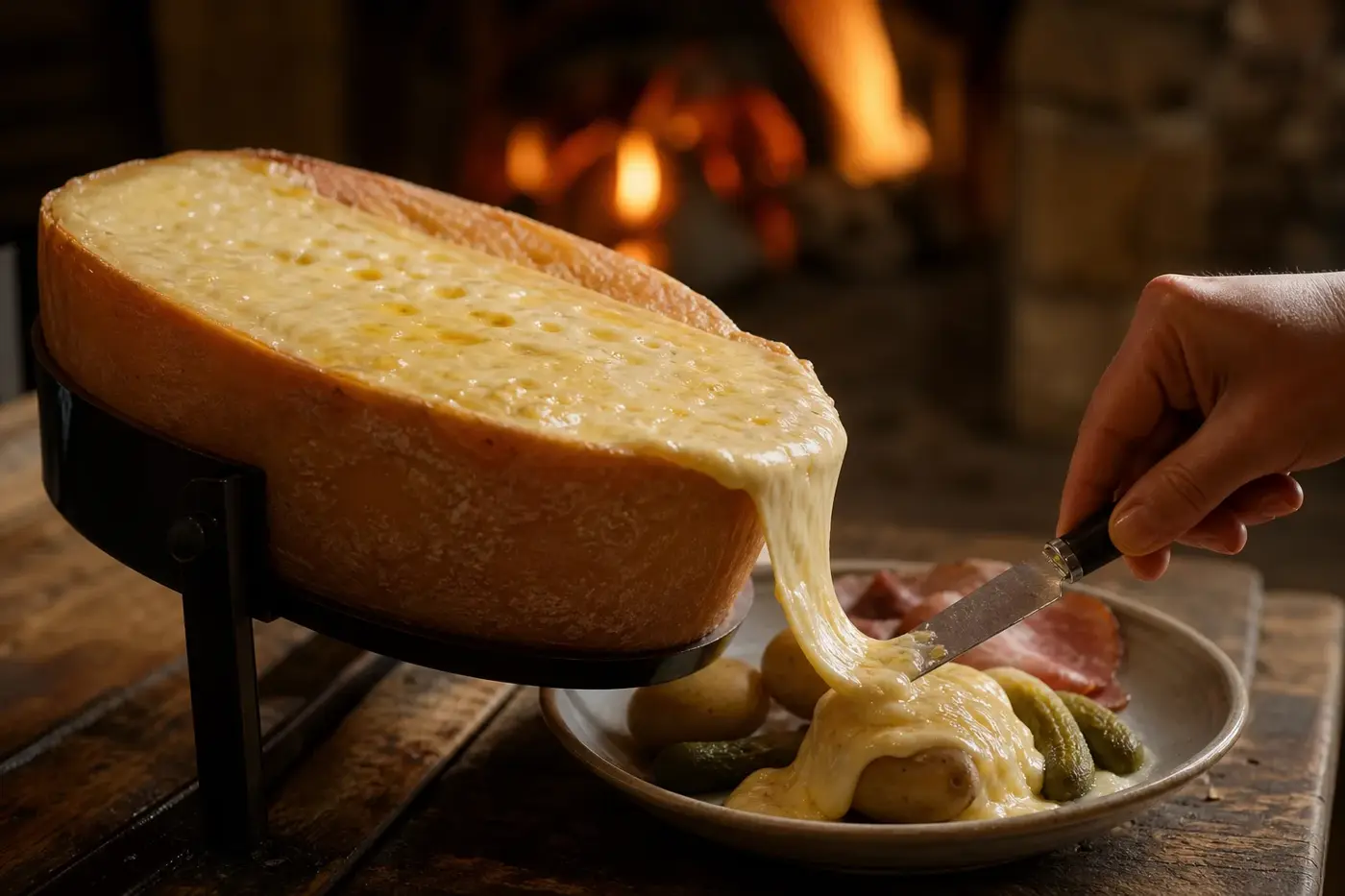
A half-wheel faces the heat. Its cut surface softens, and a molten layer slides onto your plate at the scrape of a knife. This is traditional Alpine raclette: both a meal and a family of cheeses, usually supple cow’s milk cheeses that soften readily when heated. You could call it supper with a front-row seat. [1,2]
Your quick introduction to raclette
| What you want to know | The essentials |
|---|---|
| Name | Raclette means both a cheese family and a meal [1,2] |
| Usual milk | Cow’s milk; treatment varies with the cheese [2] |
| Style | A pressed melting cheese with a surface-ripened rind [2] |
| Protected examples | Raclette du Valais, also Walliser Raclette, Swiss AOP; Raclette de Savoie, identified as IGP by INAO [3,11] |
| Authorities | Swiss Federal Office for Agriculture; INAO [3,11] |
| Protection context | November 2026; these protection statements concern Switzerland and the French IGP record respectively [3,11] |
Pull up a chair by the Alpine fire
Picture the Valais mountains in 1574, with cheese melting beside a fire. You will find that scene in a description recorded by the Swiss Federal Office of Culture. The word raclette, linked to a local word for scraping, appears in sources during the second half of the nineteenth century. By 1909, raclette was being promoted at the Sion cantonal exhibition. [1]
The same cultural account places raclette firmly in Valais pastoral life. Cutting into a wheel for melting became part of shared celebrations, though the practice reaches beyond the canton. That wider Alpine connection explains why Swiss and French cheeses share the family name without losing their regional identities. [1,3]
Meet the rind, then taste what is inside
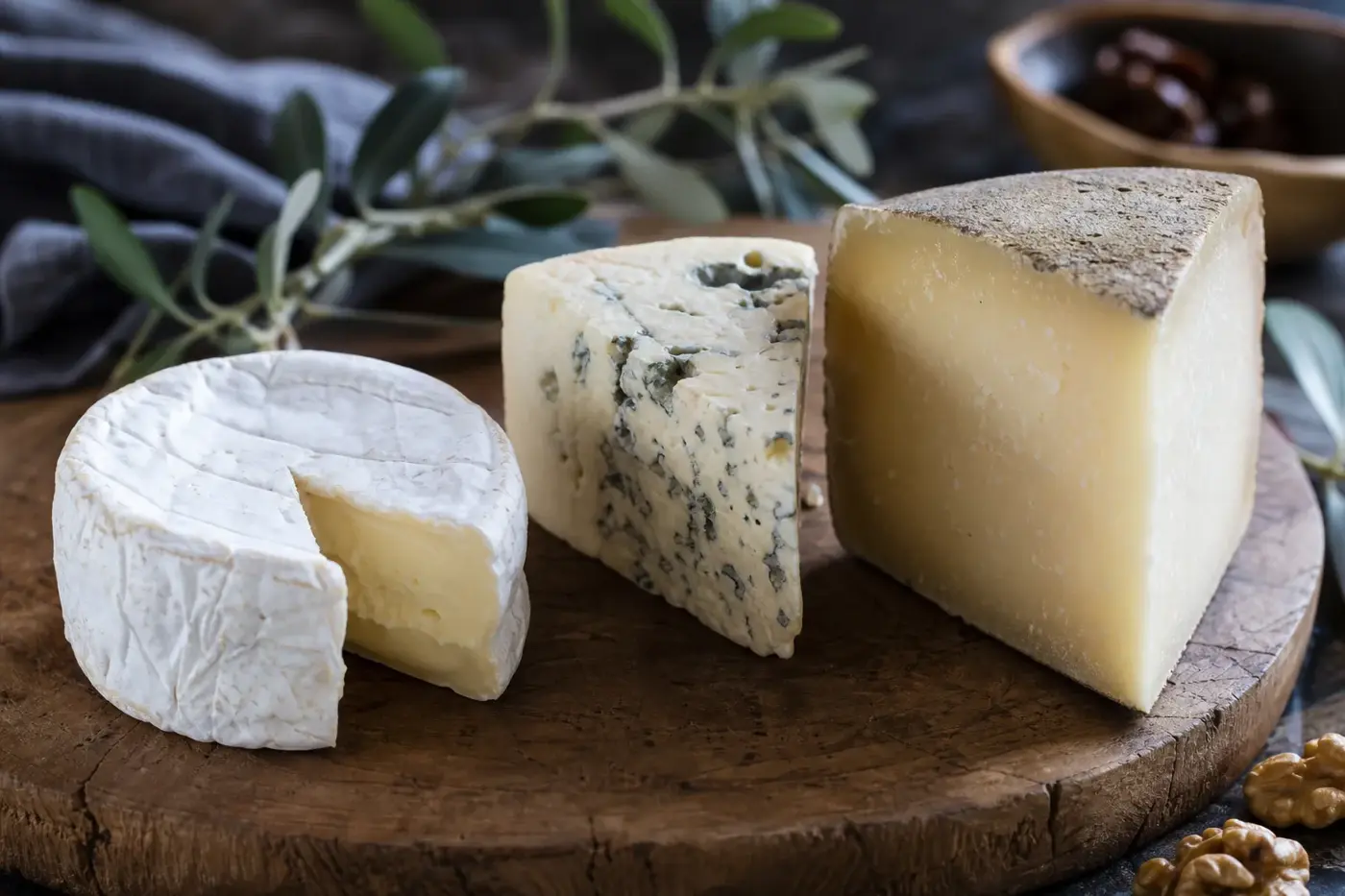
Look at a raclette wheel and you will generally see a low, round shape, with supple, pale cheese inside. The washed or rubbed rind may be brownish-red rather than white and fluffy. Raclette Suisse describes a ripened surface washed before sale, with some of that aromatic outer layer left in place. [2,5]
Inside, the Valais specification describes smooth, supple paste with fresh lactic and floral aromas. Acidity meets vegetal and fruity notes. Raclette Suisse calls its members’ cheeses savoury and aromatic, giving you a useful starting point rather than a promise that every wheel tastes alike. Strength varies across the family. [4,5]
Read the name beneath the mountain picture
Raclette alone does not identify one protected cheese. The Swiss specification expressly says the word itself is not protected in Switzerland. Raclette du Valais AOP is the specific Swiss protected name, covering production in Valais and the named Spittelmatten alpine pasture in Kandersteg, canton Bern. [4,11]
A closer look at the Raclette du Valais AOP specification: November 2026
| What shapes your cheese | What the Swiss rules require |
|---|---|
| Milk | Raw cow’s milk only [4] |
| What sets the milk | Calf rennet [4] |
| Standard wheel for melting | Diameter 29 to 32 cm; height 6 to 8 cm; weight 4.6 to 5.8 kg [4] |
| Minimum maturing time | Three months for Raclette du Valais; two months for à la coupe; twelve months for à rebibes [4] |
INAO identifies Raclette de Savoie as an indication géographique protégée (IGP), the French term for protected geographical indication (PGI). For other Swiss and French raclette cheeses, turn to the label. Country, milk treatment, maker and added flavourings tell you more than a mountain illustration, however handsome its peaks. [2,3]
Want to untangle regional names from general styles? Start with protected names explained.
Follow the cheesemaker into the maturing room
The process described by Raclette Suisse starts with cow’s milk, either raw or pasteurised among its members’ cheeses. Bacterial cultures and rennet, the enzymes that help milk set, turn it into a gel. Cutting that gel gives you curds, the solid pieces, surrounded by liquid whey. [2]
The cheesemaker then drains the curds, presses them into moulds and salts the wheels in brine. Regular turning and surface care during maturation develop the rind and the cheese’s character. There is patient work at every stage, from handling the curd to tending the ripening wheel. Adding a particular mould to the outside is only part of the story. [2]
Follow the bigger picture in how cheese is made. Or compare raw, thermised and pasteurised cheese before choosing your pack.
What turns a slice into that glorious melt?
Behind the flowing cheese sits a network of casein proteins holding moisture and fat. Heat liquefies the fat and makes the hydrated protein structure more mobile. For your cheese to melt rather than remain a stubborn block, that network needs enough flexibility to flow. [6]
Swiss dairy researchers explored calcium’s role using experimental raclette made from pasteurised milk. Reducing calcium bound within the curd improved melting across most measured characteristics. So protein structure matters alongside fat and moisture. The catch is that better melting did not necessarily mean better flavour. [6]
At your table, the lesson is simple. Watch the cheese and serve it as it flows. Raclette Suisse warns that heating slices for too long can make the fat separate. [7]
Looking for a substitute? Start with suppleness
Look for a supple cheese intended for hot dishes, rather than the driest, longest-aged wedge on the counter. Ask your cheesemonger for a melting cheese, then test a small piece under your grill. Watching what happens is a practical way to put the research on cheese structure and flow to work. [6]
Le Gruyère and Comté are sensible Alpine candidates to discuss. Consider the particular cheese’s suppleness, age and saltiness, because neither name guarantees an identical melt. For molten slices over potatoes, raclette remains your first choice. An oven-baked potato dish gives you more room to experiment. [6,8]
Choose your route from cheese to plate
Your method determines how the cheese reaches your plate. Wheel scraping follows the Swiss cultural record, individual trays follow Swiss cheese industry guidance, and the oven method draws on Swissmilk. The pan method is an editorial adaptation for you to try as an experiment. [1,7,8]
- Scrape from a wheel. Secure a half-wheel in equipment designed for the purpose, following its instructions. Warm the exposed face, scrape the softened layer onto a plate and serve immediately. The traditional fireside method works on the same principle. [1]
- Gather round the tabletop grill. Put a slice in a raclette tray, melt it under the element and slide it onto cooked potatoes. Begin with plain cheese before adding toppings. You can then judge how it behaves. [7]
- Put the oven to work. Arrange slices over cooked, halved potatoes in an ovenproof dish. Swissmilk’s version uses 180 °C fan, 200 °C conventional (392 °F conventional), for 10 to 12 minutes. Follow the thorough-heating guidance below where it applies. [8,9]
- Try a small panful. For a small serving, melt slices gently in a small non-stick frying pan, then slide them onto potatoes. Watch the cheese rather than the clock. Your pan, hob and slice thickness all affect the result. [6,7]
Bring potatoes, pickles and something to sip
Cooked potatoes, cornichons and pickled onions are the starting point in Switzerland Cheese Marketing’s basic raclette recipe. The cornichons bring acidity and crunch; the potatoes give your molten cheese somewhere to settle. It is a rather good division of labour. Seasonal suggestions include asparagus, blanched vegetables, pears and grapes. [10]
For a meat-free table, choose vegetables, potatoes and pickles instead of cured meats. If you are vegetarian, check the coagulant too. Raclette du Valais requires calf rennet, so you will need another raclette explicitly labelled suitable for vegetarians. [4]
For an alcohol-free drink, Raclette Suisse suggests black tea, herbal tea or sparkling apple juice. Unsweetened tea lets the cheese take the lead. [7]
Choose your cheese and care for it well
Before buying, read the milk treatment, ingredients and storage instructions. Ask whether the cheese is intended for melting in slices or scraping from a wheel. If you want to avoid raw milk, look for an explicit pasteurised-milk declaration. Raclette du Valais requires raw milk. [2,4]
Whether you can eat the rind depends on your cheese. Raclette Suisse says its members’ rinds can be eaten and describes washing away some surface material before sale. For either protected raclette, ask the seller about that particular rind and follow any removal instructions on the label. Remove packaging and non-food coverings before heating. [5]
FSA guidance for England, Wales and Northern Ireland recommends refrigerating dairy products at 0 to 5 °C (32 to 41 °F). Follow pack instructions and keep chilled food out for the shortest possible time, with a maximum of four hours during preparation. Put out small batches of slices and replenish them as needed. [12]
Cool cooked leftovers and refrigerate within one to two hours. The FSA advises eating them within 48 hours or freezing them. Reheat only once, until steaming hot throughout. [9,12]
Know when melted must mean hot throughout
For pregnancy in the UK, the NHS lists pasteurised semi-hard cheeses among those you can eat. It also says certain soft cheeses can be eaten when cooked until steaming hot all the way through. Consult its current guidance for your particular cheese and milk treatment; November 2026 is the guidance context here. [13]
Where thorough cooking is needed, follow the FSA’s advice for England, Wales and Northern Ireland. The centre should reach 70 °C (158 °F) for two minutes, or an equivalent published combination. Use a clean food thermometer to check the centre. A softened surface alone does not establish that temperature. [9]
Consult the official guidance as you plan your meal, especially for anyone advised to take extra care with food. For the broader questions behind milk treatment and storage, explore cheese food safety and how to store cheese at home.
General information only, not medical advice: follow the official guidance where you live.
Questions people ask
What is raclette?
Raclette is both a meal and a family of cheeses. The cheeses are usually supple cow’s milk cheeses that soften readily when heated.
How do you melt raclette at home?
You can melt a slice in a raclette tray under a tabletop grill and slide it onto cooked potatoes. Swissmilk also describes baking slices over cooked, halved potatoes at 180 °C fan or 200 °C conventional for 10 to 12 minutes.
Can you eat the rind of raclette?
Raclette Suisse says its members’ cheese rinds can be eaten. For either protected raclette, ask the seller about the particular rind and follow any removal instructions on the label.
Is raclette suitable for vegetarians?
Raclette du Valais requires calf rennet. For a vegetarian option, the page suggests choosing another raclette explicitly labelled suitable for vegetarians.
Can you eat raclette during pregnancy?
The NHS lists pasteurised semi hard cheeses among those that can be eaten and says certain soft cheeses can be eaten when cooked until steaming hot all the way through. See the NHS’s current guidance for the particular cheese and milk treatment.
Sources
- Swiss Federal Office of Culture, Raclette comme pratique sociale, June 2018. Cultural inventory account, including its attributed historical evidence. Official document.
- Raclette Suisse, Manufacturing, undated, retrieved November 2026. Industry association’s account of its members’ production. Manufacturing account.
- INAO, Raclette de Savoie, official product record, including notices of specification changes in 2026. Retrieved search record; full document retrieval was unsuccessful. Official product record.
- Swiss Federal Office for Agriculture, Cahier des charges: Raclette du Valais, incorporating amendments through 13 December 2023, official file published March 2024. Product specification.
- Raclette Suisse, Swiss raclette cheese: you can also enjoy the rind, undated, retrieved November 2026. Industry statement about its members’ cheeses. Rind guidance.
- Agroscope Liebefeld-Posieux Research Station, Raclette cheese: less calcium for better melting properties, 2007, Agrarforschung. Experimental research, with an English abstract and German full paper. Research abstract; full paper.
- Raclette Suisse, Preparation, undated, retrieved November 2026. Industry serving and drink suggestions. Preparation guidance.
- Swissmilk and the Swiss association of rural women, Raclette-Kartoffeln im Ofen, undated, retrieved November 2026. Published recipe from organisations with dairy and farming interests. Oven preparation.
- Food Standards Agency, Cooking your food, 2017, current retrieved guidance for England, Northern Ireland and Wales. Official cooking guidance.
- Switzerland Cheese Marketing, Basic raclette recipe, undated, retrieved November 2026. Commercially interested industry recipe source. Serving suggestions.
- Swiss Federal Office for Agriculture, AOP / IGP: appellations d’origine et indications géographiques, current register listing, retrieved November 2026. Official register and specification links.
- Food Standards Agency, How to chill, freeze and defrost food safely, 2017, current retrieved guidance for England, Northern Ireland and Wales. Official refrigeration guidance.
- NHS, Foods to avoid in pregnancy, current web edition, retrieved November 2026. Official pregnancy guidance.
- Food Standards Agency, Alerts, live index, retrieved November 2026 for the editorial recall check. Official alerts index.
Researched through official Swiss records, an official cultural inventory, dairy research, attributed industry accounts and UK public food guidance.
Last checked: November 2026
Last checked November 2026.
The editors suggest you read next
How to Tell Cheese Styles Apart: Milk, Rind, Texture and Method
Watch mozzarella curd being worked and stretched in hot water.