Ragstone
Cut into a log of Ragstone and a soft, lemony centre appears inside its creamy-white mould rind.
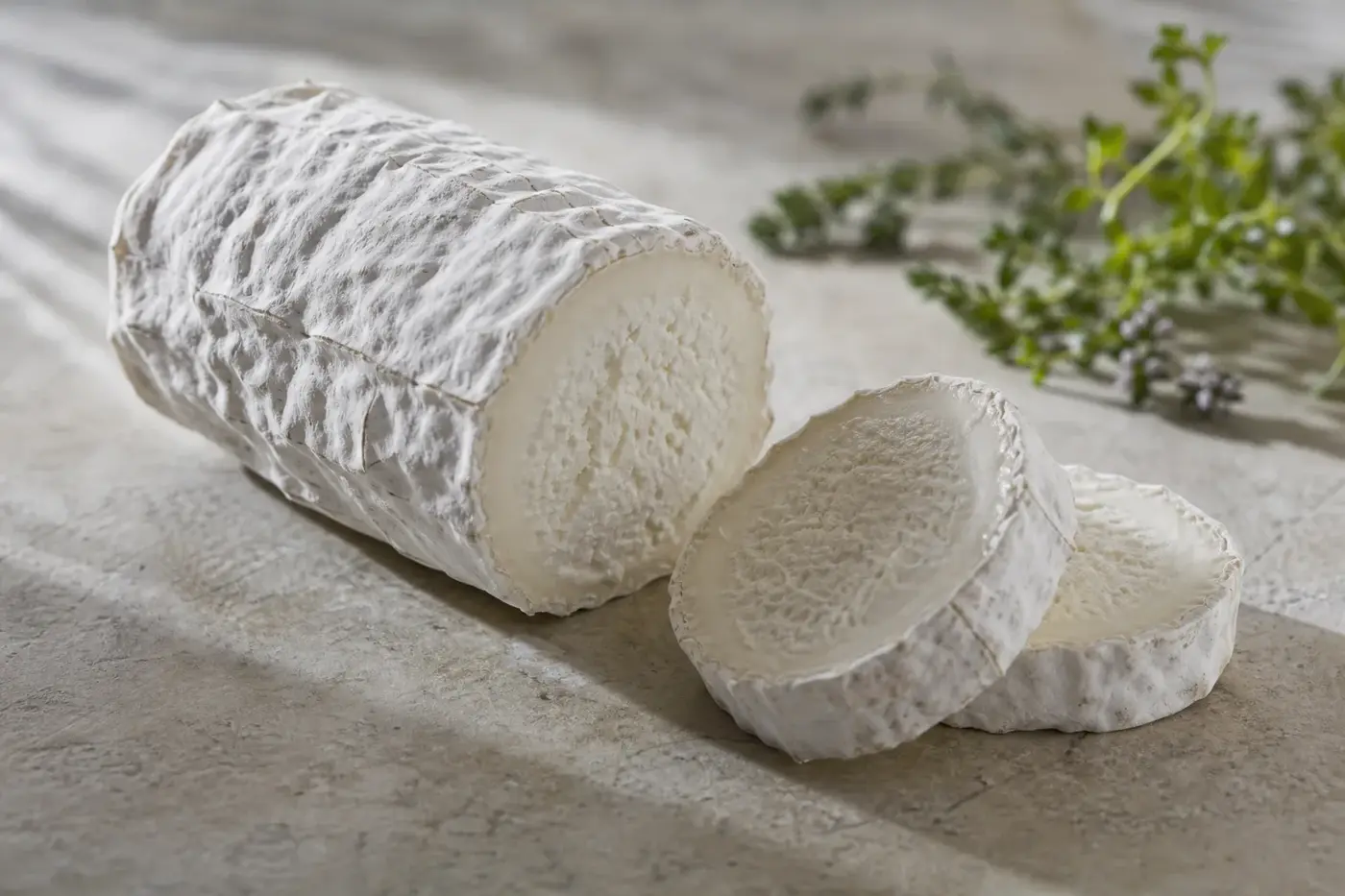
Cut into a log of Ragstone and a soft, lemony centre appears inside its creamy-white mould rind. Taste the two together: fresh lactic brightness meets something deeper and more savoury. Made by Neal’s Yard Creamery on Dorstone Hill in Herefordshire, England, this ripened goat’s cheese gives you good reason not to leave the rind on the side of your plate. [1,2,3]
| Get to know Ragstone | The details |
|---|---|
| Name | Ragstone [1] |
| Made by | Neal’s Yard Creamery [1] |
| Home | Dorstone Hill, Herefordshire, England [2] |
| Style | Soft, lactic, white mould-ripened log [1,3] |
| Milk | Pasteurised goat’s milk [1] |
| Milk comes from | Wychmoor Farm, Titley, Herefordshire [2] |
| Coagulant | Cardoon, a plant coagulant derived from thistles [1] |
| Sizes | 200 g; larger cutting log approximately 600 g [1] |
| Ripening flora | White Penicillium rind; species uncertain [3] |
| Allergens | Milk; supplier specification also declares trace cow’s milk in cultures [6] |
Find the brightness beneath the rind
Much of Ragstone’s character lies in the meeting of white rind and soft interior. Its curd forms largely through acidification, then ripens beneath a developing surface rind. Neal’s Yard Dairy’s technical account helps you picture the journey: yoghurt-like curd drains in log-shaped moulds, followed by several weeks of maturation. [3]
No added flavouring is doing the work here. The maker describes a creamy-white surface and a flavour that is savoury, lactic and lemony. Look for fresh dairy acidity alongside the rounder character that comes with ripening. That combination, rather than the log shape alone, makes Ragstone distinctive. [1]
For your first taste, leave the log recognisable on the board and cut it into rounds. Each slice gives you a clear view of the paste and its surrounding rind, ready to compare. If you want to place it in the wider cheese family, the guide to cheese styles explains how milk, rind and method fit together.
Follow Ragstone from Kent to the Wye
The name takes you first to the Ragstone ridge near Sevenoaks. According to Neal’s Yard Dairy’s product history, that is where the cheese was developed. Its home today is Herefordshire: Neal’s Yard Creamery records moving from south-east England to Dorstone Hill in 1996. [2,4]
The Creamery describes a site overlooking the River Wye. Here, it makes fresh and mould-ripened cheeses, yoghurt and crème fraîche. Ragstone belongs to a busy dairy household, rather than a business devoted to one cheese alone. [2]
If the similar names have you rereading the label, you are not alone in needing the distinction. Neal’s Yard Creamery and Neal’s Yard Dairy began as one business, the Creamery says, before it became independent. Today, the Creamery makes Ragstone; the Dairy receives young cheeses and develops their rinds in its own maturing rooms. [2,4]
There is more to this Herefordshire home than the cheesemaking itself. The Creamery describes generating much of its electricity with wind and solar equipment, heating with solar energy and locally sourced wood, and treating drainage water through a wetland system. These are the everyday workings behind that view over the Wye. [5]
Meet the milk, the thistles and the small print
Ragstone starts with pasteurised goat’s milk. The Creamery names Wychmoor Farm at Titley, Herefordshire, as the milk source for its goat’s cheeses. So the milk comes from a supplying herd, rather than goats living at the Creamery itself. [1,2]
Then the thistles have their part to play. The maker’s current Ragstone listing names cardoon, a thistle-derived ingredient, as its vegetarian coagulant. It helps milk become curd, the solid material from which cheese is made. [1]
Cardoon accompanies a lactic make here, with slow acidification still central to the Dairy’s description of the process. You can explore the broader distinctions in rennet explained. It is a useful bit of background to what happens between milk and mould. [1,3]
If you have particular dietary requirements, read the label carefully. Neal’s Yard Dairy’s August 2024 product specification lists goat’s milk and says the cheese cultures contain trace cow’s milk; its retail ingredient declaration repeats that detail. Read the actual pack’s ingredients and allergen declaration when choosing for your needs. [6]
Watch a delicate curd become a log
Ragstone begins with an overnight set, with acidification central to its lactic coagulation. The Dairy describes the resulting curd being hand-ladled into log-shaped moulds. Its crib sheet calls that curd yoghurt-like, which gives you a sense of how delicate this future cheese is. [3,4]
A Dairy team’s account of visiting the Creamery, published in March 2025, brings the handling into closer focus. Curds were ladled onto mesh mats above moulds, allowing whey, the liquid separated from the curd, to drain away. The drained curds were then gently transferred from the mats into the moulds. [7]
That word “gently” matters. The account stresses how readily the curd can break, making careful transfer part of the work towards Ragstone’s eventual texture. To follow the wider journey from milk to drained curd, turn to how cheese is made. [7]
Next comes patience. Neal’s Yard Dairy describes receiving Ragstone at about a week old, then moving it into warmer maturing rooms to encourage white rind coverage over roughly another week. Its retail page gives an average age of 3 to 4 weeks; its 2026 crib sheet gives a broader average-age range of 3 to 6 weeks. These are the supplier’s descriptions of maturity. [3,4]
Give the centre and rind their own moment
Lemon, savoury depth and a smooth texture lead the maker’s tasting notes. Trethowan Brothers, writing as a Ragstone retailer in May 2020, also describes bright lemon flavours and a dense paste beneath the white mould rind. Expect acidity with substance, rather than sharpness alone. [1,8]
The Dairy’s 2026 notes bring the rind into the picture: mushroom-like, with yoghurt notes and a mineral finish. They describe a smooth paste that stays sliceable. Try a little centre first, then a piece with the rind attached. You will find it easier to follow the shifting balance that way. [3]
Longer maturation can move that balance further. The Dairy says ageing can bring deeper, sometimes spicier flavours, while its crib sheet also describes some drying alongside texture breakdown. Tell your cheesemonger whether you fancy a brighter, firmer slice or a more developed savoury character. Ask about the particular log in front of you, rather than expecting every Ragstone to taste the same. [3,4]
Make a little room at the table
Start with plain bread and a slice of Ragstone on its own. Then try fresh pear or a little apple for contrast, leaving strongly flavoured relish until later. These suggested pairings give the cheese’s documented lemony and savoury notes room to speak. The chutney can wait its turn. [1,8]
Water is a useful first drink when you want to concentrate on the cheese. For an alcohol-free alternative, try lightly brewed, unsweetened tea with the bread, treating it as an invitation to explore rather than a fixed match. A 2025 Dairy account records Ragstone served at the Creamery with red peppers, toast, tomato salad and tea. There is a simple lunch to take your cue from. [7]
To take the chill off, bring a small portion out of the refrigerator briefly, rather than warming the whole log for a long display. Food Standards Agency advice for England, Wales and Northern Ireland, as recorded in November 2026, says chilled food should stay out for the shortest possible time. Its stated maximum during preparation is four hours. [9]
Outdoors, take particular care. For England, Wales and Northern Ireland, FSA guidance as recorded in November 2026 advises discarding perishable picnic or barbecue food left unrefrigerated for more than two hours in hotter than usual weather. Keep Ragstone shaded and chilled until shortly before serving. Bring out only what you expect to eat. [10]
Look after the next slice
Keep your fridge between 0 and 5 °C, refrigerate dairy products and follow the pack’s instructions. That is the FSA’s storage advice for England, Wales and Northern Ireland. Once you have cut a portion, return the remaining cheese promptly. For the broader routine, see storing cheese at home. [9]
Keep the label with the cut cheese so you retain its date and any after-opening instructions. Follow those instructions even if you had different plans for the next portion. UK government labelling guidance distinguishes use-by dates, which concern safety, from best before dates, which concern quality. Do not eat food beyond its use-by date. [11]
Ragstone’s white rind is part of its intended ripening. The Dairy also records blue, green or grey spots developing during maturation under its care. [4] If unexpected mould appears on your cut log at home, consult current food safety advice for where you live rather than relying on appearance alone.
Buying a portion from the larger log? Ask your cheesemonger to include the cheese’s name, storage advice and date information, especially if you are comparing pieces at different stages of ripeness. Let that portion’s condition and instructions guide your next serving. Keep the rest chilled while you prepare the bread and accompaniments. [9,11]
Follow your curiosity to the next cheese
- How to Tell Cheese Styles Apart: Milk, Rind, Texture and Method: discover where Ragstone’s lactic curd and mould rind sit among other cheesemaking approaches.
- Mould on Cheese: When to Cut and When to Bin: learn to distinguish intended ripening from unwanted mould.
- How to Read a Cheese Label: find your way through ingredients, milk treatment and date information when buying a whole log or cut portion.
General information only, not medical advice: follow the official guidance where you live.
Questions people ask
What milk is Ragstone made from?
Ragstone is made with pasteurised goat’s milk from Wychmoor Farm in Titley, Herefordshire. The supplier’s specification also declares trace cow’s milk in the cultures.
Is Ragstone suitable for vegetarians?
The maker lists cardoon as its vegetarian coagulant. Cardoon is derived from thistles.
What does Ragstone taste like?
The maker describes Ragstone as savoury, lactic and lemony. Neal’s Yard Dairy also describes mushroom and yoghurt notes in the rind, with a mineral finish.
How long is Ragstone aged?
Neal’s Yard Dairy says it receives the cheese at about a week old and encourages white rind coverage over roughly another week. Its retail page gives an average age of 3 to 4 weeks, while its 2026 crib sheet gives a range of 3 to 6 weeks.
How should Ragstone be stored?
The Food Standards Agency advises keeping the fridge between 0 and 5 °C, refrigerating dairy products and following the pack’s instructions. See its storage advice for England, Wales and Northern Ireland.
Sources
[1] Neal’s Yard Creamery. Goat’s Milk Cheeses. Undated online product listing, retrieved November 2026. Maker’s product and tasting descriptions.
[2] Neal’s Yard Creamery. Welcome to Neal’s Yard Creamery. Undated online account, retrieved November 2026. Maker’s location, history and milk-sourcing statement.
[3] Neal’s Yard Dairy. Ragstone crib sheet. 2026 edition. Affineur and retailer’s technical, maturation and tasting account.
[4] Neal’s Yard Dairy. [Ragstone](../ragstone/). Undated online product account, retrieved November 2026. Affineur and retailer’s history, handling and maturation statements.
[5] Neal’s Yard Creamery. Our Ethos. Undated online account, retrieved November 2026. Operational statements attributed to the maker.
[6] Neal’s Yard Dairy. Neal’s Yard Dairy Product Specification: Ragstone. Updated August 2024.
[7] Neal’s Yard Dairy. A Citroën, curds & great company: A team trip to Herefordshire. Published 5 March 2025. Commercial partner’s recorded visit, handling observations and meal account.
[8] Trethowan Brothers. Introducing “Ragstone” and “Finn” from Neal’s Yard Creamery. Published 31 May 2020. Retailer’s attributed tasting description.
[9] Food Standards Agency. How to chill, freeze and defrost food safely. Published 18 December 2017; live guidance retrieved November 2026. Applies to England, Northern Ireland and Wales.
[10] Food Standards Agency. Food safety in a heatwave: advice for consumers. Live guidance retrieved November 2026.
[11] GOV.UK. Understanding food labelling: Best before and use-by dates. Live guidance retrieved November 2026.
Researched by comparing the maker’s current listings with its affineur’s specifications and published observations, then checking handling advice against official guidance.
Last checked: November 2026
Last checked November 2026.
The editors suggest you read next
West Country Farmhouse Cheddar Cheese
Large pieces of curd turn and stack under the cheesemaker’s hands.