Red Anster
Fresh garlic, chives and a tumble of crumbs: all you need now is a piece of bread.
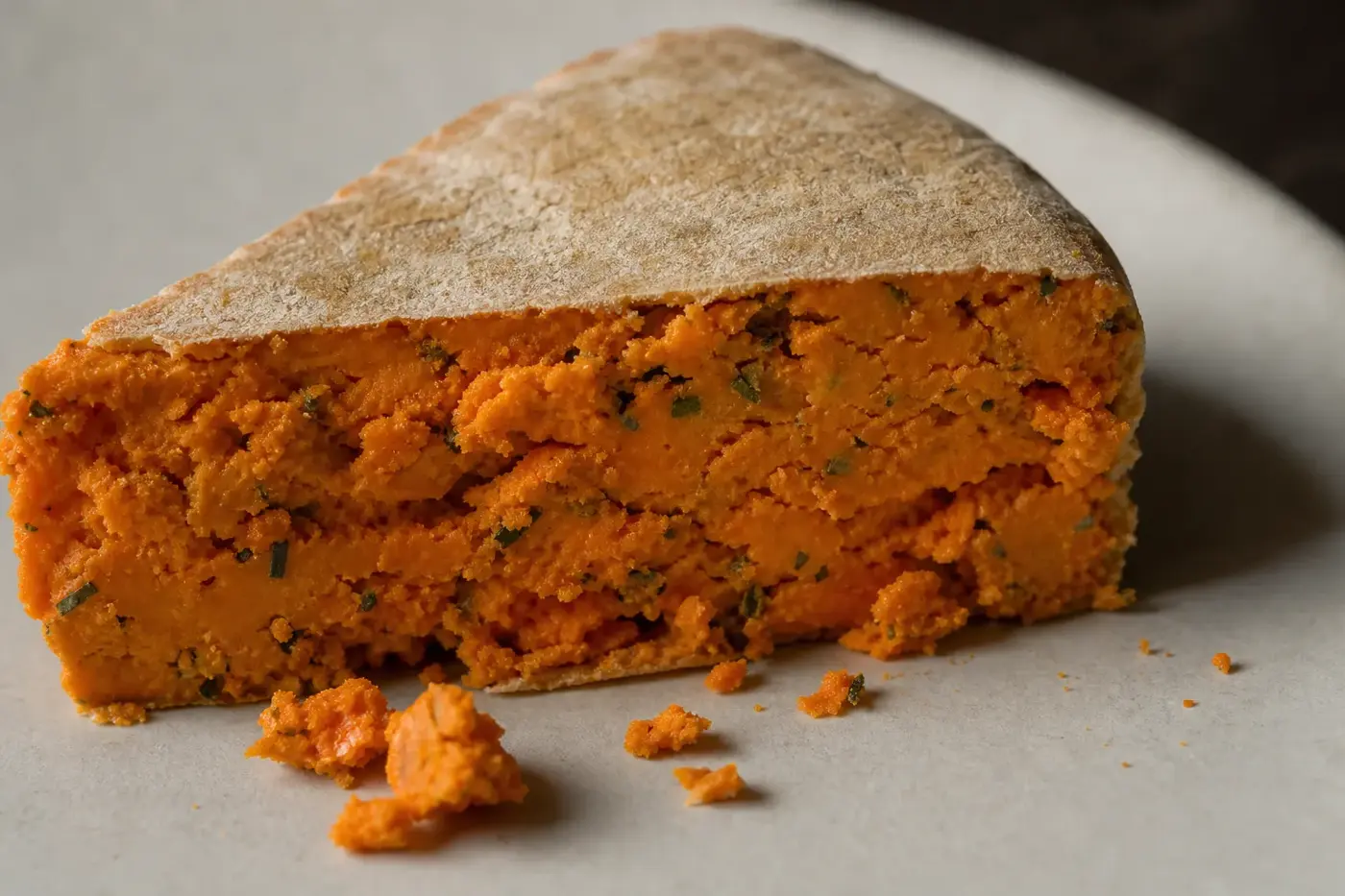
Fresh garlic, chives and a tumble of crumbs: all you need now is a piece of bread. Red Anster comes from St Andrews Farmhouse Cheese Company at Falside Farm, overlooking the Firth of Forth. This annatto-coloured companion to plain Anster typically matures for 2 to 4 months, adding its own seasoning to the farmhouse cheeses of Fife.[1,2]
| What you might want to know | The details |
|---|---|
| Name | Red Anster.[1] |
| Maker | St Andrews Farmhouse Cheese Company.[1] |
| Place | Falside Farm, Pittenweem, East Neuk of Fife, Scotland.[2] |
| Milk source | Across the maker’s range: milk from its own Holstein Friesian herd. For Red Anster specifically: confirmation needed.[2,3] |
| Milk treatment | Across the maker’s range: unpasteurised. For Red Anster specifically: confirmation needed.[3] |
| Coagulant | The maker says traditional rennet. Exact source: confirmation needed.[3] |
| Added ingredients | Annatto, fresh garlic and fresh chives.[1] |
| Rind | Natural rind.[1] |
| Typical maturation | 2 to 4 months.[1] |
| Registered name, authority and register ID | Confirmation needed. |
| Protection status | EU: confirmation needed. Great Britain: confirmation needed. Northern Ireland: confirmation needed. Switzerland: confirmation needed. United States: confirmation needed. |
Meet the Anster family, plain, seasoned and smoked
Red Anster is the flavoured sister of Anster. Fresh garlic, fresh chives and annatto come together on the maker’s product page, setting it apart from both plain Anster and the separately listed Smoked Anster.[1,5,6]
The company describes plain Anster as pale and crumbly, with a citrus finish. Smoked Anster takes a different path, with oak smoking at a local smokery in St Monans. You have three ways into the family: plain, garlic-and-chive, and oak-smoked.[5,6]
Keep your first comparison simple. Put small pieces of plain and Red Anster beside the same bread, so the accompaniment stays constant and the seasoning is easier to notice. This is a serving suggestion, not a reported tasting: try each cheese alone before reaching for pickle, mustard or another strong condiment.
From Wales to a farm above the Forth
Look out from Falside Farm and the Firth of Forth lies before you, in the East Neuk of Fife. Here, cheesemaking belongs firmly to the dairy farming business, using milk from cows bred on the farm. The connection to the landscape is practical as well as picturesque: the farm supplies both the milk and the place where cheese is made.[2]
The first batch dates to January 2008. The maker’s published history begins with learning cheesemaking in Wales, followed by the journey back to Fife with a cheese vat, presses and moulds. As the business grew, its production and maturation space expanded.[4]
There is plenty of character in that straightforward beginning. This is a modern farmhouse business, shaped by practical influences and a developing range of its own. When you encounter its Fife identity, there is something tangible behind it: a particular farm and herd.
A closer look at the milk and rennet
The company identifies its cattle as Holstein Friesians and says its cheeses use unpasteurised milk from its own herd. Its awards page also names heritage cultures and traditional rennet. Those statements describe the cheesemaking operation as a whole.[2,3]
Red Anster’s product description gives you its flavouring ingredients and maturation period. If a milk or ingredient detail matters to your choice, keep the distinction between product information and broader range statements in mind. Save the wrapper or counter label, and ask the maker or supplying cheesemonger about your particular piece.
Rennet is the enzyme preparation that sets milk into curd. “Traditional” is the company’s wording, rather than an exact identification of an animal or other source. You can explore the different coagulants in rennet explained, and milk treatments in raw, thermised and pasteurised cheese.
Give those crumbs a place at the table
The maker compares Red Anster’s delicate, crumbly character to Caerphilly. Annatto brings the colour; fresh garlic and chives bring the added seasoning.[1] Let that Caerphilly comparison guide your expectations of texture, without borrowing another cheese’s entire tasting description.
At the table, let the crumble happen. Cut manageable pieces and leave the smaller fragments alongside, ready to spoon onto bread or your plate. Immaculate thin slices are not an entrance requirement: loose crumbs and easy-to-pick-up portions suit this cheese rather well.
This page summarises published guidance from the official sources it cites. It is not medical advice. Guidance differs between countries and changes over time, so check the current source for where you live, and ask your doctor, midwife, pharmacist or dietitian about your own circumstances.
Follow the curd from vat to store
The company’s general cheesemaking account starts with warming the milk. Rennet goes in, the set curd is cut, and stirring and further heating follow. Whey, the liquid released from the curd, drains away.[4]
Next comes a succession of hands-on steps: the curd is cut into blocks, piled, milled and salted before moulding and pressing. Block handling and milling are particularly distinctive details in this account. Milling breaks the curd into smaller pieces before it goes into the moulds.[4]
The maker then describes moving the pressed cheeses into a maturation store with controlled temperature and humidity. For Red Anster specifically, the use of block handling and milling, along with its particular maturation conditions, calls for confirmation from the maker.[4]
Red Anster’s own product page gives a typical maturation of 2 to 4 months.[1] That is the maker’s usual ageing range, not a legal minimum. If you would like a wider view of the work behind this outline, turn to how cheese is made.
Take a small journey from centre to rind
A natural rind, delicate crumble and mild flavour lead the maker’s description. Then come an onion-like finish and, close to the rind, a cellar-like, almost mushroom-like character.[1] These are the maker’s tasting notes, not a fromage.co.uk tasting.
For the whole cheese’s shape and the precise colours of its surface and paste, ask the maker for details. You can still use its flavour description to give your tasting a simple route. Start with a little inner paste, the body of the cheese, then try a piece nearer the outside.
Smell before eating, and notice how the cheese breaks. After swallowing, pay attention to how long the seasoning stays with you. Your notes need not become an essay; the cheese has not set homework.
Does the garlic lead, and can you pick out the chives? Is the outer portion different from the centre? Record what your own piece offers, rather than hunting for every descriptor in the maker’s account.
Bring bread, fruit and a little breathing room
Start with plain bread or oatcakes, then add contrast with a crisp apple or pear and a little chutney. Taste the cheese before the chutney. That gives you room to decide how much sweetness or acidity you want alongside it.
Apple already has a place among the company’s suggested accompaniments: its recipe collection includes an apple condiment for Anster.[7] With Red Anster, put strongly spiced condiments to the side. Each person can then add a little without covering the cheese’s own seasoning.
Four simple steps to serving
- Cut only what you expect to serve, leaving the rest refrigerated.
- Arrange the pieces with room to collect loose crumbs.
- Keep the serving portion refrigerated until needed.
- Offer plain bread first, with fruit and condiments separately.
For England, Wales and Northern Ireland, consult the Food Standards Agency’s current guidance on keeping chilled food out of refrigeration.[9] Let that guide your serving plans.
For alcohol-free drinks, try water, unsweetened tea or apple juice, served separately in small glasses. Water gives you the simplest starting point when comparing cheeses. Tea and apple juice offer other directions to explore, while keeping the cheese, rather than the drink, at the centre of the meal.
Let Red Anster take care of the seasoning
Think of Red Anster as an ingredient that arrives with garlic and chives already included. Crumble it over a baked potato, tuck pieces into a savoury tart filling, or scatter it over vegetables just before serving. Taste before adding more garlic, chives or onion: those flavours are already in the cheese.
These are cooking suggestions rather than site-tested recipes. Begin with a familiar dish whose seasoning you can adjust, choosing somewhere distinct pieces or a crumbly topping would suit. Save a little cheese to taste alone, so you have a clear reference for the flavour going into your dish.
The maker’s recipe collection takes its cheeses in several directions, including scones, cheese straws, macaroni cheese and soufflé.[7] Its published scone recipe combines plain Anster with St Andrews Farmhouse Cheddar.[8] That pairing gives you a way to explore more than one texture, though substituting Red Anster would be your own adaptation.
On a first attempt, change one ingredient at a time. Replace some of a familiar recipe’s cheese with Red Anster, then decide whether the extra seasoning works for you. Note the quantity and result before adjusting again: one measured change is easier to judge than several at once.
Keep it chilled and keep the label
Follow the storage instructions and date supplied with your piece. For home storage in England, Wales and Northern Ireland, the Food Standards Agency advises refrigerating dairy products, keeping the fridge between 0 and 5 °C (32 and 41 °F), and following packaging instructions. November 2026 is the guidance reference date for this page.[9]
Once you open the cheese, keep its label and follow any stated consume-within period. If a counter label says nothing about the opened piece, ask the supplying cheesemonger or maker. Writing the opening date on the wrapping keeps that useful detail with the cheese.
Think ahead to the meals you want from it: a piece to serve plainly, some for sandwiches and a little for cooking. Taking out only what you need leaves most of the cheese chilled. For more help with wrapping and fridge organisation, see how to store cheese at home.
Questions people ask
What is Red Anster cheese?
Red Anster is a crumbly cheese made by St Andrews Farmhouse Cheese Company. It contains annatto, fresh garlic and fresh chives, and typically matures for 2 to 4 months.
Where is Red Anster made?
It is made at Falside Farm in Pittenweem, in the East Neuk of Fife, Scotland. The farm overlooks the Firth of Forth.
Is Red Anster made with pasteurised milk?
The maker says its cheeses use unpasteurised milk from its own Holstein Friesian herd, but this has not been verified specifically for Red Anster. Check the label or ask the maker or cheesemonger about your piece.
Is Red Anster suitable for vegetarians?
The maker describes its rennet as traditional, but its exact source has not been verified. Ask the maker or cheesemonger to confirm the details for your piece.
How should I store Red Anster?
For England, Wales and Northern Ireland, the Food Standards Agency advises refrigerating dairy products, keeping the fridge between 0 and 5 °C and following packaging instructions. Consult the agency’s current guidance and keep the label with your cheese.
Sources
- St Andrews Farmhouse Cheese Company, Red Anster, undated product page, retrieved November 2026. Product description.
- St Andrews Farmhouse Cheese Company, St Andrews Farmhouse Cheese Company, undated homepage, retrieved November 2026. Farm, herd and location account.
- St Andrews Farmhouse Cheese Company, Awards, undated page, retrieved November 2026. Used for the maker’s declarations about milk, cultures and rennet, not as independent verification of awards. Maker’s account.
- St Andrews Farmhouse Cheese Company, Cheesemaking, undated page, retrieved November 2026. History and production account.
- St Andrews Farmhouse Cheese Company, Anster, undated product page, retrieved November 2026. Plain Anster description.
- St Andrews Farmhouse Cheese Company, Smoked Anster, undated product page, retrieved November 2026. Smoked Anster description.
- St Andrews Farmhouse Cheese Company, Recipes, undated collection, retrieved November 2026. Commercial producer source, used for its own suggested dishes. Recipe collection.
- St Andrews Farmhouse Cheese Company, St Andrews Farmhouse famous Cheese Scones, undated recipe, retrieved November 2026. Commercial producer source, used to identify its stated cheese combination. Scone recipe.
- Food Standards Agency, How to chill, freeze and defrost food safely, published 18 December 2017, current retrieved version November 2026. Applies to England, Northern Ireland and Wales. Official household guidance.
Researched from the maker’s product descriptions, production account and recipes, with household storage guidance checked against the Food Standards Agency.
Last checked: November 2026
Last checked November 2026.
The editors suggest you read next
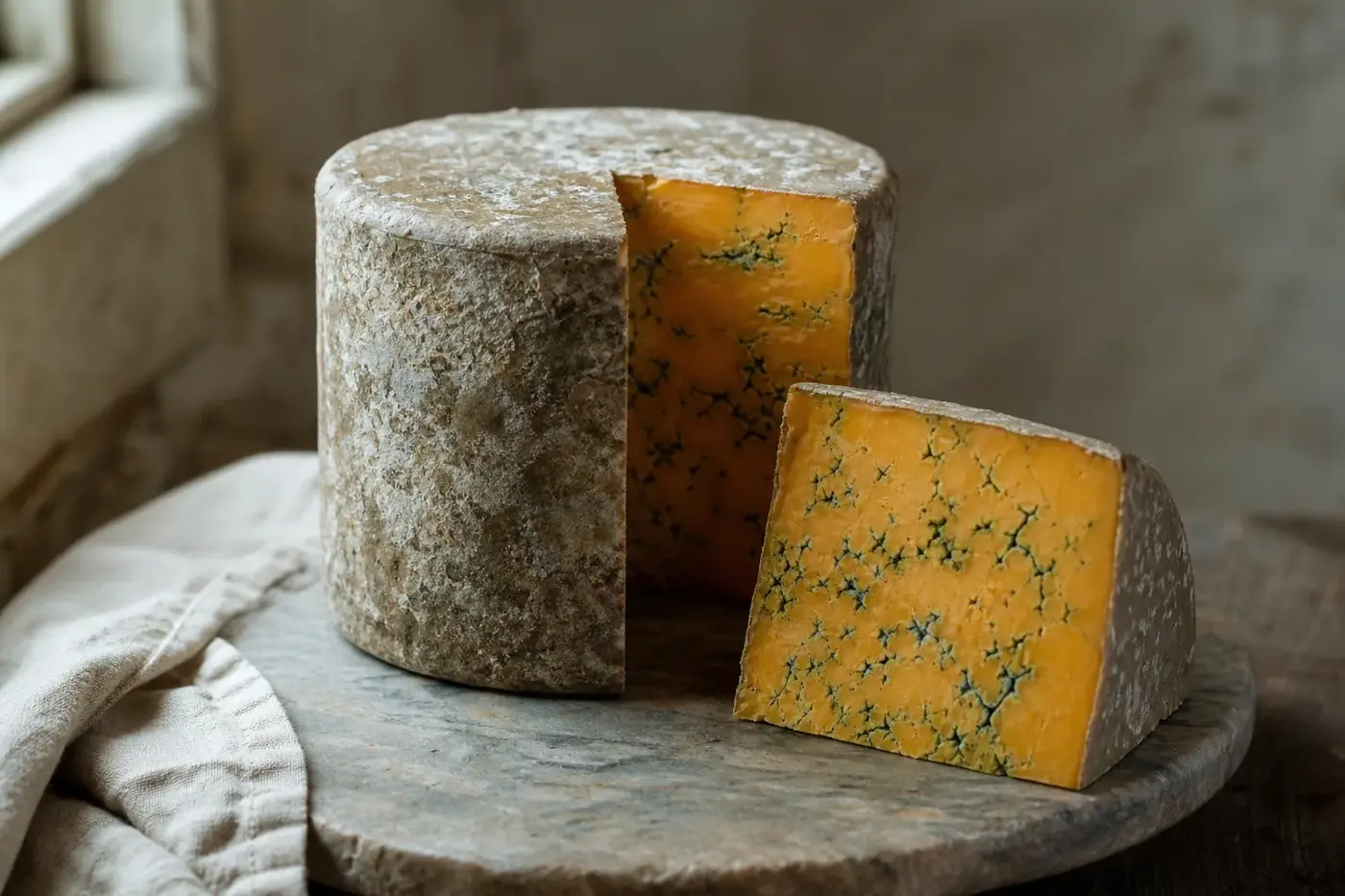
Shropshire Blue
Cut into Shropshire Blue and you get quite a colour scheme: orange crossed by blue-green veins.