Robiola di Roccaverano
In the hills around Roccaverano in Piedmont, goats browse woodland and shelter from the summer heat.
In the hills around Roccaverano in Piedmont, goats browse woodland and shelter from the summer heat. You can follow that landscape all the way to the cheese: its specification links the varied forage to its aromatic character.[6] The first taste begins well before the plate.
Pasture, hay and goat farming shape this small cheese, known as either Robiola di Roccaverano or Roccaverano. Under the amended EU specification, it is made exclusively from whole raw goat’s milk.[2][5] Try it young for delicacy and sometimes a little acidity. Leave it longer and the flavour finds its voice.[3]
| At a glance | What to know |
|---|---|
| The familiar name | Robiola di Roccaverano.[2] |
| Name in the 2023 EU amendment | Robiola di Roccaverano/Roccaverano.[1] |
| EU legal instrument | Commission Implementing Regulation (EU) 2023/335, approving the specification amendment.[1] |
| Great Britain | Registered PDO listing, November 2026.[9] |
| Northern Ireland | Current status: unconfirmed. |
| Switzerland | Current status: unconfirmed. |
| United States | Rights in the name: unconfirmed. |
| Its legally defined home | Nineteen municipalities in Piedmont’s provinces of Asti and Alessandria.[4] |
| Milk and coagulant | Whole raw goat’s milk; animal rennet.[5] |
| A whole cheese measures | Diameter 10 to 14 cm; height 2.5 to 4 cm; weight 250 to 400 g, measured at the end of minimum maturation.[3] |
| When it can first be sold | From the fourth day after placement in moulds.[5] |
| Fat | Minimum 40% fat in dry matter, assessed at the third day of maturation.[3] |
Two names, one cheese to get to know
If you find Roccaverano on one pack and Robiola di Roccaverano on another, both names belong here. The EU’s 2023 amendment changed the registered name from “Robiola di Roccaverano” to “Robiola di Roccaverano/Roccaverano”. The specification expressly allows either name on the finished cheese.[1][7]
A pack marked Roccaverano DOP and one marked Robiola di Roccaverano DOP can therefore identify the same protected cheese. DOP is the Italian abbreviation corresponding to protected designation of origin, or PDO.[1][7]
The amendment was adopted on 1 February 2023 and published on 15 February. Entry into force on the twentieth day made it operative on 7 March 2023.[1] To untangle regional cheese names from protected designations, visit protected names explained.
Great Britain’s register has its own part in the story. It lists Robiola di Roccaverano as a registered PDO, retaining the longer name, with a UK scheme registration date of 31 December 2020.[9]
Meet the nineteen communities that make it possible
Roccaverano gives the cheese its name, but there are neighbours to meet. The production area takes in the Langa Astigiana and Alto Monferrato Acquese, crossing the boundary between Asti and Alessandria.[4][8]
In Asti, the specification names ten municipalities: Bubbio, Cessole, Loazzolo, Mombaldone, Monastero Bormida, Olmo Gentile, Roccaverano, San Giorgio Scarampi, Serole and Vesime. Across in Alessandria, it names Cartosio, Castelletto d’Erro, Denice, Malvicino, Merana, Montechiaro d’Acqui, Pareto, Ponti and Spigno Monferrato.[4]
These boundaries matter beyond the map. They govern the milk’s origin, cheesemaking, attainment of the prescribed maturation periods and packaging. The cheese’s connection to Roccaverano rests on an organised local production system shared by these neighbouring communities.[4]
Beneath the grass lie clay soils over marl. Above them, mixed meadows and woodland give the goats somewhere to browse and escape the summer heat. The specification connects this varied forage with the milk’s character and the aromas you find in the cheese.[6]
Follow the goats, then look at the milk
Whole raw goat’s milk is now essential. It must come from Roccaverano goats, Camosciata Alpina goats or crosses between those breeds, all within the defined production area.[5]
If you have read about other milks, there is a reason. Piedmont’s regional agriculture website carries an older account of goat’s milk combined with cow’s or sheep’s milk. For cheese made under the current specification, follow the rule published after the 2023 amendment: goat’s milk alone.[2][12]
The 2023 published specification prescribes grazing between 1 March and 30 November. It also allows fresh or conserved forage and specified feed materials, with more than 80% of feed coming from the production area. Maize and forage silage are prohibited, and milk from landless holdings is excluded.[5]
Even the meadows, pasture and woodland must be recorded with the control body. This landscape is more than a handsome backdrop for a cheese label. The requirements tie the goats’ keeping and feeding to the cheese’s place of origin.[5]
Into the dairy, where a gentle hand matters
Acidification does much of the work here. Roccaverano is a lactic-curd cheese: acidification is central to forming the curd, the milk’s soft solid portion that separates from the liquid whey. Local natural milk or whey starters are permitted, and animal rennet must be added only after acidification has begun.[2][5]
The milk comes from consecutive milkings over 24 to 48 hours. Depending on working conditions, coagulation takes 8 to 36 hours. The acid curd then moves gently into perforated moulds, with fine cloths allowed for preliminary draining.[2]
This delicate mass helps explain descriptions of ladled curd. Rather than cutting and pressing it into a firm block, the cheesemaker handles it gently. That gentle handling is required by the specification; hand ladling is not expressly prescribed.[2]
The cheeses stay in their moulds for up to 48 hours, with turning to help the whey escape. Both faces are dry-salted during turning or after moulding.[2] For more on milk treatments, take a look at raw, thermised and pasteurised cheese.
Cut a piece and let the rind tell its story
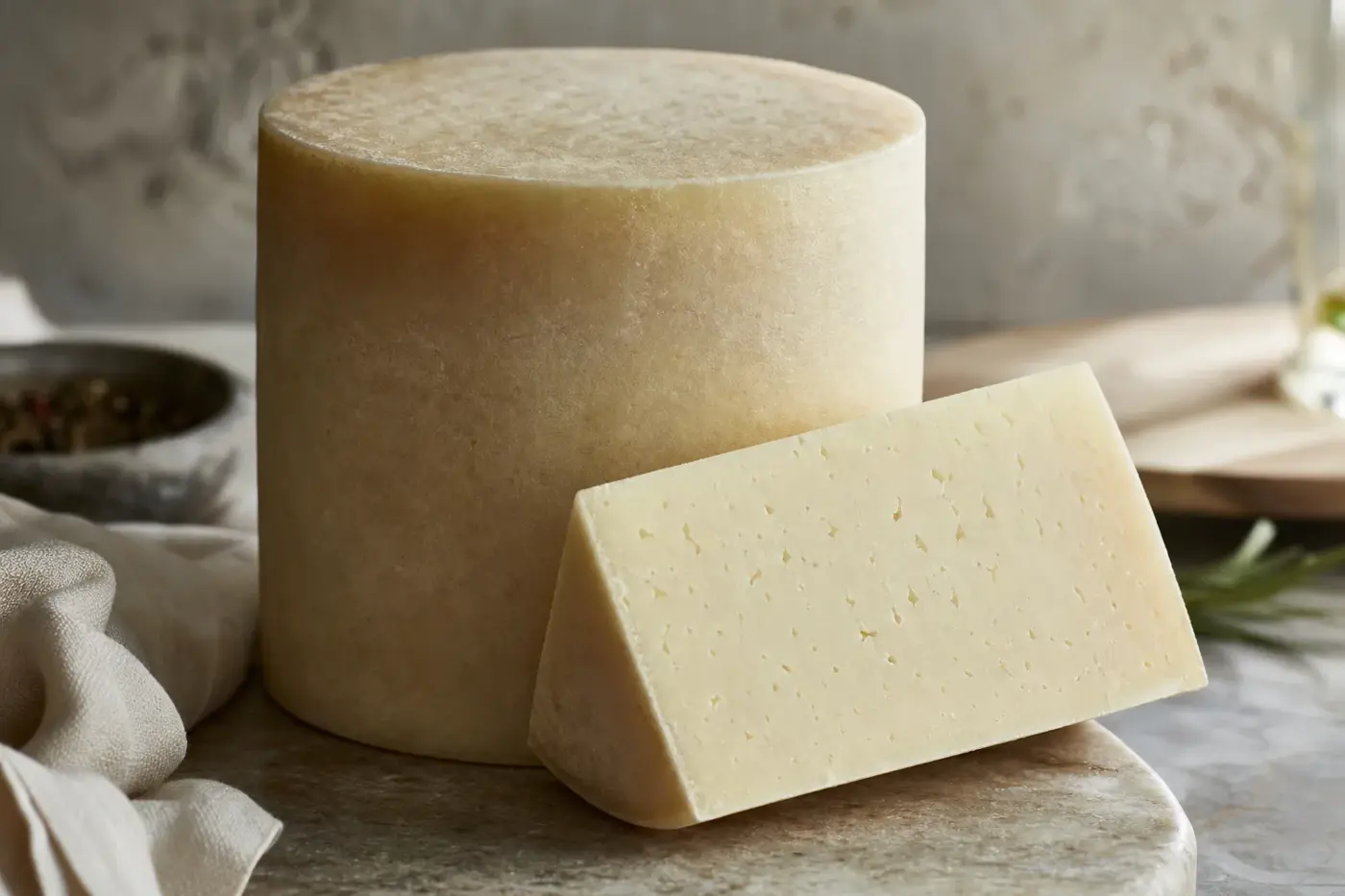
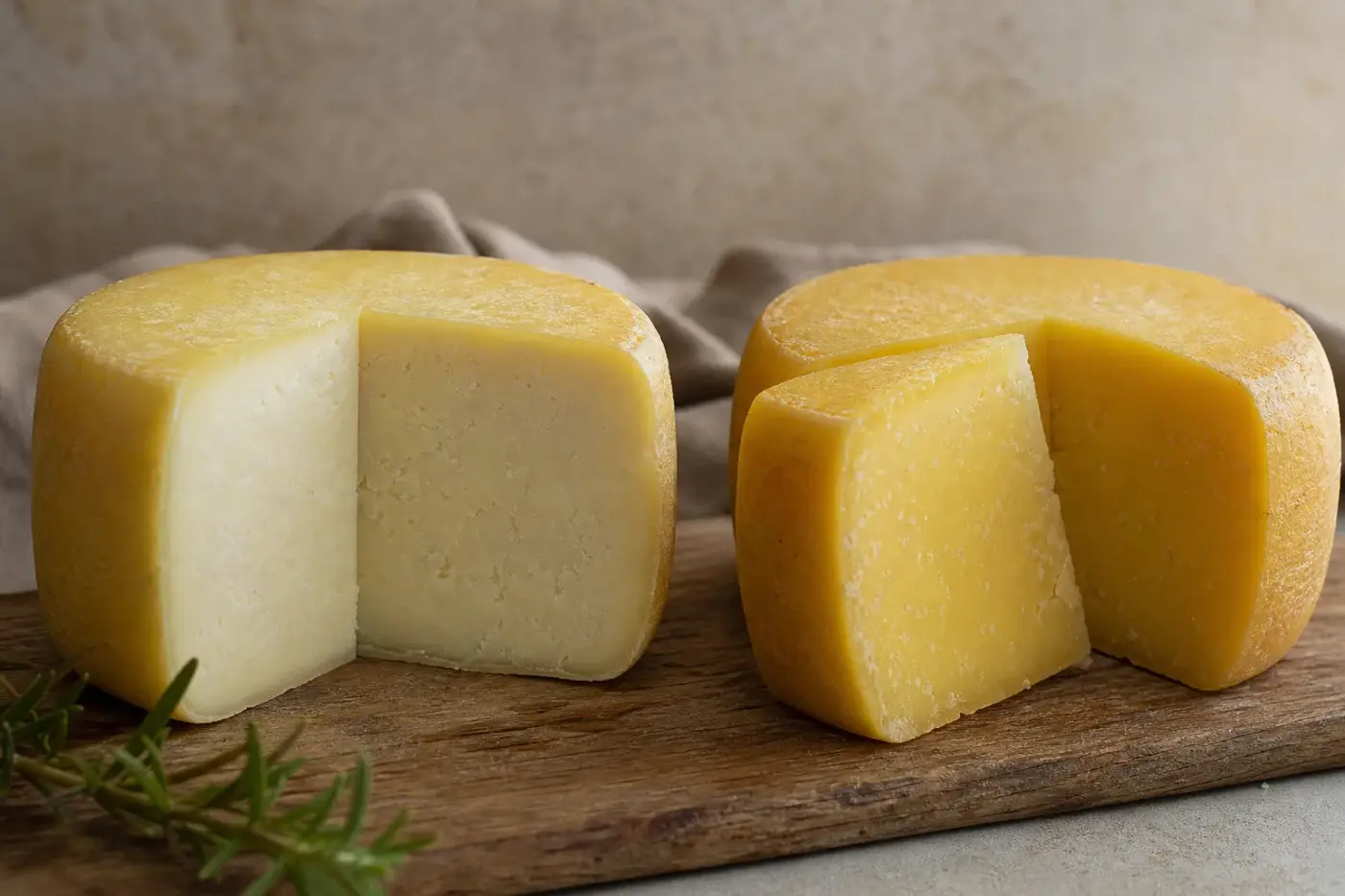
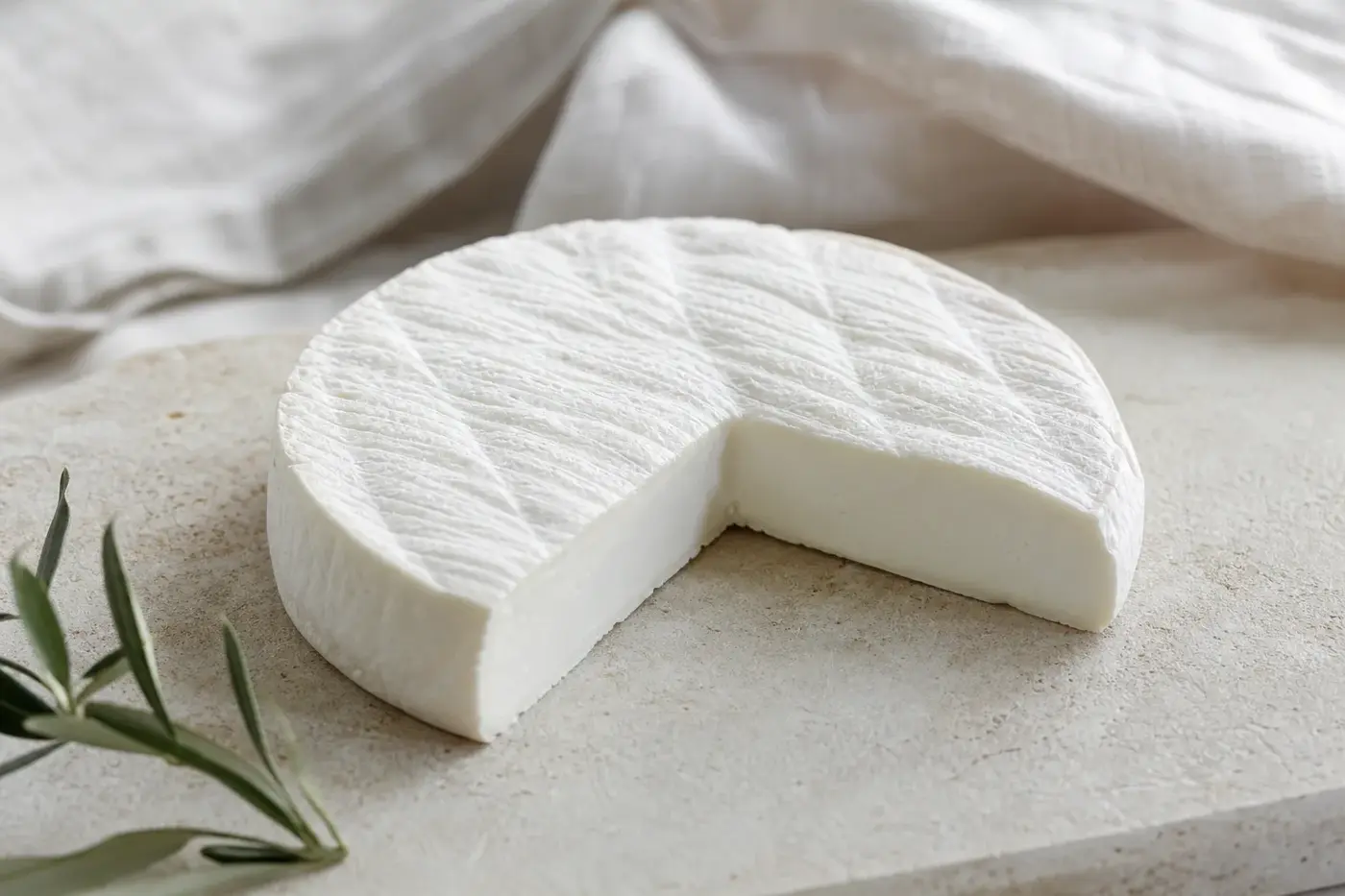
A cut portion gives you a good view of surface and centre. The finished cheese is a low cylinder, with flat faces, slightly raised edges and a gently convex side.[3]
Inside, the specification describes a milk-white paste. Cream, straw and faint reddish shades belong to the exterior as maturation progresses. You should not expect an ivory colour running all the way through.[3]
A young cheese may have no rind, or just a light natural mould bloom. With age, that natural surface becomes more evident. The paste can become slightly more compact while softening immediately beneath the rind.[3]
Young or mature? There is pleasure in both
A few days can make quite a difference to what you taste. Young cheese is described as delicate, savoury and sometimes slightly acidulous. Further maturation builds aroma and flavour, eventually bringing pungency.[3]
| What you notice | Fresh cheese | More mature cheese |
|---|---|---|
| Sensory category in the specification | Fourth to tenth day of maturation.[3] | From the eleventh day.[3] |
| Surface | No rind or a light natural mould bloom.[3] | Natural mould bloom; cream, straw or slightly reddish exterior.[3] |
| Texture | Soft and creamy.[3] | Soft and increasingly compact; potentially creamy beneath the rind.[3] |
| Aroma and flavour | Delicate, savoury, sometimes gently acidulous.[3] | More pronounced, potentially pungent with further affinage.[3] |
For a closer sense of the aromas, turn to the specification’s geographical-link section. It offers green grass and aromatic plants, followed with development by toasted hazelnut and distinctly goaty notes. These descriptions give you the range set out in the specification.[6]
Choose a young cheese for gentleness and a texture suited to spreading. Choose further maturation for greater savoury persistence. Age is not a competitive sport, even on a cheeseboard: tasting the two together tells you more than simply hunting down the oldest.
Read the days as well as the word affinato
The cheese may be sold from the fourth day after the curd enters the moulds. Affinato means matured or refined through further ripening.[5]
The published specification contains a small wrinkle. Article 2’s sensory categories place affinato from day eleven, while Article 4 calls the cheese affinata from day ten after moulding. Ask the seller for its actual age rather than relying on the word alone.[3][5]
You may also come across stagionato, meaning aged. That term appears in the consortium’s consumer descriptions.[8]
At the counter, tell the seller what you enjoy
Start with the name, then describe the character you want. “Soft and gently tangy” or “more developed and savoury” gives the seller more to work with than “a good one”. No cheese vocabulary exam is required.
Each whole cheese must enter the market packaged and sealed. The denomination’s seal has an ochre background and carries the producer’s identification code and a sequential label number.[7] These details connect your cheese to its producer, so keep the packaging until you have eaten it.
Ask whether the seller recommends it for spreading, cutting or cooking. For your first encounter, try the cheese unadorned. Let yourself taste the milk and maturation before inviting oil, herbs or stronger accompaniments onto the plate.
Check dated recall information too. Italy’s Ministry of Health listed an AGRILANGA Roccaverano DOP recall for microbiological risk on 28 September 2026. Consult the official notice when checking a pack from that producer.[11]
For help with the packaging, see how to read a cheese label. Keep that label handy for storage instructions as well as identification.
Make room in the fridge, and keep the label
Follow the pack’s refrigeration instructions and date marking. If you follow Food Standards Agency consumer guidance in England, Wales and Northern Ireland, the recommended domestic fridge setting is 0 to 5 °C.[10]
The consortium suggests a ceramic or porcelain plate beneath an inverted bowl of the same material.[8] If the producer specifies different packaging or handling, follow those instructions and keep the label available. For wrapping and fridge organisation, visit how to store cheese at home.
When you are ready to serve, consult the Food Standards Agency’s current guidance for England, Wales and Northern Ireland on chilled food kept outside the fridge.[10] Include that practical detail in your plans for serving.
Start simply, then take it into the kitchen
Plain bread is a good beginning, but taste the cheese alone first. Keep that first accompaniment quiet. You want somewhere to spread the soft paste, not a flavour that competes with its gentle acidity.
The consortium suggests oil and a little chilli with both fresh and mature examples. Its culinary uses also include fillings, pasta dishes, savoury baked dishes and desserts.[8] Taste before seasoning, then add a little at a time.
With young cheese, try a small spoonful beside simply cooked vegetables or spread it on bread. With a more mature example, start with a smaller piece on its own before deciding what else it needs. These suggestions follow the contrasting characters described in the specification.[3]
Water makes an easy alcohol-free accompaniment when you compare ages. Keep elaborate dressings and strongly flavoured garnishes separate. Everyone can then decide how much to add, and you can keep tasting the cheese itself.
Still curious? Follow the milk and the method
- How to Tell Cheese Styles Apart: Milk, Rind, Texture and Method: find this lactic-curd cheese’s place among other styles.
- Rennet Explained: Animal, Microbial and Fermentation Produced: get to know the coagulant its specification requires.
General information only, not medical advice: follow the official guidance where you live.
Questions people ask
What milk is Robiola di Roccaverano made from?
The current specification requires whole raw goat’s milk from Roccaverano goats, Camosciata Alpina goats or crosses between them. It also requires animal rennet.
Where is Robiola di Roccaverano made?
The defined production area covers 19 municipalities in the Piedmont provinces of Asti and Alessandria. The boundaries govern the milk’s origin, cheesemaking, prescribed maturation and packaging.
How does fresh Roccaverano differ from a mature cheese?
A young cheese is soft, creamy, delicate and sometimes slightly acidulous. Further maturation brings a more pronounced aroma and flavour, potentially becoming pungent.
What does affinato mean on Roccaverano?
Affinato means matured or refined through further ripening. The published specification gives two boundaries: its sensory categories place affinato from day eleven, while another article uses day ten after moulding. Ask the seller for the cheese’s actual age.
How should I store Robiola di Roccaverano?
Follow the pack’s refrigeration instructions and date marking. The Food Standards Agency recommends a domestic fridge setting of 0 to 5 °C for consumers in England, Wales and Northern Ireland.
Sources
- European Commission, Commission Implementing Regulation (EU) 2023/335 of 1 February 2023 approving non-minor amendments to the specification for a name entered in the register of protected designations of origin and protected geographical indications (‘Robiola di Roccaverano’ (PDO)), Official Journal L 47, 15 February 2023. Official regulation.
- Disciplinare di produzione della denominazione di origine protetta “Robiola di Roccaverano/Roccaverano”, March 2023 text, supplied by the producers’ consortium, Articles 1 to 4. Specification PDF.
- Italian Ministry of Agriculture, Provvedimento 8 marzo 2023, annex, Article 2, “Caratteristiche del prodotto”, Gazzetta Ufficiale No. 66, 18 March 2023. Official text accessed through the publication and annex menu.
- Same official publication, annex, Article 3, “Zona di produzione”, 2023.
- Same official publication, annex, Article 4, “Metodo di ottenimento”, 2023.
- Same official publication, annex, Article 7, “Legame con l’ambiente geografico”, 2023.
- Same official publication, annex, Article 8, “Etichettatura”, 2023.
- Consorzio dei Produttori del Roccaverano DOP, Caratteristiche, undated consumer information, accessed November 2026. Producer-representative source with a promotional interest. Consortium account.
- Department for Environment, Food & Rural Affairs, Robiola di Roccaverano, protected food names register entry, published 4 January 2021, accessed November 2026. Great Britain register entry.
- Food Standards Agency, How to chill, freeze and defrost food safely, published 18 December 2017, consumer guidance applying to England, Northern Ireland and Wales, accessed November 2026. Official guidance.
- Italian Ministry of Health, ROCCAVERANO DOP, AGRILANGA recall listing, published 28 September 2026. Listing retrieved in search; full notice access blocked. Official recall page.
- Regione Piemonte, Robiola di Roccaverano/Roccaverano DOP, undated regional product page, accessed November 2026. Its preparation text retains mixed-milk provisions inconsistent with the attached 2023 specification. Regional account.
Researched from the approved EU amendment, the Italian government’s published specification, official guidance and register information, with consortium descriptions attributed separately.
Last checked: November 2026
Last checked November 2026.
The editors suggest you read next
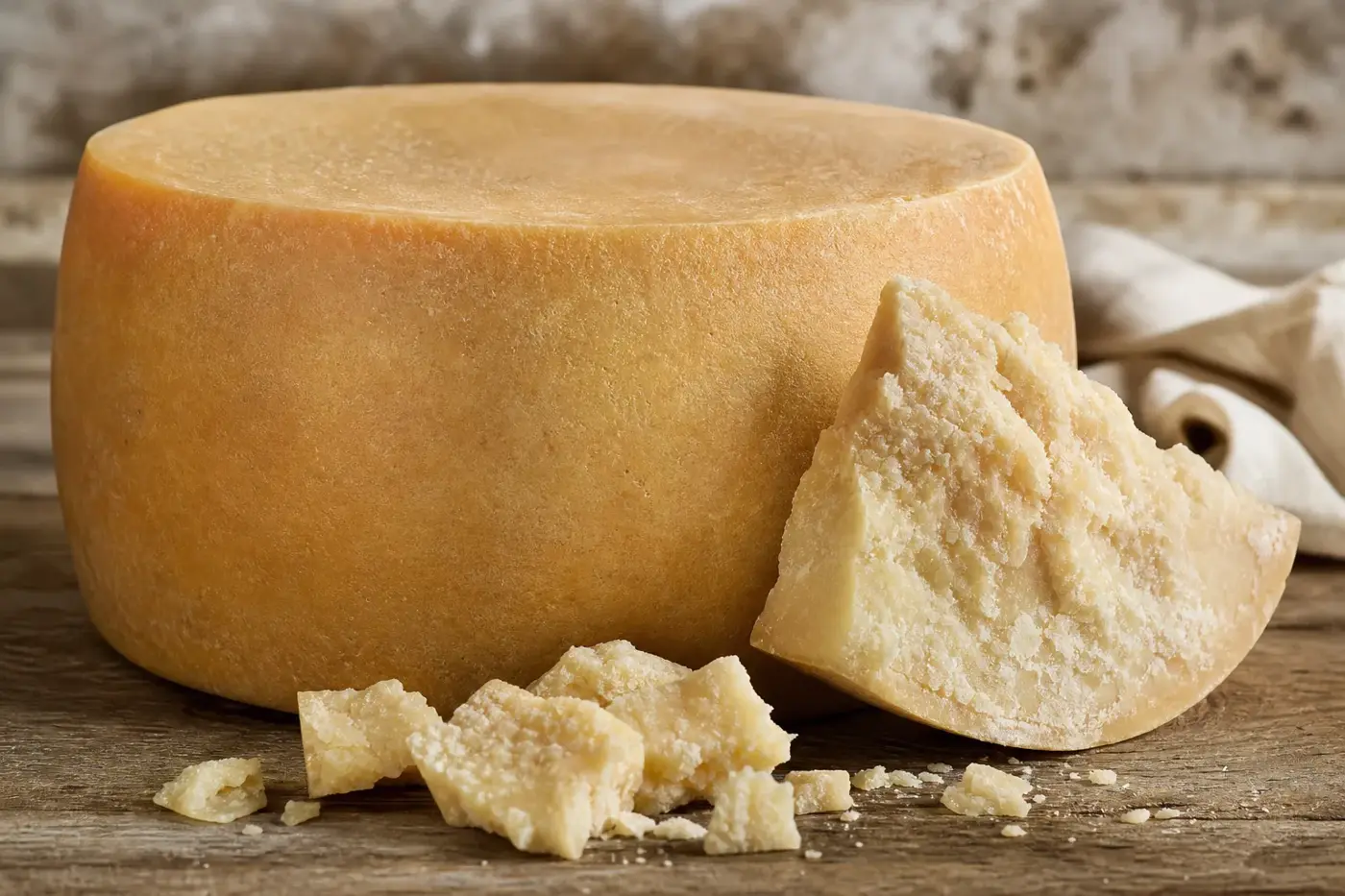
Parmigiano Reggiano
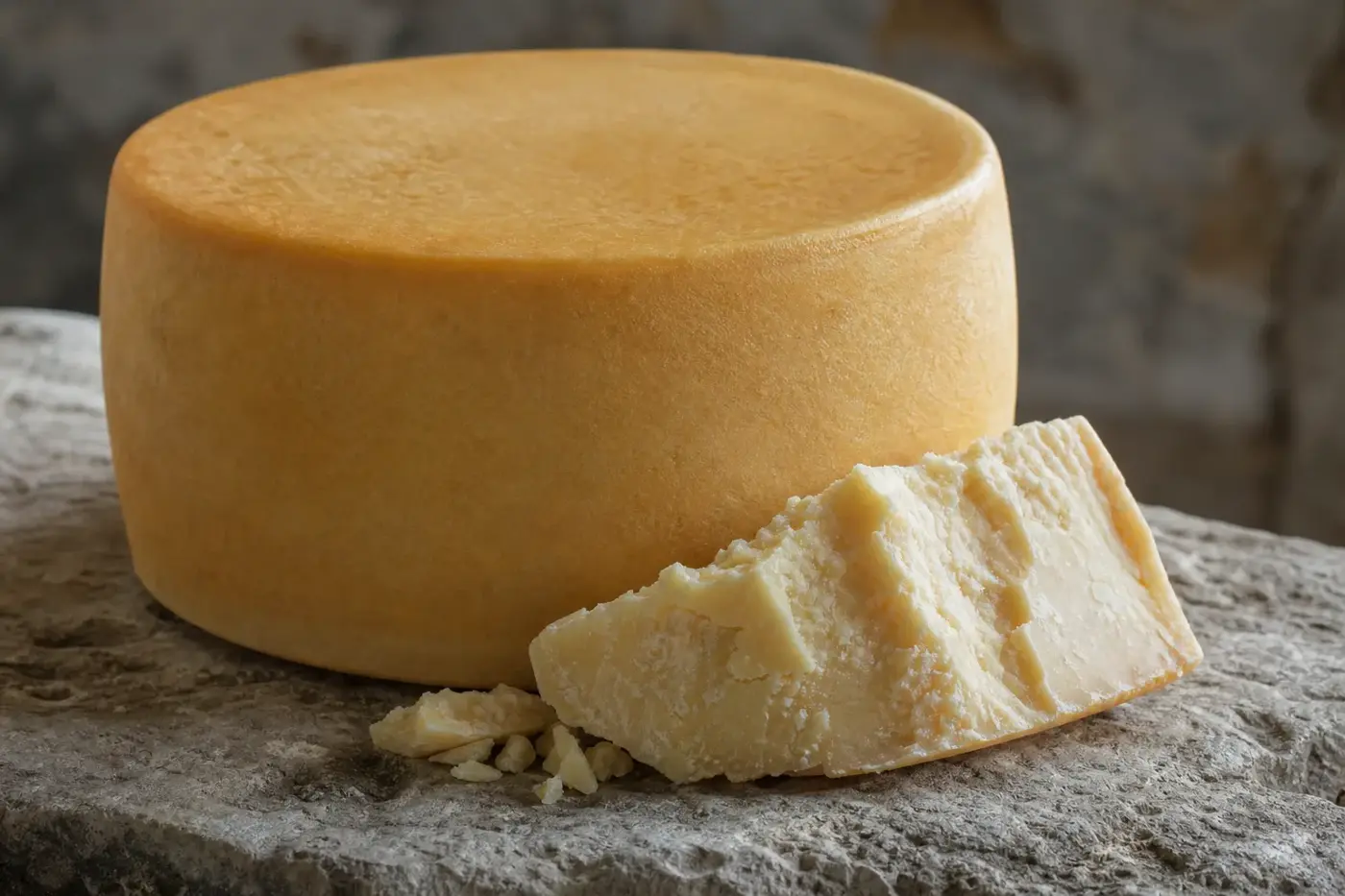
Break into a wheel of Parmigiano Reggiano and flakes fall away, revealing a finely granular cheese, pale straw to straw in colour.