Semi Hard Cheeses Explained
Bend a slice of young Gouda Holland and feel it give.
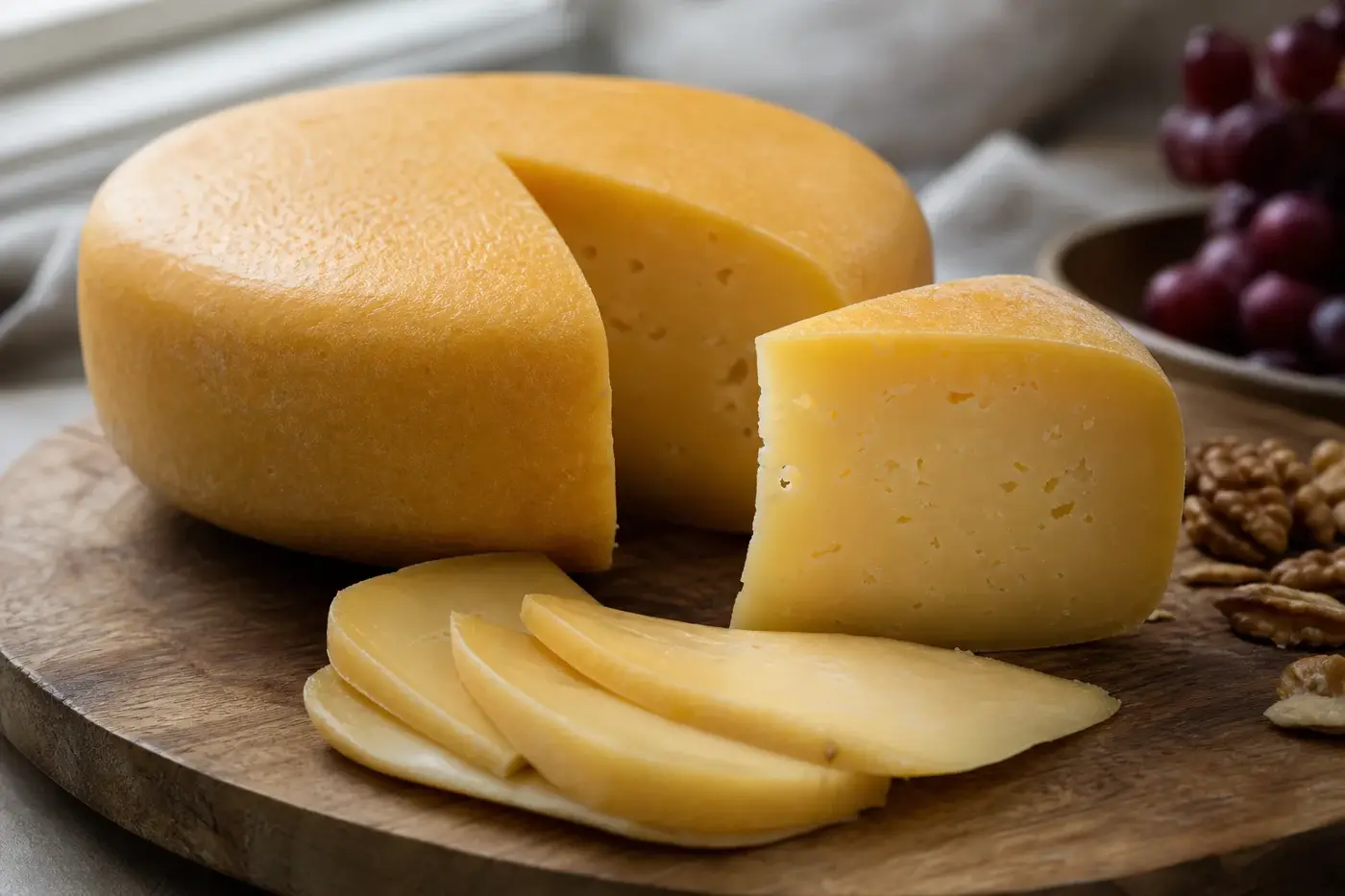
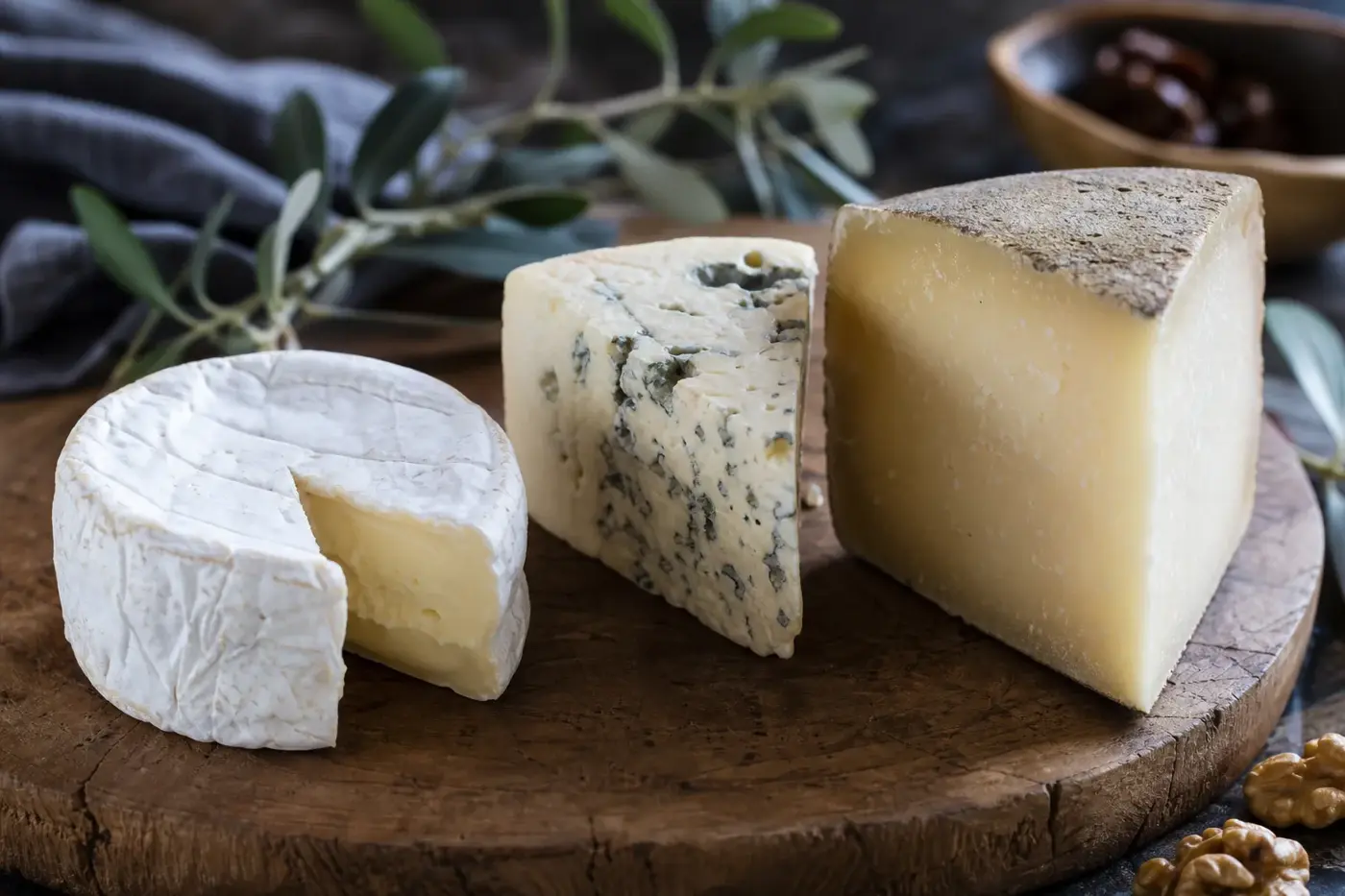
Bend a slice of young Gouda Holland and feel it give. At four weeks, that slightly soft, pliable body is part of its character; leave it longer and it becomes firmer and tighter.[6] Semi-hard cheese rewards your attention like this: supple and springy in youth, then denser and more brittle with age. Moisture retained during cheesemaking, followed by maturation, shapes that firm but yielding bite.[2,6,7]
Semi-hard, with room for interpretation
You might hope for a tidy category. Cheese has declined to provide one. Semi-hard describes texture, but it is not a single worldwide legal class. Codex, the international food standards reference, groups “firm/semi-hard” cheeses at 54 to 69% moisture on a fat-free basis; hard spans 49 to 56%, while soft is above 67%, with deliberate overlaps.[1]
“Moisture on a fat-free basis” means water as a proportion of everything except the fat. It differs from both the water percentage of the whole cheese and fat in dry matter. Codex provides an international reference, not something that automatically has legal force where you live.[1]
Other systems look at the making rather than the moisture. The University of Guelph puts Gouda and Edam within “semi-hard washed cheese”, alongside varieties with different rinds. Start with the category, then get to know the individual cheese and its age. Your guide to cheese styles explores these overlapping ways of sorting them.[2]
Give your first bite as much attention as the finish. “Firm” describes resistance, “elastic” describes how the cheese deforms, and “crumbly” describes how it breaks. Notice each sensation and two semi-hard cheeses can reveal quite different characters. Your favourite texture matters more than the category: it is a description, not a quality grade.
From the vat to that yielding bite
Your slice begins with the cheesemaker cutting the curd. Curd is the gel formed when milk coagulates, or sets; whey is the liquid it releases. Cutting opens the gel so whey can escape. Smaller pieces generally lose more moisture because they expose more surface area relative to their volume.[3]
Heat and stirring come next, making the curd contract and release more whey. Draining removes the liquid; pressing brings the particles together and encourages further whey loss. This expulsion is called syneresis. Pressing matters, but every stage helps shape the texture you eventually bite into.[4,5]
For Gouda-style cheeses, the cheesemaker has another way to guide the result: washing the curd. Some whey is replaced with water, removing lactose, the milk sugar fermented by starter bacteria. Less lactose lets the maker limit subsequent acid development. This takes place in the vat, quite separately from washing a rind during ripening.[2]
To follow the transformation from the beginning, start with the milk in how cheese is made. It puts that finished slice in perspective.
Cultures, salt and the pleasure of patience
Starter cultures get fermentation moving. These added microorganisms produce acid, changing the protein structure and helping determine how much moisture the curd releases. Salt seasons the cheese and slows acid development. When it arrives matters as much as how much goes in.[5]
Maturation then changes the balance. Moisture loss can make cheese firmer, while enzymes breaking down proteins alter its elasticity. Together, these processes can leave an older cheese denser yet more readily fractured. Age does more than turn a young cheese into a tougher version of itself.[6,7,9]
Take a look at the outside, too. Gouda Holland's published specification describes a smooth, dry rind formed during maturation. The Swiss Tilsiter organisation describes regular surface smearing that develops a natural brown-red rind. Different surfaces can have a similar firmness beneath them.[6,8]
Meet Gouda, Edam and the Swiss side of Tilsit
Gouda and Edam are broad cheese names. Add “Holland” and you are looking at something more specific: Gouda Holland and Edam Holland are entered in the EU register as protected geographical indications, or PGIs, under Regulations (EU) No 1122/2010 and No 1121/2010. Both published specifications require Dutch cows' milk, pasteurisation before cheesemaking and maturation in the Netherlands.[6,7]
Gouda Holland gives you a particularly clear taste of ageing. Its specification describes a slightly soft to pliable body at four weeks, becoming firmer and tighter with further maturation; flavour ranges from mild to strong according to age. Minimum maturation is 28 days. Try a young slicing Gouda beside an older, denser piece and taste the progression yourself.[6]
Edam Holland starts firm enough to cut, then tightens with age, according to its specification. Its flavour ranges from mild to piquant, and minimum maturation is 28 days, with a 21-day exception for Baby Edam Holland. Those requirements belong to the named Dutch products. They do not cover every Gouda or Edam you encounter.[7]
With Tilsit, let the maker introduce you. SO Tilsiter Switzerland describes its red-label Tilsiter as a raw-milk semi-hard cheese matured for three months, with regular rind care on wooden boards. The organisation calls the flavour mild and aromatic. That is the story of this Swiss version, not every cheese sold as Tilsit.[8]
Why cheese families overlap
A semi-hard cheese generally holds less moisture than a soft style, giving you a slice that supports itself. Compared with a hard style, it generally has more moisture and a more yielding body. Codex's overlapping figures help explain why two knowledgeable sellers might put the same borderline cheese in different sections.[1,2]
Firmness tells you only part of the story. “Washed-rind” describes surface treatment, while “washed-curd” describes an earlier production step; Alpine describes a regional and cheesemaking tradition, not one measurement of firmness. A cheese can belong to one of these families and also be semi-hard. At the counter, ask which feature the label describes.[2,8]
Ask your way to a favourite
Begin with what you want your cheese to do. For sandwiches, ask for something supple that cuts into complete slices; for shavings or grating, choose a firmer, drier piece. If you are cooking, describe the dish and ask how that particular cheese melts. The family name cannot answer that on its own.[6,9]
Four questions will help: how old is it, which milk is used, how was the milk treated, and what covers the outside? Age helps explain texture, while milk and treatment identify the product more precisely. Find out whether the outside is a natural rind or a removable coating. Follow the maker's directions for eating it.
Ask to taste two ages of the same cheese. Does the slice bend or snap, and is the bite smooth or slightly crumbly? Notice how long the flavour stays: that is a better shopping note than “strong”, which leaves rather a lot of work to the cheesemonger. See how to read a cheese label for the information to carry home.
Slice it, shave it, put it to work
Supple pieces lend themselves to thin slices; firmer ones suit shavings or grated toppings. For a simple plate, try plain bread and apple or pear, tasting the cheese alone before adding an accompaniment. A little pickle offers a sharper contrast if you enjoy one. Water or unsweetened tea keeps your pairing alcohol-free.
Melting asks more of a cheese than firmness alone can tell you. Moisture and fat help loosen the protein network, while acidity and calcium also affect the result; too little or too much acid can limit flow for different reasons. During ageing, protein breakdown can reduce stretch and the cheese's ability to hold fat. Other changes can still make it feel firmer when cold.[9]
The Cheese Science Toolkit gives young Gouda as an example of a good melter. Drier aged Gouda needs surrounding moisture to melt well. If your cheese is unfamiliar, test a small quantity in the intended dish first. Your whole piece need not audition at once.[9]
A good home in your fridge
Keep cut cheese covered in suitable original wrapping or a clean food container. Follow its storage instructions. For domestic fridges, the FSA advises 0 to 5 °C in England, Wales and Northern Ireland. The US FDA advises 40 °F, about 4.4 °C, or below.[10,11]
Take out a small serving rather than repeatedly warming your whole supply. US FDA guidance for foods requiring refrigeration limits total time at room temperature to two hours, reduced to one hour above 32 °C (90 °F). Preparation time and time on the table both count. Aim for the serving texture you enjoy within that limit.[11]
Once you open the pack, follow its instructions. Semi-hard cheeses do not all share one fridge life. The guide to storing cheese at home takes you further into wrapping and handling.[10,11]
This page summarises published guidance from the official sources it cites. It is not medical advice. Guidance differs between countries and changes over time, so check the current source for where you live, and ask your doctor, midwife, pharmacist or dietitian about your own circumstances.
Unwanted mould: when to let go
Discard mouldy sliced, shredded or crumbled cheese of every type. USDA guidance treats these separately from hard blocks, and distinguishes hard cheeses from soft ones. For hard cheese, its exception allows you to cut away at least 2.5 cm (1 inch) around and below a mould spot. Keep the knife out of the mould, then rewrap the cheese in fresh wrap.[12]
That exception applies only when the cheese fits the agency's hard-cheese category. A semi-hard label at the counter does not establish this; if you cannot establish that the exception applies, discard the affected cheese. Intended ripening flora is different from unwanted growth, so ask the maker about its normal rind. See when to cut and when to bin for fuller guidance.[12]
Choosing with care when you are at higher risk
If you are pregnant in the UK, the NHS lists pasteurised semi-hard cheeses, including Edam, among foods that can be eaten. Separate rules require thorough cooking of mould-ripened soft cheeses and soft blue-veined cheeses, whether pasteurised or unpasteurised. Read the current pregnancy guidance alongside your cheese's milk treatment and type.[13]
In the US, CDC guidance advises people who are pregnant, aged 65 or over, or have weakened immunity to avoid unheated cheese made with raw milk. It lists hard cheeses made with pasteurised milk among safer choices. As an alternative, it gives heating raw-milk cheese to 74 °C (165 °F) or until steaming hot. November 2026 is the reference date for these country-specific sources.[14]
Questions people ask
What makes a cheese semi hard?
Semi hard describes texture, but it is not a single worldwide legal class. Codex uses moisture on a fat free basis as an international reference, though its categories overlap.
What is washed curd cheese?
For Gouda style cheeses, some whey is replaced with water in the vat, removing lactose. This allows the cheesemaker to limit subsequent acid development and is separate from washing a rind.
Does Gouda melt well?
The Cheese Science Toolkit gives young Gouda as an example of a good melter. Drier aged Gouda needs surrounding moisture to melt well.
Can you cut mould off semi hard cheese?
USDA guidance advises discarding mouldy sliced, shredded or crumbled cheese of every type. Its exception for cutting away mould applies to hard cheese, and a semi hard label does not establish that the exception applies. See the USDA guidance for details.
Can you eat semi hard cheese during pregnancy?
The NHS lists pasteurised semi hard cheeses, including Edam, among foods that can be eaten during pregnancy. It advises thorough cooking of mould ripened soft cheeses and soft blue veined cheeses, whether pasteurised or unpasteurised. Check the current NHS pregnancy guidance.
Sources
- FAO and WHO, Codex Alimentarius Commission. General Standard for Cheese, CXS 283-1978, amended 2024. Section 7.1, Table B, firmness designations and moisture on a fat-free basis.
- University of Guelph. Cheese Making Technology e-Book: Cheese Families, undated web edition, accessed November 2026. Classification by manufacturing method, particularly Family 5, semi-hard washed cheese.
- Cheese Science Toolkit. Cutting, undated web edition, accessed November 2026. Coagulation, curd particle size and whey expulsion.
- Cheese Science Toolkit. Syneresis, undated web edition, accessed November 2026. Effects of cutting, heating, stirring, pressing, salting and acidification.
- University of Guelph. Cheese Making Technology e-Book: Process Control, undated web edition, accessed November 2026. Sections 1 to 3, structure, moisture and acidity control.
- European Commission. Commission Regulation (EU) No 1122/2010 of 2 December 2010 entering a designation in the register of protected designations of origin and protected geographical indications [Gouda Holland (PGI)], 2010. Registration act and Annex II specification summary.
- European Commission. Commission Regulation (EU) No 1121/2010 of 2 December 2010 entering a designation in the register of protected designations of origin and protected geographical indications [Edam Holland (PGI)], 2010. Registration act and Annex II specification summary.
- SO Tilsiter Switzerland. Der Rote, mild aromatisch, undated product account, accessed November 2026. The industry organisation's description of its red-label Swiss Tilsiter.
- Cheese Science Toolkit. Melt and Stretch, undated web edition, accessed November 2026. Composition, acidity, calcium and protein breakdown.
- Food Standards Agency. How to chill, freeze and defrost food safely, published 18 December 2017, live edition accessed November 2026. Applies to England, Northern Ireland and Wales.
- US Food and Drug Administration. Are You Storing Food Safely?, live consumer guidance accessed November 2026. Refrigeration temperatures, label instructions and time outside refrigeration.
- US Department of Agriculture, Food Safety and Inspection Service. Molds on Food: Are They Dangerous?, reproduced USDA guidance hosted by Gallatin City-County Health Department, edition date not verified. Retrieved table excerpt distinguishes hard cheese from soft, sliced, shredded and crumbled cheeses.
- NHS. Foods to avoid in pregnancy, live guidance accessed November 2026. Cheese, milk and other dairy section.
- US Centers for Disease Control and Prevention. Preventing Listeria Infection, dated 31 January 2025, accessed November 2026. Higher-risk groups and cheese-specific prevention advice.
Researched through published standards, university cheesemaking references, specialist explanations, official food safety guidance and an attributed industry product account.
Last checked: November 2026
Last checked November 2026.
The editors suggest you read next
How to Tell Cheese Styles Apart: Milk, Rind, Texture and Method
Watch mozzarella curd being worked and stretched in hot water.