Sharpham Elmhirst
Cut through Elmhirst’s edible white bloom and watch the centre tell its age.
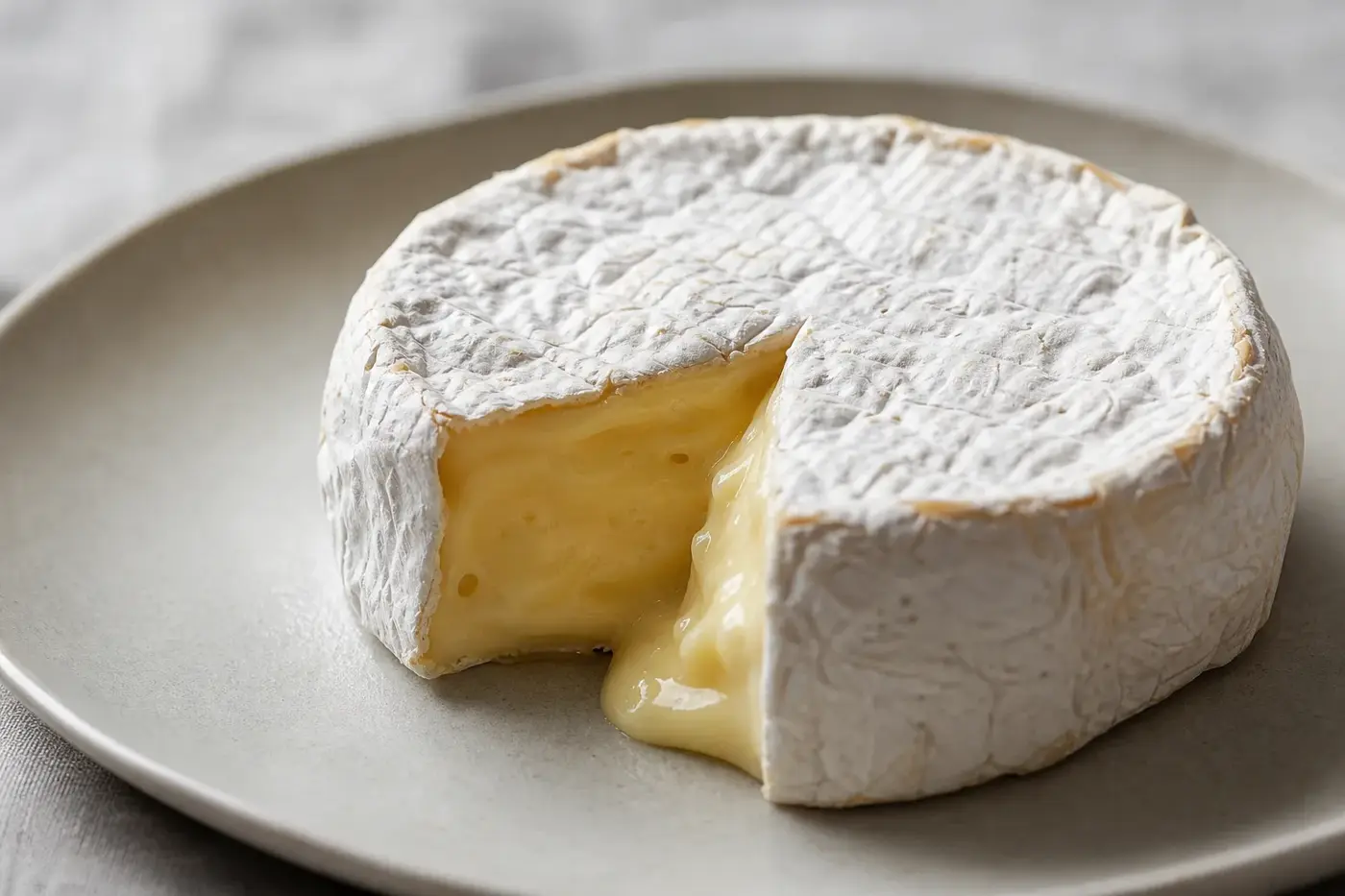
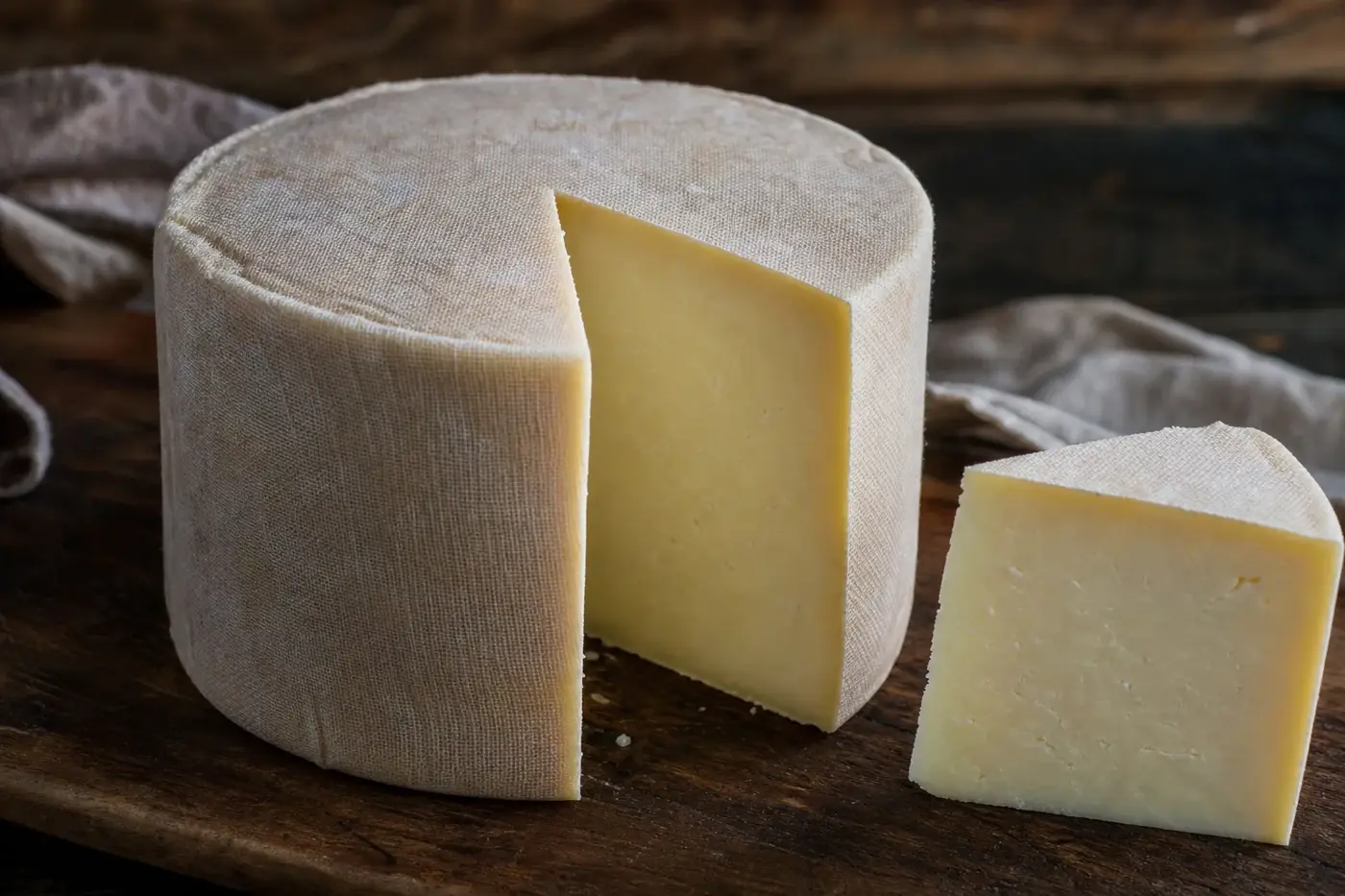
Cut through Elmhirst’s edible white bloom and watch the centre tell its age. At 2 to 3 weeks, Sharpham Dairy describes it as mousse-like; at 4 to 6 weeks, fuller and more flowing. Pasteurised Jersey cow’s milk and double cream make this the dairy’s triple-cream cheese, fresh in youth and buttery with ripeness. Your knife meets a different cheese depending on when you arrive. [1]
Meet Sharpham Elmhirst at a glance
| What to know | The details |
|---|---|
| Maker | Sharpham Dairy. [1] |
| Milk | Pasteurised Jersey cow’s milk. [1] |
| Added richness | Cow’s double cream. [1] |
| Style | Soft, white mould-ripened, triple-cream. [1] |
| Shape and size | Round, approximately 130 g or 660 g. [1] |
| Rind | Edible white bloom. [1] |
| Vegetarian suitability | Suitable, according to the maker. [1] |
| Measured fat in dry matter | Not established here |
| Production area | Not established here |
| Protection status by jurisdiction | Not established here |
| Coagulant | Not established here |
| Legal minimum ageing | Not established here |
| Typical ageing | The maker describes stages at 2 to 3 weeks and 4 to 6 weeks. [1] |
Meet the family name behind this Devon cheese
There is a family behind the name on your cheese. According to Sharpham Dairy, Elmhirst honours that family and its contribution to the local area. The name belongs to an individual cheese within the dairy’s range. [1]
The white bloom catches your eye, but it tells only part of the story. Explore the guide to milk, rind, texture and method to see where Elmhirst sits among other cheeses. There is plenty to discover beneath the surface.
Triple cream, with a little label reading
Sharpham calls Elmhirst triple-cream and makes it with added cream. To understand the term, you need to separate fat in dry matter from fat in the whole cheese. They are not interchangeable, however tempting it is to let the word “cream” do all the explaining. [1,2]
Fat in dry matter measures fat as a proportion of everything left once the water is removed. Fat per 100 g of cheese includes the water in that 100 g. The figures answer different questions, so you cannot compare their percentages directly. [2]
In France, the expression has a precise legal meaning. Article 13 of Décret n° 2007-628 permits “triple crème” when cheese or a cheese speciality contains at least 75 g fat per 100 g after complete drying. That is a French labelling rule, not a measured composition figure for Elmhirst. [2]
Try a hypothetical example. A cheese with 40 g dry matter and 30 g fat in every 100 g would have 75% fat in dry matter, but 30% fat in the whole cheese. Divide 30 by 40, then multiply by 100. These are teaching figures, not Elmhirst’s nutritional values.
For a dietary comparison, use the fat per 100 g on your actual pack. For composition or style, look at which basis the figure uses. The guide to reading a cheese label helps you separate a product description from its nutrition declaration.
Let the centre show you its age
Elmhirst begins with milk enriched with double cream and finishes as a mould-ripened cheese. Sharpham describes a mousse-like texture at 2 to 3 weeks, followed by a fuller, more flowing cheese at 4 to 6 weeks. The rind may draw you in, but the centre reveals what time has done. [1]
Curious about the steps between milk and finished cheese? Follow the wider sequence in how cheese is made.
Taste your way from fresh to buttery
Young Elmhirst is clean and fresh, according to the maker. As it ripens, the flavour becomes buttery and fuller, changing alongside the texture. You have more than one stage to get acquainted with, depending on how ripe you like your cheese. [1]
A Platinum moment for Elmhirst in 2024
Food Drink Devon’s published 2024 results list Sharpham Elmhirst under Platinum Award in the Producer Awards. That gives you a dated result, a named competition and its organiser. It tells you rather more than an undated “award-winning” description on its own. [3]
Give Elmhirst a little space on your plate
Start with the cheese, plain bread and water. Then introduce accompaniments, so you can decide whether you prefer a quiet partner or a sharper contrast. Choose one or two additions; every slice need not audition for a different topping.
For home handling in England, Wales and Northern Ireland, the Food Standards Agency advises a fridge temperature between 0 and 5 °C (32 to 41 °F). Follow the storage instructions on the pack. [4]
- Read your pack first. Follow its storage instructions and date, including any direction for using the cheese after opening. [4,5]
- Take out only what you plan to serve. Leave the remainder refrigerated rather than warming the entire supply for a small tasting.
- Keep your serving refrigerated until needed. Follow the storage instructions on the pack. [4]
- Choose a clean plate and knife. Cut portions with both surface and centre. Taste a little alone before adding an accompaniment.
Bring bread, fruit and something gentle to drink
A plain baguette or an unsalted cracker gives soft cheese some structure without introducing a second strong flavour. Thin slices of apple or pear offer another simple option. Keep the fruit separate so you can choose how much sweetness or sharpness each mouthful needs.
Try sparkling water or a lightly sparkling apple juice alongside your cheese. These serving and pairing suggestions are editorial recommendations, rather than a recorded tasting. For a more systematic way to compare drinks, turn to cheese and wine pairing.
Keep your cheese well, and know when to stop
Follow your pack’s storage instructions, including any limit after opening, and return the remainder to the fridge promptly. FSA advice for England, Wales and Northern Ireland is to keep dairy products refrigerated and follow the label. [4]
A use-by date is about safety; a best before date is about quality. GOV.UK guidance makes that distinction and warns that incorrect storage can make food unsafe before its use-by date. Pay attention to both storage and dates. [5]
Start with the date and handling history when deciding whether your cheese is past its best. The FSA warns that harmful bacteria such as Listeria cannot be seen, tasted or smelt. Appearance and aroma cannot override a use-by date. [5,7]
Discard the cheese if its use-by date has passed. If you notice an unexpected change before then, stop and ask the retailer or dairy about that particular cheese rather than tasting it to investigate. Keep the packaging and batch information handy so they can identify it. [5,7]
For wrapping and refrigerator organisation, continue to how to store cheese at home. If unexpected growth is your concern, see mould on cheese, which explains the distinctions between cheese styles.
General information only, not medical advice: follow the official guidance where you live.
Questions people ask
What milk is Sharpham Elmhirst made from?
It is made with pasteurised Jersey cow’s milk. Cow’s double cream is added to make this triple cream cheese.
Can you eat the rind of Sharpham Elmhirst?
Yes, its white bloomy rind is edible. Beneath it is a soft centre.
Is Sharpham Elmhirst suitable for vegetarians?
Yes, according to Sharpham Dairy. The coagulant used has not been verified on the page.
What does triple cream mean for Sharpham Elmhirst?
Sharpham describes Elmhirst as triple cream and makes it with added cream. Its measured fat in dry matter has not been verified.
How should Sharpham Elmhirst be stored?
The Food Standards Agency advises keeping dairy products refrigerated and following the label. For England, Wales and Northern Ireland, it advises keeping the fridge between 0 and 5 °C; see its guidance for details.
Sources
- Sharpham Dairy. Sharpham Elmhirst. Current product information, undated web edition retrieved November 2026. Product description, dimensions, dietary information and ripeness descriptions. Product information.
- Légifrance. Décret n° 2007-628 du 27 avril 2007 relatif aux fromages et spécialités fromagères, Chapter III, Article 13, consolidated provision displayed as in force from 1 January 2014. French definition of “triple crème”. Official text.
- Food Drink Devon. Awards Results 2024. Organiser’s published results, 2024. Producer Awards, Platinum Award list. Official results.
- Food Standards Agency. How to chill, freeze and defrost food safely. Published 18 December 2017, current web edition retrieved November 2026. Applies to England, Northern Ireland and Wales. Official guidance.
- GOV.UK. Understanding food labelling: Best before and use-by dates. Current web edition retrieved November 2026. Official guidance.
- UK Health Security Agency. Food safety in a heatwave: advice for consumers. Current official search extract retrieved November 2026. Official guidance.
- Food Standards Agency. Are YOU guilty of the 12 Festive Food Fails? Official campaign extract retrieved November 2026. Advice concerning use-by dates and the limits of sensory checks. Official publication.
This desk-researched draft combines the maker’s product information, a French legal definition, the award organiser’s results and official food-handling guidance.
Last checked: November 2026
Last checked November 2026.
The editors suggest you read next
West Country Farmhouse Cheddar Cheese
Large pieces of curd turn and stack under the cheesemaker’s hands.