Washed-Rind Cheeses: How Washing Shapes the Cheese
First, the animal aroma reaches you.
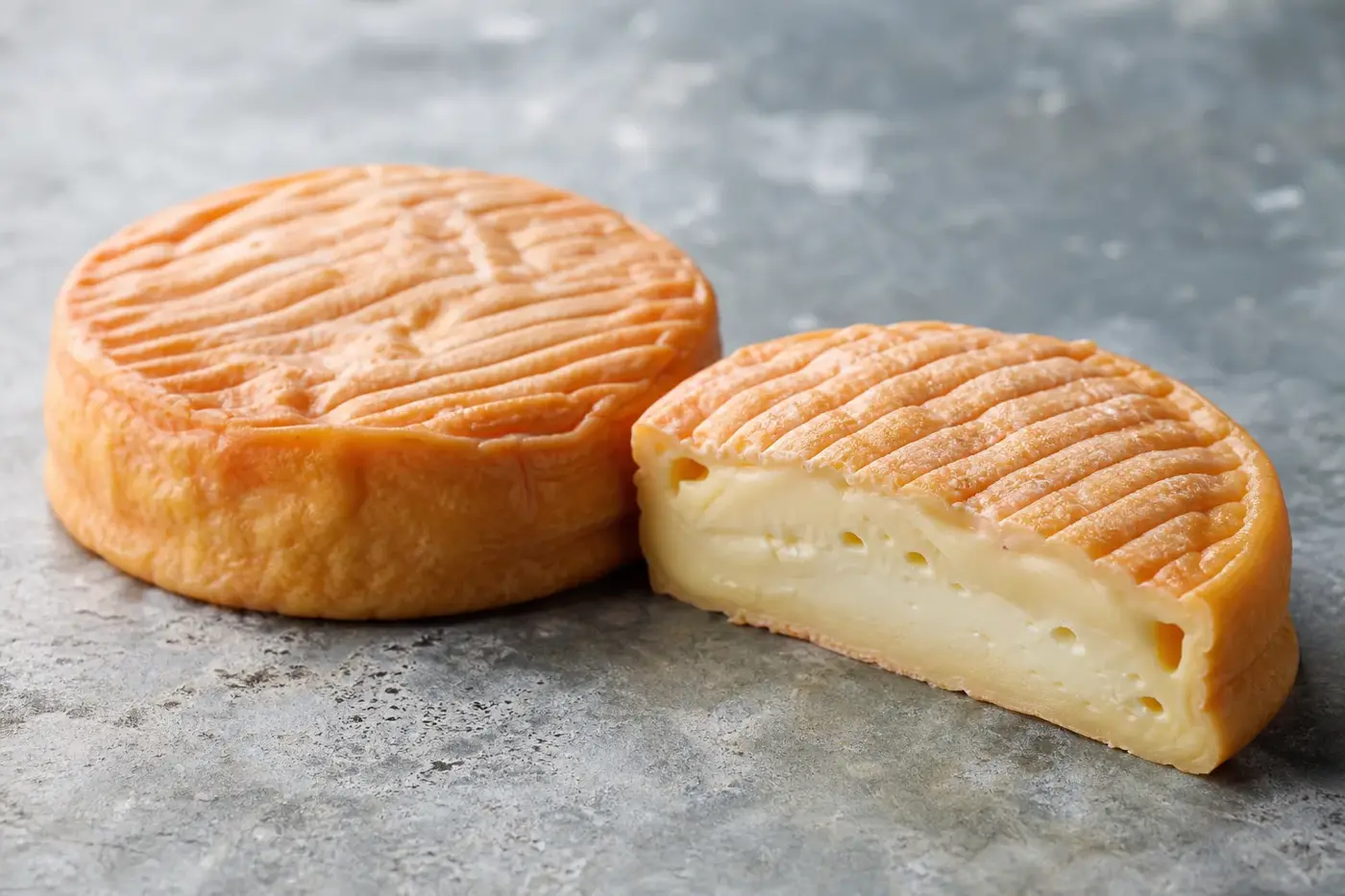
First, the animal aroma reaches you. Then comes the surprise: fruity softness. The Époisses producers’ association describes that contrast, a good reason to taste beyond your first impression. Behind the powerful rind lies a patient routine of damp rubbing, turning and returning the cheese to its ripening room.[1][5]
Each wash helps shape the surface community responsible for colour, aroma and flavour. That pungent exterior can conceal a much gentler paste. Your nose, for all its confidence, has not necessarily read the whole menu.[1][5]
| Your first look | What to expect |
|---|---|
| The care that defines it | Repeated washing, moist rubbing or related surface care during ripening.[1][4] |
| The cheese beneath | No single texture: washing describes surface treatment, not the consistency inside.[1][4][6] |
| The rind’s character | A microbial surface, often yellow, pink or orange-red, with plenty of variation between cheeses.[2][4][6] |
Beyond the aroma: meet the washed-rind family
Put Munster beside Taleggio and you meet two cheeses with moist surface care in common. Their specifications describe different shapes and textures. Washed-rind cheeses share neither one milk species nor one shape or degree of softness: the connection is how they ripen, not what you find inside.[4][6]
You will often hear the word “smear”. It means the microbial growth encouraged and spread across the rind. Washing helps manage that growth, together with conditions in the ripening room.[1]
Research comparing cheese rinds found recognisable microbial differences between washed, bloomy and natural-rind communities. Each group still contained considerable diversity. You are looking at a family resemblance, not a row of identical cheeses.[1]
For the broader picture, start with how to tell cheese styles apart.
Behind every rind, a patient pair of hands
Washing begins once the cheese has been formed, during ripening. The work can mean wiping, rubbing or brushing rather than immersion. Munster’s official description mentions rubbing or other moist treatments; Époisses receives repeated rubbing with water enriched with marc de Bourgogne, a grape-pomace spirit.[4][5]
Every visit changes the surface environment. Moisture influences which organisms flourish, while salt helps select those able to tolerate it. Rubbing spreads growth across the rind.[1][3]
The pauses are part of the work, too. The surface keeps changing while the cheese rests, so the time between treatments helps shape the result. Temperature and humidity matter throughout ripening, not simply at the finish.[1][3]
There is no family timetable pinned to every ripening-room door. Époisses’ producers describe regular care throughout maturation, while Taleggio’s production description specifies treatment with water and salt. Those details give you a clearer picture than “washed” alone.[5][6]
Think of it as tending a living surface, rather than simply applying flavouring. That distinction helps you understand the developing smell, the changing rind and the texture beneath it.[1][2]
First the yeasts, then the bacterial company
A young cheese’s acidic surface does not welcome every organism equally. Yeasts can help raise its surface pH, reducing acidity and making conditions more hospitable to others. Research describes a succession: yeasts arrive first, followed by several groups of bacteria, rather than a complete mature community appearing at once.[3]
Brevibacterium linens may be the name you recognise from orange washed rinds. It does not work alone. Researchers have also identified organisms from genera including Corynebacterium, Arthrobacter, Micrococcus and Staphylococcus.[3]
The organisms differ between cheeses, and their community develops over time. A study sequencing 137 rind communities from ten countries found 24 widely distributed dominant bacterial and fungal genera. One familiar bacterial name tells you only a small part of that story.[1][3]
Laboratory reconstructions also revealed positive and negative interactions between community members. The inhabitants affect one another. A developed rind is a collective result, not the achievement of a single useful organism.[1]
Follow the colour, aroma and softening paste
That orange glow owes something to pigments made by surface organisms. In an experimental study, researchers applied two commercial smear-culture mixtures to a young Cheddar-curd base. They linked the developing colour with microbial production of carotenoids, a family of yellow, orange and reddish pigments.[2]
Aroma develops through microbial metabolism, too. During ripening, enzymes break down cheese components. Microorganisms then transform the resulting compounds into smaller flavour and aroma molecules, some of whose volatile compounds you can detect at very low concentrations.[2]
This helps explain a familiar surprise: your nose prepares you for something fiercer than your mouth encounters. A washed rind can smell considerably more forceful than the cheese tastes.[2]
The changes reach beneath the surface. Protein breakdown and the changing chemical environment help a soft cheese become more yielding towards its exterior. Taleggio’s production description offers a clear example: comparatively compact paste, softer immediately beneath the rind.[2][6]
You may hear this called “outside-in ripening”. The visible rind and changing paste are connected, but the cheese’s original structure and composition also shape the result. The surface matters, and so does the cheese beneath it.[2][3]
In the wash: brine, wine, beer and spirits
Water and salt provide a washing medium. A reproduced production description records that treatment for Taleggio, while Époisses producers describe adding marc de Bourgogne to their rubbing water. Each liquid belongs to a documented routine; it does not explain the whole cheese by itself.[5][6]
If a wine-washed or beer-washed cheese catches your eye, ask the producer or seller three questions. What liquid is used? Is it diluted? When is it applied?
Those answers tell you more than the label alone. Two cheeses with the same washing description need not follow the same method. Surface moisture, salt, microbial growth and ripening conditions still have their parts to play.[1]
With Époisses, for example, the producers describe repeated care with the spirit-containing wash throughout maturation. It is part of the continuing work, not a single application held back for the end.[5]
Admire the rind, then look beneath it
Orange-red might be the colour you expect, but there is more to this family’s palette. Munster’s official description ranges from yellow to orange-red; Taleggio’s describes a naturally pinkish rind. Enjoy the colour, but do not expect it to identify the cheese on its own.[4][6]
Next, look at the paste. “Washed-rind” can describe a yielding soft cheese or a much firmer surface-ripened cheese. In softer examples, the contrast between the outer paste and the centre can tell you a great deal.[1][6]
Taleggio’s softer layer beneath the rind, for instance, is not the same as an interior that flows evenly throughout. That is a useful distinction when you are choosing what you want to eat.[6]
Tell your cheesemonger about texture. You might want a neat slice, something that yields under a knife, or a cheese you can spoon. That gives them more to work with than “the one that announces itself through the wrapping”.
A taste of place: Munster, Époisses and Taleggio
From the Vosges and Burgundy to Italy, these cheeses show how differently moist rind care can turn out. The November 2026 source descriptions below bring their places, production and character into focus.[4][5][6]
| Cheese | Where it comes from in the source | What is said about milk treatment | Rind care and character |
|---|---|---|---|
| Munster | Vosges area, associated with Alsace and Lorraine, France.[4] | No milk-treatment detail given here | Cow’s-milk cheese; rubbing or other moist treatment; yellow to orange-red rind.[4] |
| Époisses | Burgundy, France.[5] | No milk-treatment detail given here | Cow’s-milk cheese; repeated rubbing with water enriched with marc de Bourgogne.[5] |
| Taleggio | Italy.[6] | Milk-treatment detail from the current operative specification is not provided here | Reproduced production description: water and salt treatment, thin pinkish rind and paste softer beneath it.[6] |
Their sensory portraits are just as individual. The Époisses producers’ association describes powerful animal aroma followed by fruity gentleness. Taleggio’s production description records sweet, aromatic flavour, balanced saltiness and lactic notes.[5][6]
Treat those descriptions as invitations to notice character, rather than a ranking by strength. There is much more for you to discover than which cheese has the most pronounced aroma.[5][6]
Washed, bloomy or natural? Look at the care
Repeated moist treatment distinguishes washed rinds. Bloomy rinds are associated with conspicuous fungal growth, often forming a white surface. Natural rinds develop under a different surface-care regime.[1]
Research finds differences between these microbial communities, but their organisms do not fall into perfectly separate groups. Some cheeses combine treatments or develop a mixed-looking surface. Looks alone can leave you uncertain.[1]
If you notice a pale bloom over a coloured rind, ask the maker or cheesemonger about that cheese. Its ripening method, supported by its documented description, is a better guide than colour alone.[1]
At the counter, let texture lead the conversation
Ask about milk treatment, the cheese’s present texture, the maker’s intended rind character and storage after cutting. For a gentler introduction, say you want a restrained flavour. A pale rind or a less obvious smell is a less useful guide to what you want to taste.
At home, follow the packaging and refrigerate the cheese. UK NHS guidance advises keeping your fridge at 5 °C or below, separating raw and ready-to-eat foods, and observing use-by dates. It also advises using opened food within two days unless the packaging says otherwise.[9]
Keep the wrapping and handling instructions with the cheese, particularly when several cheeses share a board. For broader advice, see how to store cheese at home. If unexpected surface growth appears, follow the guidance on mould on cheese.
Take your time with the paste and rind
Take out only the portion you intend to serve. Let it briefly lose some refrigerator chill, following any maker’s instructions. For England, Wales and Northern Ireland, the FSA advises eating ready to eat foods shortly after removal from refrigeration: within four hours, or within two hours on a very warm day.[7]
Begin with a little paste. Then, if the producer identifies the rind as edible, try a piece that includes it. You can compare the interior’s flavour with the surface contribution, rather than tasting everything together straight away.
Ask the seller about any unfamiliar coating or treatment before eating it. You do not need to guess.
As you taste, record three things separately: the rind’s aroma, the texture immediately beneath it and the consistency at the centre. This helps you notice the contrasts, especially when a pronounced exterior encloses a gentler interior.[5][6]
Keep accompaniments simple at first: plain bread, boiled potatoes or fresh pear. Then decide whether sweetness, acidity or crunch improves the combination for you. Water is an option too; see cheese and wine pairing for a fuller discussion of pairings.
This page summarises published guidance from the official sources it cites. It is not medical advice. Guidance differs between countries and changes over time, so check the current source for where you live, and ask your doctor, midwife, pharmacist or dietitian about your own circumstances.
Pregnancy and higher-risk guidance: what to follow in the UK
Pregnant people, newborn babies, people with weakened immunity and older people are among the groups the NHS identifies as being at greater risk of serious illness from listeriosis. Its guidance also stresses refrigeration, use-by dates and avoiding cross-contamination.[9]
The NHS states that any cheese cooked until steaming hot can be eaten during pregnancy.[8] Check its current guidance for the specific cheeses to avoid and the exceptions that apply.
For an individual soft washed-rind cheese, discuss its milk treatment and product information with your midwife or another appropriate healthcare professional. Follow the NHS pregnancy guidance and NHS listeriosis guidance, with November 2026 as this page’s reference date. The site’s listeria and cheese safety guide explains the wider food-safety context.
Questions people ask
What makes a cheese a washed rind cheese?
It is defined by repeated washing, moist rubbing or related surface care during ripening. The treatment can involve wiping, rubbing or brushing rather than immersion.
Why can a washed rind cheese smell stronger than it tastes?
During ripening, microorganisms produce aroma compounds, some of which can be detected at very low concentrations. The Époisses producers’ association describes a powerful animal aroma followed by fruity gentleness.
What liquids are used to wash cheese rinds?
Taleggio receives treatment with water and salt. Époisses is rubbed with water enriched with marc de Bourgogne throughout maturation.
Can you eat the rind of a washed rind cheese?
If the producer identifies the rind as edible, you can try a piece that includes it after tasting the paste. Ask the seller about any unfamiliar coating or treatment before eating it.
How should washed rind cheese be stored?
Follow the packaging and refrigerate the cheese. The NHS advises keeping the fridge at 5 °C or below, observing use by dates and using opened food within two days unless the packaging says otherwise. See the NHS listeriosis guidance at https://www.nhs.uk/conditions/listeriosis/.
Sources
[1] Cell, Cheese rind communities provide tractable systems for in situ and in vitro studies of microbial diversity, 2014, author manuscript available through PubMed Central. Full text.
[2] mSystems, Omics-Based Insights into Flavor Development and Microbial Succession within Surface-Ripened Cheese, volume 3, issue 1, e00211-17, 2018. Full text.
[3] Journal of Dairy Science, Crystallization and demineralization phenomena in washed-rind cheese, online article record, publication year not verified during this session. Article record.
[4] Institut national de l’origine et de la qualité, Munster, undated product record, including its official description and links to specification documents. Product record.
[5] Syndicat de Défense de l’Époisses, Accueil, undated, sections “Saveurs” and “Histoire”. This is the producers’ association’s account, including its own sensory descriptions. Association website.
[6] European Commission, Publication of an application for approval of an amendment, which is not minor, to a product specification: Taleggio, Official Journal C 74, 14 February 2022; and Consorzio Tutela Taleggio production description reproduced by CLAL, Taleggio Product Specification, undated. Commission publication; reproduced production description.
[7] Food Standards Agency, Listeria, published 2018, current retrieved web guidance, applying to England, Northern Ireland and Wales. Guidance.
[8] NHS, Foods to avoid in pregnancy, current retrieved web edition, checked November 2026. Guidance.
[9] NHS, Listeriosis, reviewed 10 November 2023, current retrieved web edition checked November 2026. Guidance.
This article was researched from published dairy-science research, official product descriptions, specification material, producers’ association accounts and UK public-health guidance.
Last checked: November 2026
Last checked November 2026.
The editors suggest you read next
How to Tell Cheese Styles Apart: Milk, Rind, Texture and Method
Watch mozzarella curd being worked and stretched in hot water.