Why Some Cheeses Squeak
Bite into a fresh Wisconsin cheese curd and listen.
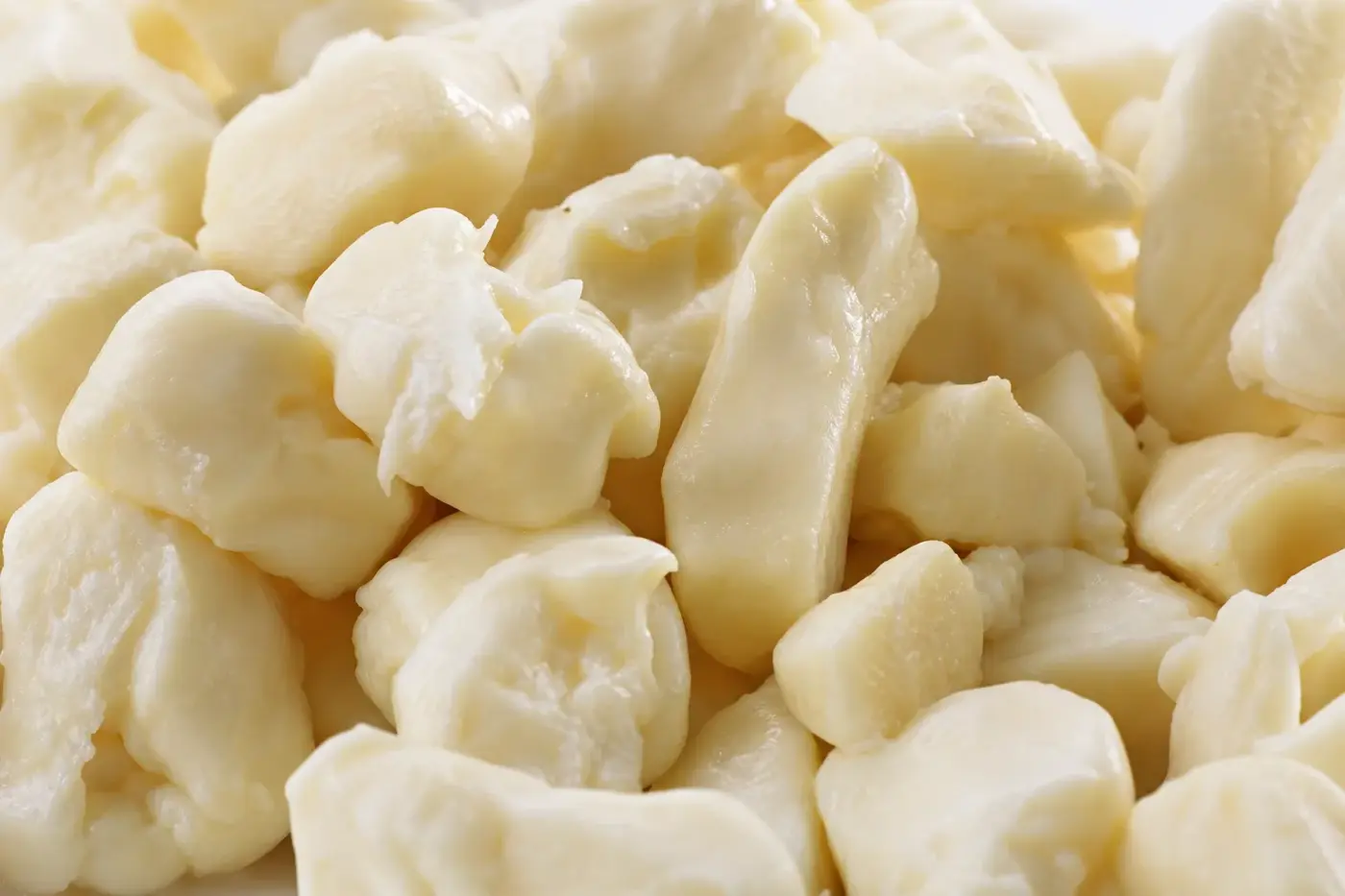
Bite into a fresh Wisconsin cheese curd and listen. First comes springy resistance, then a clean, milky, salty flavour, then a high-pitched squeak against your teeth. Your snack has something to say. Wisconsin dairy researchers describe cheese that pushes back rather than crunches: friction may make its elastic protein network briefly resist movement, then yield with audible vibrations.[1,2]
Meet the bite that answers back
With fresh curds, you get firmness, rebound and sound in the same mouthful. Wisconsin dairy researchers call the texture springy and rubbery. The squeak arrives as cheese moves against your teeth during chewing, not as a dry crunch.[1]
Firmness alone cannot explain the noise, though. A curd can resist your bite without a peep, because squeaking happens during movement; it is not another word for hardness. That is why researchers study sound alongside mechanical properties: a compression measurement captures only part of what happens during a chew.[1,6]
The little pause that makes the noise
The leading explanation begins where cheese meets tooth. Friction is resistance between moving surfaces. In the proposed stick-slip mechanism, contact briefly holds while the cheese deforms, then releases as sliding resumes. Repeated releases can trigger vibrations: the protein network supplies resistance and elasticity, while your tooth provides the frictional contact.[1,2]
In 2024, an acoustic study put 100 pieces of Finnish leipäjuusto, or bread cheese, and 100 Gouda controls between a bamboo board and a wetted blade. Every bread-cheese sample squeaked; none of the controls did. Sound followed movement after a short delay, consistent with resistance building before release.[2]
Moving forwards and backwards produced similar sound spectra, making destructive changes inside the cheese a less plausible explanation. That supports a frictional mechanism, but the experiment modelled shearing in a laboratory, not teeth in your mouth. Exactly how different cheeses generate and transmit their squeaks remains an active research question.[2]
Inside a curd with plenty of spring
Picture a fresh curd as a connected structure containing fat and moisture. Its main structural protein, casein, forms a network, while calcium associated with that network helps maintain connections between proteins. When intact and well connected, the structure can resist deformation and recover. Those are the mechanical conditions associated with squeaking.[3,4]
You need not imagine separate protein strings rubbing like violin strings. The important question is whether the connected structure stores energy as it bends or yields more readily under pressure. Wisconsin researchers describe the squeak through resistance, rebound and vibration: how that network responds to movement is central to the sound.[3,4]
How acidity and water shape your bite
Calcium's position in the curd matters, not simply the amount you read in the nutrition information. As curd acidifies, some calcium phosphate associated with casein becomes soluble. Changes in mineral connections and protein interactions alter how the curd deforms. Acidity is often expressed as pH, with lower values meaning greater acidity.[3,5]
A 2025 experiment explored this in cow's-milk halloumi-type cheese, varying acid development and examining composition, microscopy and mechanical behaviour. Calcium content fell as pH fell, while texture and melting changed differently across the acidity range. At sufficiently low pH, stronger protein interactions emerged again. So “more acid means softer cheese” does not quite cover it.[5]
Water plays its part, too. In that experiment, moisture helped explain differences in hardness, while draining and pressing change the balance of water and solids. Their influence on squeak comes through the structure they produce. Neither wetter nor drier curds are necessarily louder.[5,8]
Catch cheddar before it becomes a block
Fresh cheddar curds let you meet cheddar's protein structure early in its life, before pressing into a block and extended maturation. These snack curds are not arbitrary fragments cut from mature cheese. Wisconsin research associates the separate pieces with the cheddaring and milling stages.[1,6]
The process begins with milk set into a gel by rennet, the milk-clotting enzyme preparation, while starter bacteria develop acidity. The gel is cut, the curd worked, and whey, the liquid separated from the curd, drained. During cheddaring, the curd forms slabs that are stacked and turned. These are then milled into smaller pieces and salted to produce the separate snack curds.[3]
You can follow the wider process in how cheese is made. The Cheddar guide takes the story beyond the loose-curd stage.
Halloumi and paneer find their own way
Halloumi's curd goes through a hot whey-cooking stage, producing a structure associated with a firm bite and resistance to melting. It earns its place in this noisy company: the acoustic literature includes halloumi among cheeses that sometimes squeak. The 2025 halloumi-type study also shows how strongly acidity can change this kind of network's behaviour.[2,5]
Paneer reaches firmness by another route. Heat comes first, followed by acid coagulation, in which acid gathers milk proteins into curd; draining and pressing follow. The Canadian Dairy Commission describes the finished texture as firm and smooth despite substantial moisture. Heat-altered whey proteins are incorporated alongside casein.[7]
That texture makes a squeaky bite plausible, although applying the friction explanation to paneer remains an inference. A controlled paneer study compared citric acid, lemon juice and amla juice, measuring mechanical properties and examining microscopy rather than recording sound. Differences in hardness, resilience and network arrangement help explain why you should not expect every paneer, or every halloumi, to squeak identically.[5,8]
Why time turns down the volume
A curd can look much the same while the structure behind its squeak changes. During ripening, enzymes break down proteins in a process called proteolysis. Wisconsin's technical account links lost squeak to the breakdown of intact casein and changes in pH. Lose important connections, and the network responds differently to your bite.[4]
Research reported at the American Dairy Science Association's 2025 meeting connected those changes with measured sound. The team compared unbaked and differently baked Juustoleipä-style curds made with two rennets. Over 60 days, they assessed squeaking acoustically and through sensory assessment, alongside protein breakdown and elasticity. More strongly baked curds retained elasticity and squeak longer, with less proteolysis.[6]
These experimental bread-cheese-style curds strengthen the link between squeak and an elastic, relatively intact protein network. They do not give you a timetable for every bag of cheddar curds. Age matters through the structural changes it brings, not through a fixed countdown.[6]
Can a little warmth bring the squeak back?
In Wisconsin trials, warming restored the squeak in some refrigerated curds. Curds with more extensive protein breakdown, however, stayed quiet. Temperature can change an existing network's behaviour, but it cannot rebuild protein chains broken during ripening. A reversible texture change is different from structural damage over time.[3,4]
Do not let sound guide your storage decisions. For England, Wales and Northern Ireland, consult the Food Standards Agency's chilling guidance; in the United States, consult FoodSafety.gov's food safety guidance. These are the page's November 2026 references: follow the storage, use by and after opening instructions on your pack, because a squeak cannot establish whether harmful bacteria are present.[9,10]
Take a bite and lend an ear
Choose curds labelled for eating as sold, and keep the pack's instructions beside you. This tasting exercise draws on the research description of squeak. Your task is to separate what you feel from what you hear.[1,9]
- Take out only the small portion you plan to eat. Leave the rest refrigerated according to the label.[9]
- Bite slowly through a piece. Does it resist and spring back, or give way with little rebound?
- Listen during the sliding part of the chew. Record sound separately from firmness: “firm and silent” is as useful an observation as “springy and squeaky”.
- Note the product, its date information and whether you tasted it directly from refrigeration. Knowing what changed makes comparisons clearer.
For a comparison in the United States, consult the advice on time outside refrigeration in FoodSafety.gov's food safety guidance, the November 2026 reference for this exercise. Elsewhere, consult your relevant local agency and the pack instructions. For wider handling questions, see storing cheese at home.[10]
A noisy bite is no promise of a melt
Your teeth and your cooking heat ask different things of cheese. Squeaking concerns friction and vibration during a bite; melting concerns how the structure changes and flows under heat. The same protein network influences both, but one behaviour cannot stand in for the other.[5]
The halloumi-type experiment makes that distinction particularly clear. Acidification first increased melt flow, then reduced it again as protein interactions changed. A noisy bite, in other words, is no melting forecast.[5]
For a closer look, start with cheese styles and texture, then explore mozzarella for another way a protein network shapes eating and cooking behaviour. A quiet curd and a melting cheese leave you with different questions: what happened during the bite, and what happens when you apply heat?
General information only, not medical advice: follow the official guidance where you live.
Questions people ask
Why does cheese squeak against your teeth?
The leading explanation is friction between the cheese and your teeth. The elastic protein network briefly resists movement, then releases, producing vibrations.
Which cheeses can squeak?
Fresh cheddar curds and Finnish bread cheese are known for squeaking, and halloumi sometimes squeaks too. Paneer's texture makes a squeaky bite plausible, but applying the friction explanation to it remains an inference.
Why do cheese curds stop squeaking as they age?
During ripening, enzymes break down proteins and change the network that gives curds their spring. Warming restored the squeak in some refrigerated curds in Wisconsin trials, but not in curds with more extensive protein breakdown.
How are fresh cheddar curds made?
Milk is set into a gel, cut and worked, then the liquid whey is drained. The curd forms slabs that are stacked and turned before being milled into smaller pieces and salted.
Does squeaky cheese always resist melting?
No. Squeaking concerns friction and vibration during a bite, while melting concerns how cheese changes and flows under heat.
Sources
- University of Wisconsin-Madison and Wisconsin Center for Dairy Research. Squeakiness of fresh cheese curds: Analysis methods and shelf-life extension research. Research presentation, undated retrieved edition. Slides on curd characteristics, the proposed mechanism and acoustic measurement. Presentation PDF.
- Current Directions in Biomedical Engineering. Fantastic squeaks and where to find them: producing and analysing audible acoustics from leipäjuusto. Volume 10, issue 4, pages 465 to 468, 2024. DOI: 10.1515/cdbme-2024-2114. Published paper in the Aalto University repository.
- Wisconsin Center for Dairy Research. Cheese Curds: A Wisconsin Icon. Dairy Pipeline, volume 28, number 3, pages 4 to 5, 2016. Research and technical account covering manufacture, calcium, proteolysis and temperature. Issue PDF.
- Wisconsin Center for Dairy Research. Curd Clinic, question on preserving cheese-curd squeak. Dairy Pipeline, volume 11, number 2, spring 1999. Technical account of intact casein, pH and squeak retention. Issue PDF.
- Food Chemistry: X. The effect of pH on the microstructure, rheological and functional properties of halloumi-type cheese: pH-structure-function relationships. Volume 32, article 103341, 2025. DOI: 10.1016/j.fochx.2025.103341. Full research paper.
- American Dairy Science Association. Impact of baking temperatures and low-proteolytic rennets on extending the squeakiness shelf-life of Juustoleipä-style cheese curds. Abstract 1227, Journal of Dairy Science, volume 108, supplement 1, page 52, 2025. Conference research abstract. Abstract book.
- Canadian Dairy Commission. Paneer. Undated technical reference, retrieved November 2026. Sections on manufacture, incorporated whey proteins and texture. Technical reference.
- Journal of Food Science and Technology. Composition, texture and microstructure appraisal of paneer coagulated with sour fruit juices. Volume 56, issue 1, pages 253 to 261, 2019; first published online November 2018. DOI: 10.1007/s13197-018-3484-4. Full research paper.
- Food Standards Agency, GOV.UK. How to chill, freeze and defrost food safely. Published 2017, current retrieved guidance checked November 2026. Applies to England, Northern Ireland and Wales. Official guidance.
- FoodSafety.gov, United States. 4 Steps to Food Safety. Reviewed 18 September 2023, current retrieved guidance checked November 2026. Section “Chill: Refrigerate and Freeze Food Properly”. Official guidance.
Researched through published acoustic experiments, university dairy research, controlled cheese-texture studies and official food-storage guidance.
Last checked: November 2026
Last checked November 2026.
The editors suggest you read next
Where Cheese Flavour Comes From: The Chemistry Explained
Your knife slips through a bloomy-rind cheese.