Winnimere
Slip your spoon into Winnimere and the spruce band suddenly makes sense.
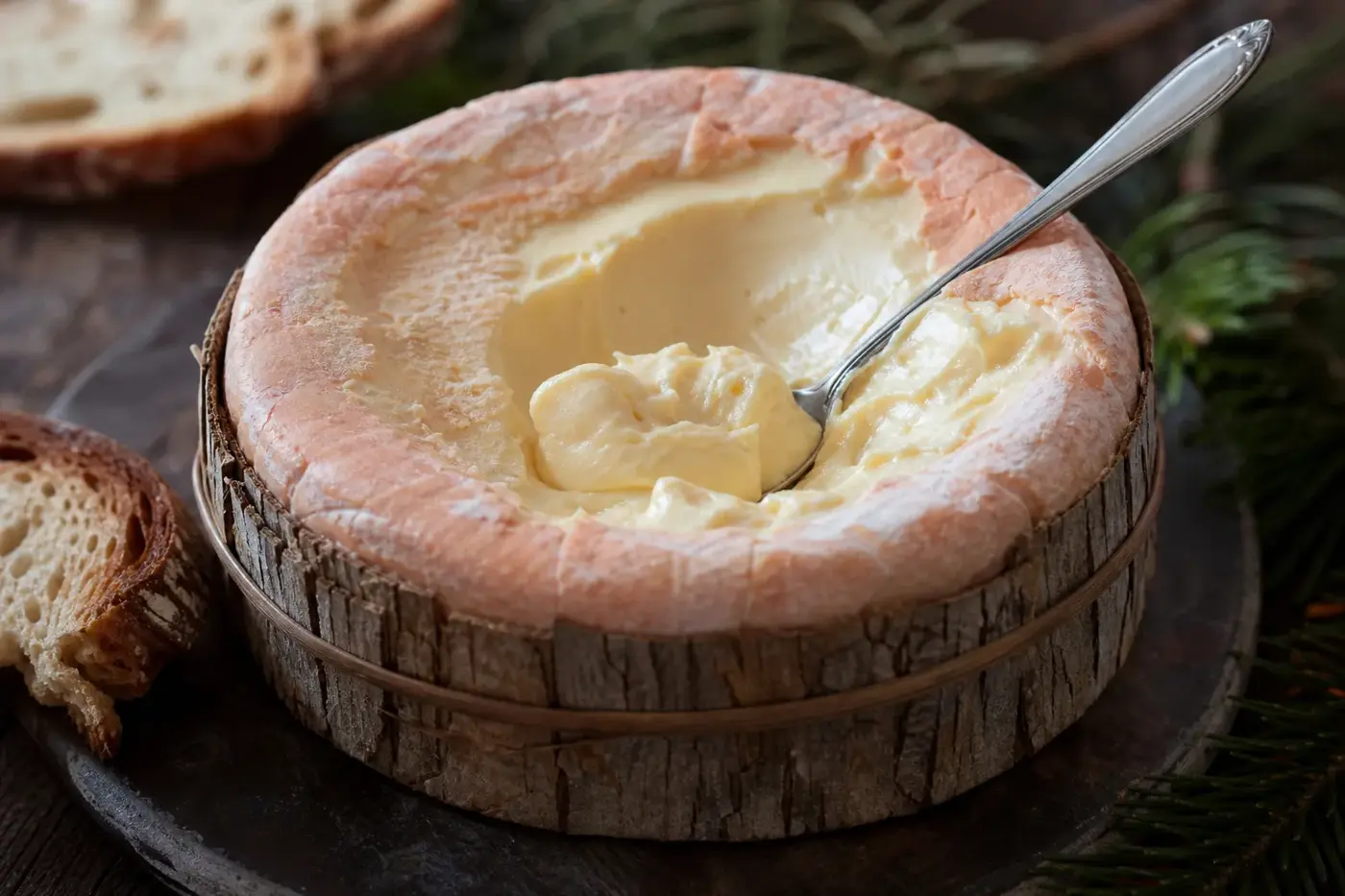
Slip your spoon into Winnimere and the spruce band suddenly makes sense. Inside, the cheese has softened to spoonable custard, with no ambition to become a tidy wedge. This winter round from Jasper Hill Farm in Vermont brings together raw cow’s milk, a washed rind and Jura mountain inspiration, with flavour notes of sweet cream, bacon and spruce.[1]
| At a glance | The details |
|---|---|
| Name to ask for | Winnimere.[1] |
| Made by, and where | Jasper Hill Farm, Greensboro, Vermont, United States.[3] |
| Milk | Raw cow’s milk from Jasper Hill’s Andersonville herd in Glover, Vermont.[1][3] |
| Cheese style | Soft cheese with a washed rind and a spruce band.[1] |
| What goes in | Raw cow’s milk, salt, rennet and cultures.[2] |
| Wheel size | Small round, approximately 369 g (13 oz).[2] |
| Time to mature | 60 days; the producer’s information sheet gives ripeness at 9 to 12 weeks.[1][2] |
| Applicable US ageing provision | Not specified here. |
| Making season | Winter.[1] |
| Protection status | Status unspecified here for the EU, Great Britain, Northern Ireland, Switzerland and United States, including possible mark rights. |
From a lakeside shack to the Jura
Before you reach the mountains, stop at an ice-fishing shack. Winnimere takes its name from a corner of nearby Caspian Lake where the founding family’s grandfather kept one. For the cheese itself, Jasper Hill looks further afield, naming Vacherin Mont d’Or and Försterkäse in the Jura’s tradition of bark-bound cheeses.[1][2]
That combination of European technique and local roots runs through the farm’s story. Its founders bought the Greensboro property in 1998, restored a long-unused dairy barn and built a creamery beside it. Several years of work on buildings, pasture and cheesemaking skills followed before the first cheeses reached the market in 2003.[4]
The aim was to turn milk into cheese locally, rather than send the raw material away. Maturation was part of that ambition from the beginning. Natural rinds needed somewhere to develop, so the young business made room beneath its creamery.[4]
You can find those priorities gathered into Winnimere’s small round. Milk, bark and patient cellar care all shape what reaches your spoon. The woodland wrapping belongs to the cheese’s character, not merely its presentation.[1][2][5]
Winter milk meets the cellar team
Winnimere begins with milk from Jasper Hill’s Andersonville herd. The producer places the farm in Glover, Vermont, where milk production is managed specifically for cheesemaking. Its raw-milk cheeses are made at the original Greensboro creamery, close to the maturation cellars.[3]
Winter has a particular role here. Jasper Hill makes Winnimere when its Ayrshire cows give rich milk from a hay-based diet.[2] That tells you about this herd and this seasonal cheese, rather than establishing a rule for winter milk everywhere.
Once the vat work finishes, another craft begins. Jasper Hill distinguishes creamery production from affinage, the skilled care of maturing cheese. Inside climate-controlled vaults, the cellar team wraps, washes, turns and monitors the cheeses, changing their treatment as they develop.[5]
If you would like to untangle the different milk treatments, head to raw, thermised and pasteurised milk. It gives you the background to that raw-milk starting point.
From the milk vat to your spoon
Milk, salt, rennet and cultures: Winnimere’s declared ingredients make a short list.[2] What follows takes two stages, first forming a shaped cheese, then developing its rind and softening its interior. Maturation finishes the work begun in the vat.
Rennet clots the milk. In the general process described by the US standard for soft-ripened cheeses, bacteria act on the milk and a suitable clotting enzyme sets it into a semisolid mass. That setting is coagulation; the milk solids are curd, while the liquid separated from them is whey.[6]
Next come draining, collecting and shaping the curd. The standard describes curing conditions that encourage biological ripening agents on the surface, with ripening working towards the centre.[6] Those are the category’s broad principles; Jasper Hill supplies Winnimere’s particular story of bark wrapping and washing.[1][2]
Young rounds receive flexible strips from the spruce tree’s inner bark layer, which Jasper Hill calls cambium. The bark comes from the farm’s woodlands. As the cheese matures, washes of cultured salt brine encourage an even rind.[2]
The interior softens while the band stays in place. Supporting that increasingly yielding cheese takes attentive cellar care. Jasper Hill describes affinage as active, physical work, with different cheeses needing different treatments and environments.[5]
For a closer look at the first transformation in the vat, explore rennet and coagulation. It explains the step that gives the cheesemakers curd to work with.
Meet the rind and its woodland wrapping
The brine tends the rind; the spruce holds the cheese together. That bark also contributes to the woodland character in Jasper Hill’s tasting description. Each plays its own part in Winnimere’s development.[1][2]
A washed rind is a cultivated surface, not simply a cheese given a rinse. Jasper Hill links the pink-orange pigmentation of washed-rind cheeses to microbes encouraged during maturation. Separate vaults offer conditions suited to different rind communities, giving each cheese type its own environment.[5]
That helps you read Winnimere’s rustic exterior. Instead of a bloomy rind’s uniformly white surface, you find colour developed through maturation. Around it, the brown spruce band gives the round its recognisable outline.[1][5]
The woodland connection is quite literal: the wrapping comes from trees. Keep that in mind when you consider the producer’s spruce descriptor, alongside the savoury character built through cheesemaking and ripening.[2]
Find cream, bacon, custard and spruce
Sweet cream, bacon, custard and spruce: Jasper Hill’s four-part profile gives you rather more to explore than “strong” or “rich”.[1] It suggests sweetness, savouriness and woodland character sharing the same spoonful.
Follow three threads as you taste. Cream and custard suggest milky sweetness, bacon brings a savoury association, and spruce supplies the woodland note. These are Jasper Hill’s published descriptions, rather than a fromage.co.uk tasting record.[1]
Bacon, incidentally, has not sneaked onto the ingredients list. That remains milk, salt, rennet and cultures.[2] As with cheeses that suggest mushrooms, fruit or nuts, the association describes what a flavour recalls.
Give the texture just as much attention. Jasper Hill presents the mature interior, often called the paste, as spoonable, with a custard-like consistency shown in its serving photographs.[1] Think about how it scoops and spreads, as well as what you taste.
Let the individual wheel guide you
Start with the cheese in front of you. Jasper Hill’s current product page gives maturation as 60 days, while its information sheet describes ripeness at 9 to 12 weeks.[1][2] Ask your cheesemonger about that particular wheel and follow its package directions: age alone cannot promise the same texture every time.
Ripening and serving temperature have different jobs. Time develops the cheese. Letting a portion lose some refrigerator chill gives you a practical way to explore its softer consistency.
Begin with a small spoonful and watch what happens. Does it hold its shape or settle back into the opening? Taste before adding bread, so you can separate the cheese’s flavour and texture from its accompaniments.
Keep any warming brief. US FDA guidance limits unrefrigerated time for perishable foods to two hours, or one hour when the air temperature exceeds approximately 32 °C (90 °F), as of November 2026.[8]
Keep it chilled, serve it simply
Refrigerate Winnimere until you need it. For US readers, FDA guidance specifies a refrigerator temperature of 4 °C (40 °F) or below. Follow the product’s storage directions too.[8]
Jasper Hill recommends retaining the original wrapper, or using fresh waxed or parchment paper inside a resealable container. It discourages freezing because this changes texture and flavour.[7] Once opened, spreadable cheeses also become harder to store as they lose their shape.
At the table, give that soft interior somewhere to stay. Jasper Hill’s serving approach lets you open the top without dismantling the whole round.[1]
- Set the wheel on a plate that can contain the softened cheese.
- Leave the spruce band in place.
- Peel back part of the upper rind.
- Lift out portions with a clean spoon. Keep bread alongside rather than pressing it repeatedly into the wheel.[1]
Promptly refrigerate any cheese you are keeping. US CDC guidance says to refrigerate perishable food within two hours, or within one hour above approximately 32 °C (90 °F).[9] Count preparation and table time together, not as separate allowances.
For more help with wrapping and making space in your fridge, see storing cheese at home. Keep the product’s own directions to hand too.
Choose good company for your spoonful
Plain bread gives the soft paste somewhere to go without hiding its flavours. Try a baguette or lightly toasted sourdough, with soft crumb as well as crust. This is a serving recommendation, rather than a producer pairing.
Jasper Hill suggests a smoky, meaty red wine or porter-style beer.[2] Both follow the savoury side of its tasting profile. If you are an adult of legal drinking age and choose alcohol, have a small serving alongside water.
People who are pregnant, driving, taking medicines that interact with alcohol, or recovering from alcohol dependence should not drink. Consult the relevant national guidance.
For an alcohol-free accompaniment, begin with sparkling water. Its neutrality keeps your attention on the cheese through successive mouthfuls. If you would prefer something warm, unsweetened black tea is another suggested option, with a drying finish that contrasts with the soft paste.
Start with the cheese and one accompaniment. Add another only if you want it; your spoonful does not need an entourage. The wider cheese and wine pairing guide explores how to build a pairing while keeping the cheese, rather than the drink, centre stage.
Winnimere or Harbison? Get beneath the spruce
Harbison is the natural comparison when you spot the spruce wrapping and spoonable mature texture. Jasper Hill makes both cheeses, but their milk treatments and rind methods differ.[10] The family resemblance is only the beginning.
| Producer-declared details, November 2026 | Winnimere | Harbison |
|---|---|---|
| Milk treatment | Raw cow’s milk.[1] | Pasteurised cow’s milk.[10] |
| Rind style | Washed rind.[1] | Bloomy rind.[10] |
| Usual wheel size | Approximately 369 g (13 oz).[2] | Approximately 255 g (9 oz).[10] |
| Time to mature | 60 days.[1] | 6 to 13 weeks.[10] |
Jasper Hill’s notes for Harbison include sweet cream, button mushroom, woodland, raspberry and mustard.[10] Set those beside Winnimere’s bacon-and-custard profile and you have a different flavour experience beneath that shared spruce band.
Choose Winnimere for the producer’s savoury winter washed-rind character, or Harbison for its bloomy-rind interpretation. The wrapping shows you the resemblance; the milk, rind and tasting descriptions reveal the differences. Whichever you choose, ask about your individual wheel’s ripeness before deciding how to portion it.[1][10]
General information only, not medical advice: follow the official guidance where you live.
Questions people ask
What milk is Winnimere made from?
Winnimere is made from raw cow’s milk from Jasper Hill’s Andersonville herd in Glover, Vermont. It is produced in winter, when the farm’s Ayrshire cows give rich milk from a hay based diet.
How long is Winnimere matured?
Jasper Hill’s product page gives a maturation time of 60 days. Its information sheet describes Winnimere as ripe at 9 to 12 weeks.
How do you serve Winnimere?
Keep the spruce band in place, peel back part of the upper rind and lift out the soft interior with a clean spoon. Plain bread, such as a baguette or lightly toasted sourdough, can be served alongside.
What is the difference between Winnimere and Harbison?
Both are made by Jasper Hill and wrapped in spruce. Winnimere is made with raw cow’s milk and has a washed rind, while Harbison is made with pasteurised cow’s milk and has a bloomy rind.
How should Winnimere be stored?
Jasper Hill recommends keeping it in its original wrapper, or in fresh waxed or parchment paper inside a resealable container. The producer discourages freezing because it changes the cheese’s texture and flavour.
Sources
- Jasper Hill Farm. Winnimere. Undated producer product page, retrieved November 2026.
- Jasper Hill Farm. Winnimere info sheet. 2024 edition, retrieved November 2026.
- Jasper Hill Farm. The creameries. Undated producer account, retrieved November 2026.
- Jasper Hill Farm. About. Undated producer history, retrieved November 2026.
- Jasper Hill Farm. The Cellars. Undated producer account of maturation, retrieved November 2026.
- US Food and Drug Administration, published through the Electronic Code of Federal Regulations. 21 CFR 133.182: Soft ripened cheeses. Text displayed as current through 5 November 2026.
- Jasper Hill Farm. Shipping & Cheese FAQ. Storage and opened-cheese guidance, undated, retrieved November 2026.
- US Food and Drug Administration. Are You Storing Food Safely? Current consumer guidance retrieved November 2026.
- US Centers for Disease Control and Prevention. Preventing Food Poisoning. 24 November 2025 edition, retrieved November 2026.
- Jasper Hill Farm. Harbison. Undated producer product page, retrieved November 2026.
- US Food and Drug Administration. Recalls, Market Withdrawals, & Safety Alerts and Investigations of Foodborne Illness Outbreaks. Live resources consulted November 2026 for editorial checks.
This desk-researched article combines the producer’s product and production records with US federal legislation and official US handling guidance; flavour descriptions are attributed to Jasper Hill.
Last checked: November 2026
Last checked November 2026.
The editors suggest you read next
American Cheese: The Processed Slice Explained
Watch a slice of American cheese soften over your burger.