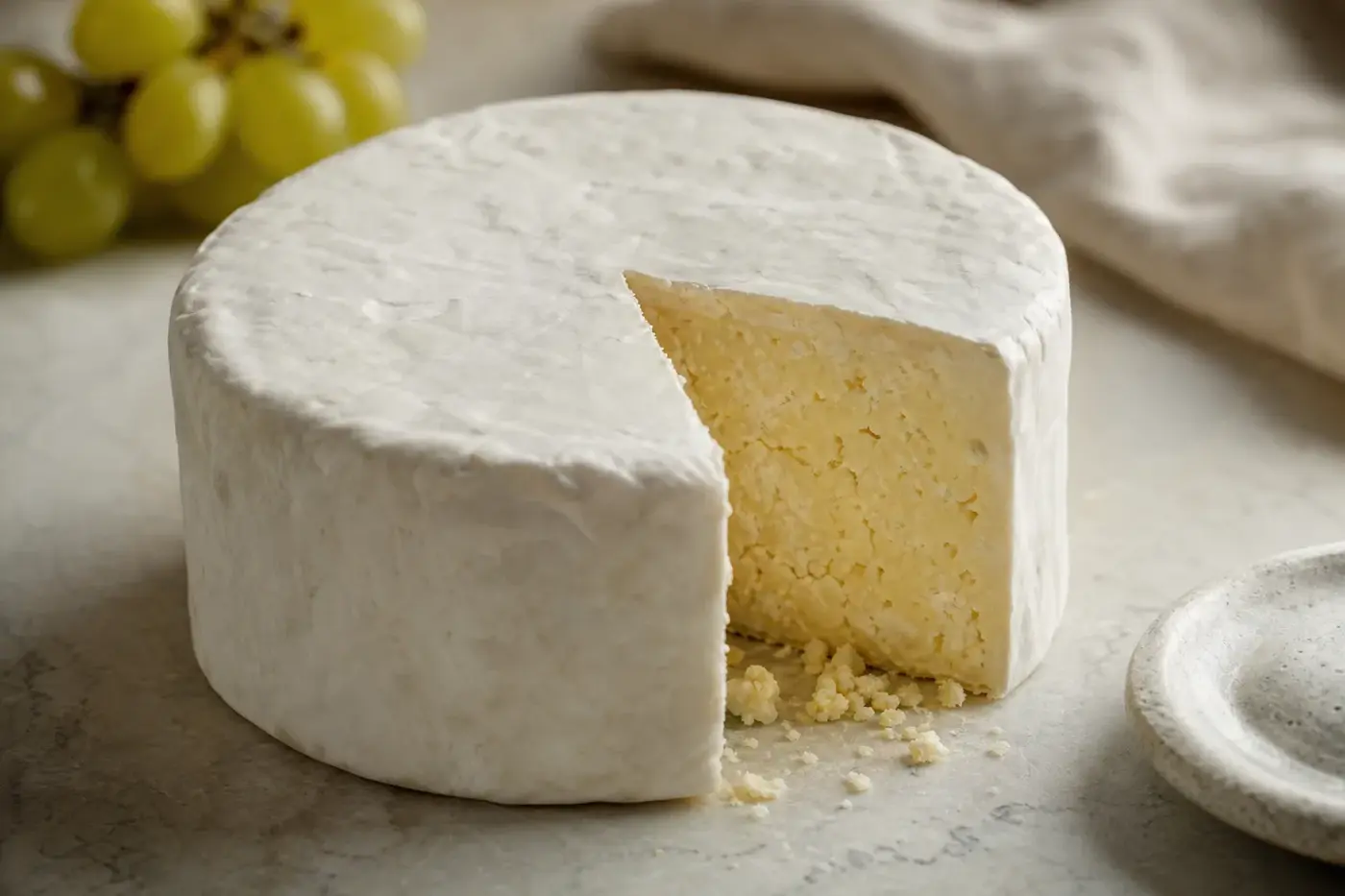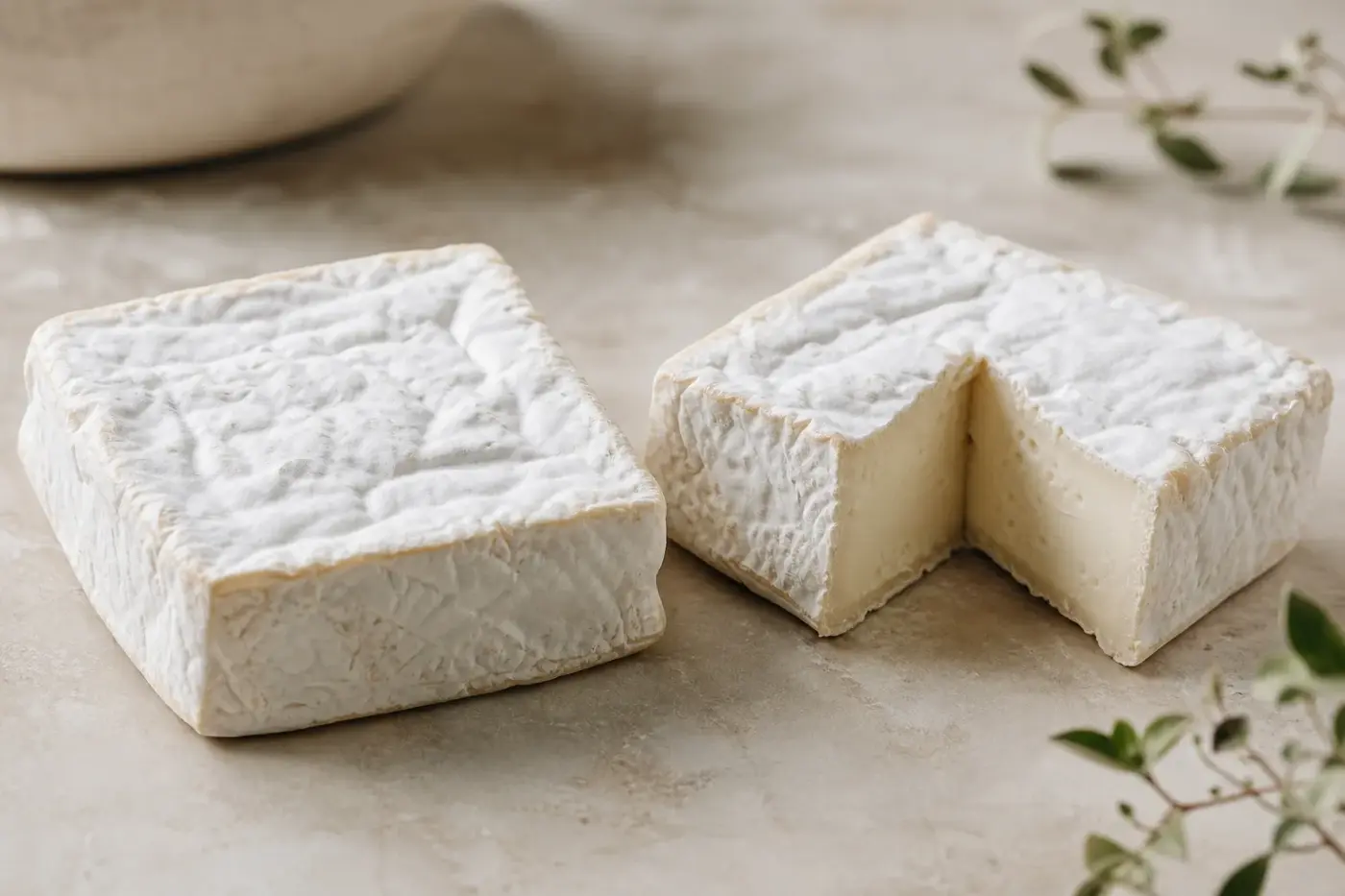
Peel back the parchment and lift away the red wax seal. Inside sits a white square with an ivory heart, looking rather pleased with its entrance. Bath Soft Cheese comes from Park Farm in Kelston, near Bath in Somerset. This cow’s milk cheese softens beneath its rind as it ripens, so your first decision is how yielding you like it; after that, keep it chilled until shortly before serving. [1, 2]
| What you might want to know | The detail |
|---|---|
| Name to look for | Bath Soft Cheese. [1] |
| The people and place behind it | Bath Soft Cheese, Park Farm, Kelston, near Bath, Somerset, England. [1, 4] |
| The milk | Pasteurised cow’s milk from the producer’s own cows. [1, 3] |
| Organic certification | Status uncertain. |
| The rennet | Animal rennet; the producer identifies Bath Soft Cheese as unsuitable for vegetarians. [3, 5] |
| Shape, rind and size | Square, white bloomy rind, ivory interior; approximately 250 g. [1] |
| Usual age when it leaves the maker | Around four weeks, according to the producer. [2] |
| Registered name, authority and register ID | Details uncertain. |
| Great Britain GI registration status | Status uncertain. |
| Allergen to know about | Milk, described as “Dairy” on the producer’s product page. [1] |
Follow the mushroom notes to a little lemon
Slice through the white surface mould and you reach the pale, ivory-coloured paste, the cheese’s interior. Its square outline, parchment and red wax seal make a distinctive package. The seal belongs to the wrapping, though, so unwrap the cheese before cutting. [1]
The maker describes mushroom flavours with a lemon-like lift. Its fuller tasting account follows the cheese from fresh, lactic tang towards earthier aromas as it ripens, including cabbage and occasional wild garlic. These are the producer’s tasting notes, rather than a fromage.co.uk tasting, and offer you a guide to what different ages might bring. [1, 2]
Give your first small piece your full attention, without accompaniments. Follow it with another on bread, then taste rind and paste separately and together. You will soon find what draws you back, before fruit or chutney has its say.
Find four generations at a farm near Bath
Park Farm’s family farming story begins in August 1914. According to the producer, today’s cheesemaking sits within four generations of the same family, with a revival in the 1990s and a purpose-built creamery opening in 2015. Kelston gives you a more precise home for this cheese than the city name alone. [4]
The route from herd to dairy is direct. The farm says its cheesemakers use milk from its own cows, supplied after the morning milking. Here, “local” means a particular herd and a particular journey to the cheesemakers, rather than a broad promise on the wrapper. [3]
At the counter, look for the maker as well as the cheese’s name. If your cheesemonger cuts or rewraps it, ask to keep the original label. You will have its identity, storage instructions and dates together, especially useful when your cheeseboard takes several shopping trips to assemble.
Discover the old recipe with salt on a feather
Full-cream milk, white mould and salt applied with a feather: the old grocer’s recipe book behind Bath Soft’s revival has details worth lingering over. The maker dates the modern relaunch to around 1993. It describes the cheese you buy today as an interpretation of that rediscovered recipe. [4]
There is an older glimpse of Bath cheese, too. The producer’s historical account reproduces a transcription dated 16 July 1801, describing cheeses made in Bath being sent as a gift after earlier recipients enjoyed their flavour. The original manuscript and its archival reference remain uncertain. [4]
Keep those two strands separate as you follow the story. One is an early nineteenth-century Bath cheesemaking association reported by the maker; the other is the late twentieth-century revival at Park Farm. The company connects that older tradition with today’s named cheese through the rediscovered recipe and its interpretation. [4]
It is a history worth bringing to the cheeseboard. At the counter, though, give ripeness more attention than antiquity. Choose the texture you want to eat, whether that means a centre that holds its shape or a cheese turning soft throughout.
Watch morning milk become a white-coated square
The producer begins by pasteurising its milk at 63 °C for 30 minutes. Starter bacteria develop acidity, then rennet, an enzyme preparation, sets the milk into curd. Cutting and draining releases whey, the liquid separated during cheesemaking. [3]
The maker explains that Bath Soft’s curd is cut into larger pieces than Bath Blue’s. Moulds give those curds their square shape. After moulding, salt is rubbed onto the surface. [3]
Maturation brings the white coat. The maker identifies Penicillium camemberti as the mould associated with the rind, with regular turning helping its development. [3]
These stages take you from milk to ripened cheese; they are not instructions for making it at home. If curd, whey and maturation still feel unfamiliar, how cheese is made explains how the pieces fit together.
Give that white rind a taste
The white rind is intended to be eaten, so try it before cutting it away. The producer describes savoury flavours and a slight bitterness. Take rind and paste in the same mouthful, then decide whether you want to leave any behind. [2]
Under that rind, age makes a considerable difference to texture. The maker describes Bath Soft becoming softer and more aromatic, eventually reaching a spoonable consistency. Ask whether yours has a firmer centre, a soft layer beneath the rind or a yielding paste all the way through. [2]
That tells you more than asking for the “best” age. A centre that holds its shape gives you neat portions; a softer cheese calls for bread and a spoon, and perhaps less ambition about neatness. Tell your cheesemonger how you plan to serve it, and let that guide your choice.
Tell your cheesemonger when supper starts
Begin with the day you want to eat it. Tonight’s supper, a gathering later in the week and a gift for someone else’s chosen occasion call for different conversations. Give your cheesemonger the timing, then describe the texture you enjoy.
A few useful questions will get you started:
- Is this cheese ready to serve now?
- Does it have a firmer centre or a soft paste throughout?
- How should it change before the day I want to serve it?
- What storage and opening instructions come with it?
If there is a cut example, ask to see its centre and the layer beneath the rind. Those visible differences give you something useful to discuss. Repeatedly pressing an uncut cheese tells you less.
Before you leave, read the wrapper’s date and instructions. The maker says its cheeses carry a use-by date. UK government guidance distinguishes use-by dates, which concern safety, from best-before dates, which concern quality; correct storage matters even before the use-by date arrives. [5, 7]
An unfamiliar term need not interrupt your shopping. Turn to how to read a cheese label for help making sense of the wrapper.
Keep it cool, with its label close by
Keep Bath Soft refrigerated and follow the packaging instructions. The FSA’s household guidance for England, Northern Ireland and Wales recommends a fridge temperature between 0 and 5 °C and says dairy products should be refrigerated. Read that advice alongside the instructions supplied with your cheese. [6]
Keep the label after opening, too. Retain clean, serviceable wrapping, or ask your cheesemonger what replacement they recommend. A covered container can help separate the wrapped cheese from other foods; the FSA advises covering or sealing food and keeping ready-to-eat foods away from raw meat. [6]
Follow any instruction giving a shorter period after opening. Finish cheese carrying a use-by date within that date and the stated opening instructions. As UK government guidance explains, incorrect storage can make food unsafe before its use-by date. [7]
If you are pregnant, the UK NHS says pasteurised and unpasteurised mould-ripened soft cheeses with a white rind must be thoroughly cooked until steaming hot. November 2026 is the reference point for the advice here. Consult the NHS pregnancy guidance for your circumstances. [8]
Take off the fridge chill, briefly
The producer recommends letting Bath Soft lose its refrigerator chill before serving. Take out only the portion you expect to eat. Keep the rest refrigerated. [2]
Make this preparation brief. For England, Northern Ireland and Wales, the FSA advises keeping chilled food out of the fridge for the shortest possible time during preparation. [6]
Set out a clean board and knife. With a square cheese, cut through the centre, then divide the pieces so everyone gets rind and paste. This is a practical suggestion, not a prescribed cutting method; if your cheese is very soft, offer a serving spoon instead.
Think of storage and serving as parts of the same routine. For a broader guide to fitting them together, see storing cheese at home.
Let bread, fruit and your glass lend a hand
Begin simply, with plain bread or a restrained cracker. Offer fruit separately, giving yourself the freedom to change the next mouthful rather than commit the whole portion. The producer suggests bread, crackers, quince, chutney and honey, alongside wine, beer and cider. [5]
Try sliced apple or pear first, then a little quince paste if you fancy sweetness. Leave assertive chutney to one side rather than spreading it over the cheese before serving. Give yourself room to taste Bath Soft itself, then discover which accompaniment you prefer.
For an alcohol-free glass, try sparkling water or an apple-based drink with a clear, tart character. If you are an adult choosing alcohol, dry cider or a fresh, lightly oaked or unoaked white wine offers a starting point. Look for refreshment and contrast rather than a powerful drink that overwhelms the rind.
Serve alcohol in small amounts, and make the alcohol-free option equally available. People who are pregnant, driving, taking medicines that interact with alcohol, or recovering from alcohol dependence should not drink. For a wider approach to choosing by style, explore the cheese and wine pairing guide.
Find its place beside Brie and Camembert
Bath Soft belongs in the white-rinded, mould-ripened corner of your cheeseboard. Its maker explicitly connects its rind development with Brie and Camembert. If you are getting to know this style, both offer useful points of reference. [3]
The guides to Brie and Camembert explain their identities. On a British board, give Bath Soft the soft-cheese place and choose contrasting textures elsewhere. You need not crowd it with several similar white-rinded cheeses.
Leave space for bread and a clean serving utensil, and keep the wrapper’s identity visible. Your guests should know what they are eating and be able to help themselves comfortably. Then all you have to decide is which piece comes next.
General information only, not medical advice: follow the official guidance where you live.
Questions people ask
What does Bath Soft Cheese taste like?
The producer describes mushroom flavours with a lemon note. As the cheese ripens, it says the fresh, lactic tang gives way to earthier aromas, including cabbage and occasional wild garlic.
Can you eat the rind of Bath Soft Cheese?
Yes, the white rind is intended to be eaten. The producer says it adds savoury flavours and a slight bitterness.
Is Bath Soft Cheese vegetarian?
No. The producer says it contains animal rennet and is unsuitable for vegetarians.
How should Bath Soft Cheese be stored?
Keep it refrigerated and follow the packaging instructions. The FSA recommends a fridge temperature between 0 and 5 °C and says dairy products should be refrigerated.
Can you eat Bath Soft Cheese during pregnancy?
The UK NHS says mould ripened soft cheeses with a white rind must be thoroughly cooked until steaming hot, whether the milk is pasteurised or unpasteurised. Consult the NHS pregnancy guidance at https://www.nhs.uk/pregnancy/keeping-well/foods-to-avoid/ for your circumstances.
Sources
- Bath Soft Cheese, Bath Soft Cheese, product page, undated, retrieved November 2026. Product identity, appearance, weight, pasteurised milk and declared allergen.
- Bath Soft Cheese, Bath Soft Cheese, cheese profile, undated, retrieved November 2026. Maker’s sensory descriptions, rind, ripening, dispatch age and serving recommendation.
- Bath Soft Cheese, The Art of Making Cheese, undated, retrieved November 2026. Milk supply, pasteurisation, starter cultures, rennet, cutting, moulding, salting and rind development.
- Bath Soft Cheese, Our History, undated, retrieved November 2026. Company account of family farming, recipe rediscovery, modern revival and historical correspondence.
- Bath Soft Cheese, FAQ’s, undated, retrieved November 2026. Vegetarian suitability, use-by dates and the producer’s accompaniment suggestions.
- Food Standards Agency, How to chill, freeze and defrost food safely, published 18 December 2017, current retrieved version November 2026. Applies to England, Northern Ireland and Wales.
- UK Government, Understanding food labelling: Best before and use-by dates, current retrieved version November 2026. Date meanings, storage and opening instructions.
- NHS, Foods to avoid in pregnancy, current retrieved version November 2026. Advice concerning white-rinded, mould-ripened soft cheeses.
This desk-researched article brings together the cheesemaker’s product and production accounts, distinguishes its historical narrative from independently verified records, and checks handling advice against official sources.
Last checked: November 2026
Last checked November 2026.
The editors suggest you read next
West Country Farmhouse Cheddar Cheese
Large pieces of curd turn and stack under the cheesemaker’s hands.