Cheeses of the Pyrenees and the Basque Country
From June, sheep flocks move up into the high pastures of the western Pyrenees.
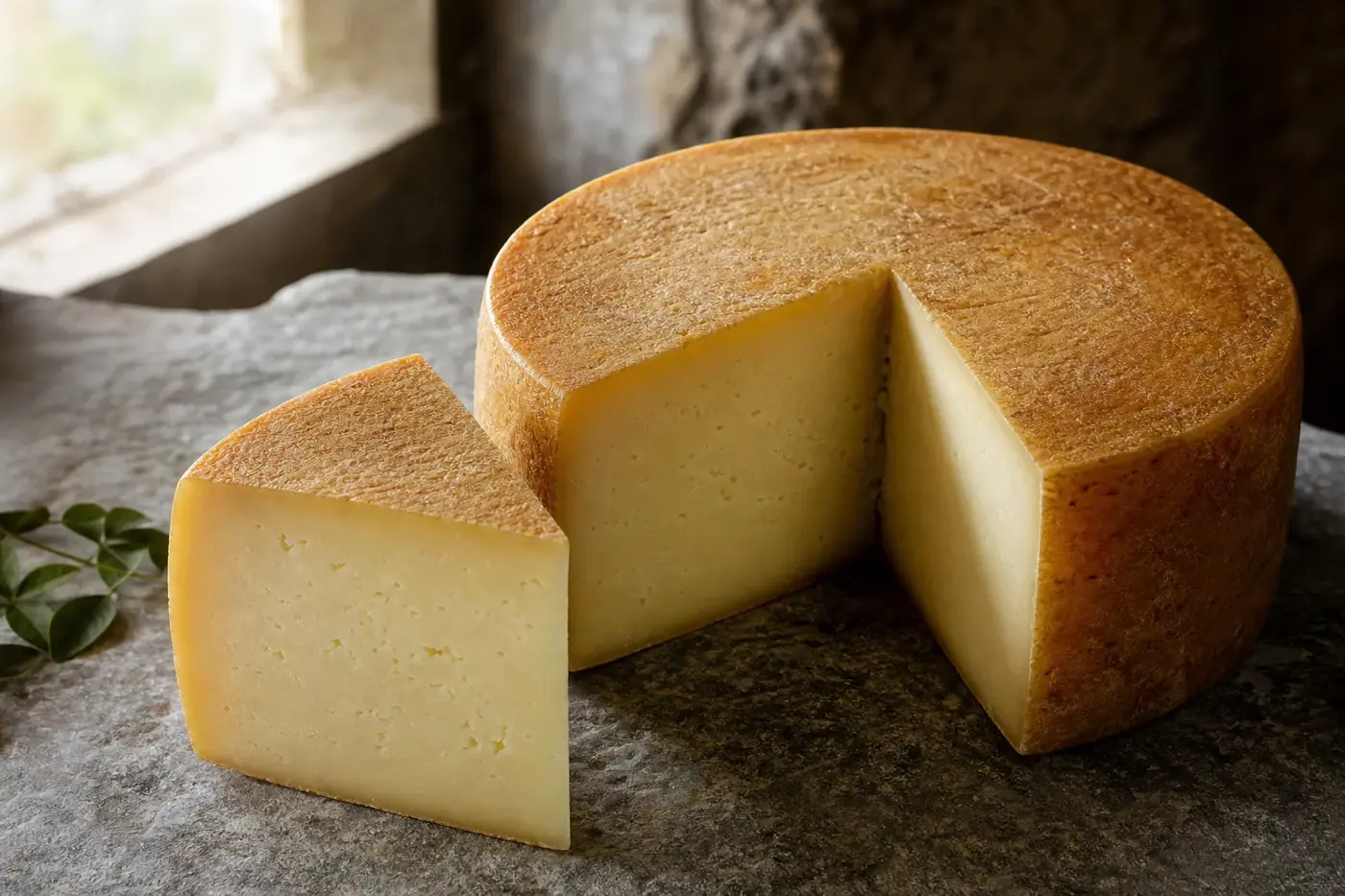
From June, sheep flocks move up into the high pastures of the western Pyrenees. Some ewes still give milk for farmhouse estive cheese; others have finished their milking season.[3] Follow the cheeses across these mountains and the landscape changes: Ossau-Iraty in Béarn and the French Basque Country, varied tommes farther east, then Idiazabal and Roncal across the Spanish border. Milk and place establish their differences; curd handling, rind care and maturation bring them into focus.[1,2,4,7,9]
| Field | Regional outline |
|---|---|
| Geographical focus | French Pyrenees, especially Béarn, the French Basque Country and Ariège.[1,4] |
| Cross-border coverage | Spanish Basque Country and Navarre.[7,9] |
| Milks | Sheep, cow and goat, including specified mixtures.[2,4,7,9] |
| EU register status | Not verified against the EU register |
Follow the valleys, read the names
Ossau-Iraty's territory joins the Basque Country and Béarn on the French side of the western mountains and foothills. Its legally defined area covers specified communes in Pyrénées-Atlantiques and three neighbouring communes in Hautes-Pyrénées. Milk production, cheesemaking and maturing must all happen within those boundaries. Farther east, Ariège forms part of the broader territory described in the Tomme des Pyrénées specification. At the counter, “Pyrenean” can therefore point to very different valleys, milk traditions and production systems.[1,2,4]
Across the border, Idiazabal and Roncal deserve separate attention rather than a single northern Spanish label. Idiazabal's area includes Álava, Biscay, Gipuzkoa and Navarre, but excludes the Roncal valley. Roncal has its own Navarrese tradition and a tightly defined valley area for making and maturing cheese. The name and its boundaries tell you more about origin than a mountain scene on a wrapper.[7,9]
Summer pastures, three kinds of milk
Estive is the summer grazing season in the mountains; transhumance is the seasonal movement of livestock between grazing grounds. The Ossau-Iraty producers' syndicat, an industry body, describes flocks moving upwards from June. Their departure also frees land around the farms for growing winter fodder. Some ewes are milked on the high pastures, supplying farmhouse estive cheese, while others have already finished milking. A flock summering in the mountains and a cheese made there tell two different stories.[3]
Sheep's milk defines Ossau-Iraty and Idiazabal. Tomme des Pyrénées allows a wider range: cow's milk, goat's milk and particular mixtures.[2,4,7] To explore that difference, put a pure sheep's milk cheese beside a cow's milk tomme and a goat's milk example. Then check the milk treatment. Raw, thermised and pasteurised milk are distinct descriptions worth finding on the label.[1,4]
Ossau-Iraty: pale paste, hard rind, local sheep
Beneath Ossau-Iraty's hard rind lies a firm, pale paste. INAO, France's national origin and quality institute, describes rind colours ranging from orange-yellow to grey, subtle floral or fruit associations, and a balance of richness and acidity. These descriptions of its recognised character offer a useful starting point when discussing an individual wheel with a cheesemonger. Ossau-Iraty has EU protected designation of origin status, usually abbreviated to PDO in English and AOP in French.[1]
Three local sheep breeds supply its milk: Basco-Béarnaise, Manech tête noire and Manech tête rousse, identified by the producers' syndicat.[3] Farmhouse Ossau-Iraty is made with raw milk from the producer's own flock. Dairies can collect milk from several flocks and may use heat-treated milk. The same PDO name can therefore encompass different milk supplies and different ways of organising production.[1,2]
From curd grains to a brushed rind
Ossau-Iraty belongs to the uncooked pressed family. Rennet, the enzyme preparation that coagulates milk, turns it into a gel, which is cut into curd grains. The curd is then worked, moulded and pressed before salting, either dry or in brine. During maturation, also called affinage, the wheels are turned and brushed. Their rind develops through that care, rather than beneath a decorative coating.[2]
Size determines the minimum maturation: at least 80 days for cheeses weighing 2 to 3 kg, and 120 days for those weighing 4 to 7 kg. A wheel may be older when sold.[2] INAO also distinguishes farmhouse production in the valleys from production on summer mountain pastures.[1] Ask for the wheel's actual age, milk treatment and production setting. Together, those details make a more revealing comparison than the name alone.
Tomme des Pyrénées: one PGI, a broad range
Tomme des Pyrénées is a shared geographical name with room for markedly different cheeses. It has EU protected geographical indication status, or PGI.[5] The specification describes a semi-hard, uncooked cheese made from raw or heat-treated milk. Cow's and goat's milk may each be used alone; sheep's milk is permitted only in specified mixtures. Milk production, cheesemaking and maturing must all take place within the defined area. Read the label closely to discover which expression you have.[4]
The familiar black or golden finish tells only part of the story. The specification also describes an orange rind accompanied by white, yellow or grey. Black or golden coatings are permitted on heat-treated milk cheeses weighing above 1.5 kg and up to 5.5 kg.[4] The producers' association describes a supple paste that firms as it matures, its flavours developing from fresh whey towards more pronounced matured cheese.[6] Before serving, establish whether the outside is a natural rind or a coating.
Bethmale: look beyond the local name
Bethmale is a local tomme associated with Ariège. To understand a particular cheese, ask for its maker, place of manufacture, milk species and maturation period. Keep those details alongside the name when comparing it with other tommes.
A shared local tradition and the written rules of a registered name provide different kinds of information. Tomme des Pyrénées, for example, has a specification defining its permitted milks, geographical boundaries and production conditions.[4] The guide to protected names explained sets out the difference between a PDO and a PGI. Use it alongside the exact wording on the cheese you intend to buy.
Across the border: Idiazabal and Roncal
Raw milk from Latxa and Carranzana sheep, followed by at least 60 days of maturation: these are requirements of Idiazabal's specification. Its milk production, cheesemaking and maturation areas coincide. That makes a precise comparison with Ossau-Iraty possible. Both connect sheep's milk and cheesemaking to a defined territory, but each has its own boundaries and production rules.[2,7]
Roncal has a different geographical arrangement. The Spanish official bulletin's 2009 published specification places its making and maturing in Uztárroz, Isaba, Urzainqui, Roncal, Garde, Vidángoz and Burgui, while milk production covers a broader Navarrese area. It describes a sheep's milk cheese with a hard paste, small pores rather than eyes, a thick rough rind and a slightly piquant flavour. Minimum maturation is four months from salting. Distinguish the milk's origin from the place where the cheese is made and matured.[9]
For a tasting, record whether each cheese has been smoked separately from its age. Permitted smoking options and their sensory effects still require verification against the current specification and a suitable sensory source before publication. Taste any smoked example last, so its smoke character does not dominate the earlier cheeses. Compare milk, rind and maturity as you go. Tomme des Pyrénées offers a useful maturation reference: its producer association describes the paste becoming firmer and the flavour moving from fresh whey towards more pronounced matured cheese.[6]
Farmhouse, artisan or dairy: ask what each means
In France, fermier is a legal description. Article 9-1 of Décret n° 2007-628 reserves it for cheese made by traditional techniques by a farmer, on their own holding, using only milk from that holding.[10] Ossau-Iraty's specification adds a requirement for raw milk in farmhouse cheese.[2] Here, the production category gives concrete information about the relationship between farm, milk and cheese.
Treat artisan and industrial as invitations to ask about scale and working methods. Who makes the cheese? Whose milk do they use? Who matures it? Compare the cheese itself and the information behind it, rather than assigning quality automatically to a production category. A clear account of origin and maturation helps you choose the character you want, whatever the scale of production.
This page summarises published guidance from the official sources it cites. It is not medical advice. Guidance differs between countries and changes over time, so check the current source for where you live, and ask your doctor, midwife, pharmacist or dietitian about your own circumstances.
Choose well, store carefully, taste side by side
Ask four questions at the counter: which milk, what treatment, who made it and how long it has matured. For Tomme des Pyrénées, add the type of rind or coating. For Ossau-Iraty, ask whether it is farmhouse or dairy-made and whether the producer identifies it as estive.[1,3,4] Keep the original label or the cheesemonger's written details with the cheese. The guide to reading a cheese label helps organise that information.
At home, follow the product's storage instructions. The UK Food Standards Agency's guidance for England, Wales and Northern Ireland advises keeping the fridge between 0 and 5 °C and refrigerating dairy products. Chilled food should spend the shortest possible time outside the fridge during preparation, with a maximum of four hours.[11] Serve small portions; leave the rest refrigerated. See how to store cheese at home for the fuller storage guide.
For a first plate, set a cow's milk tomme beside Ossau-Iraty and Idiazabal, with bread and water. Black cherry jam with sheep's milk cheese is a Basque custom.[12] Taste the cheese alone first, then decide how much sweetness suits it. Pear slices and walnuts are other accompaniments worth trying. Keep them separate so that the effects of milk, rind and maturation remain easy to compare. Note the maker and age alongside what you notice: those details make the next tasting more useful.
Continue exploring
- How to Tell Cheese Styles Apart: Milk, Rind, Texture and Method: compare the features that distinguish one tomme from another.
- How Cheese Is Made: From Milk to Cheese: follow curd handling and maturation in more detail.
Questions people ask
What milk is used to make these cheeses?
Ossau-Iraty and Idiazabal are made from sheep’s milk. Tomme des Pyrénées can be made from cow’s or goat’s milk alone, while sheep’s milk is permitted only in specified mixtures.
How long are Ossau-Iraty, Idiazabal and Roncal matured?
Ossau-Iraty must mature for at least 80 days for cheeses weighing 2 to 3 kg, or 120 days for those weighing 4 to 7 kg. Idiazabal requires at least 60 days, while Roncal’s minimum is four months from salting.
What does farmhouse mean on an Ossau-Iraty label?
In France, fermier is reserved for cheese made by a farmer using traditional techniques on their own holding and only milk from that holding. Farmhouse Ossau-Iraty must also be made with raw milk.
Is Bethmale a protected cheese?
Bethmale is a local tomme associated with Ariège, but its current protection status has not been verified on the page. For a particular cheese, ask about its maker, place of manufacture, milk species and maturation period.
How should I store these cheeses?
Follow the product’s storage instructions. The UK Food Standards Agency advises keeping the fridge between 0 and 5 °C and refrigerating dairy products; see its guidance for England, Wales and Northern Ireland.
Sources
- Institut national de l'origine et de la qualité. Ossau-Iraty, official product record, undated, retrieved November 2026. Used for the AOP designation, production categories and INAO's attributed sensory description.
- French Ministry of Agriculture and INAO. Cahier des charges de l'appellation d'origine « Ossau-Iraty », associated with notice AGRT1504237V, Bulletin officiel n° 10, 2015. Sections 2, 3 and 5 cover the cheese, geographical area, manufacture and maturation.
- Syndicat de défense de l'AOP Ossau-Iraty. Dossier de presse, February 2020. Industry account of local breeds, transhumance, farmhouse estive production and production identification.
- French Ministry of Agriculture and INAO. Cahier des charges de l'indication géographique protégée « Tomme des Pyrénées », associated with the notice published in BO Agri n° 2020-22, 2020. Sections 2, 3 and 5 describe milks, appearance, production area and manufacturing conditions.
- Institut national de l'origine et de la qualité. Tomme des Pyrénées, official product record, undated, retrieved November 2026. Includes the PGI designation and the reference to Commission Implementing Regulation (EU) 2020/694.
- Association des Fromagers Pyrénéens. Les caractéristiques de la Tomme des Pyrénées IGP, undated, retrieved November 2026. Industry description of texture and flavour development.
- Spanish Ministry of Agriculture, Fisheries and Food. Pliego de condiciones: Denominación de Origen Protegida Idiazabal, ministry-hosted specification incorporating the documented control amendments, 2014, retrieved through the ministry's specification documents. Sections B, C and E cover milk, breeds, area and maturation.
- Spanish Ministry of Agriculture, Fisheries and Food. Pliegos de condiciones en vigor, updated 25 November 2025. Cheese listings identify Idiazabal and Roncal as DOP names.
- Boletín Oficial del Estado. Resolución de 16 de febrero de 2009… denominación de origen protegida “Roncal”, BOE-A-2009-4840, published 21 March 2009. Annex, sections B and C, supplies the explicitly dated description used here. The resolution concerns national transitional protection for a modification.
- French Republic, Légifrance. Décret n°2007-628 du 27 avril 2007 relatif aux fromages et spécialités fromagères, consolidated text retrieved November 2026, Article 9-1, version effective from 1 September 2015.
- Food Standards Agency. How to chill, freeze and defrost food safely, published 18 December 2017, current retrieved guidance for England, Northern Ireland and Wales, section 1.
This desk-researched draft compares official specifications, national product records and attributed industry descriptions; serving suggestions are editorial recommendations.
Last checked: November 2026
Last checked November 2026.
The editors suggest you read next
French Cheese: The Complete Guide
Picture Normandy’s pastures, then follow the milk towards the Loire’s goat dairies, the Jura’s shared cheesemaking traditions and the sheep country of the Pyrenees.