Staffordshire Cheese
A warm Staffordshire oatcake, folded around pale cream cheese, is a fine place to begin.
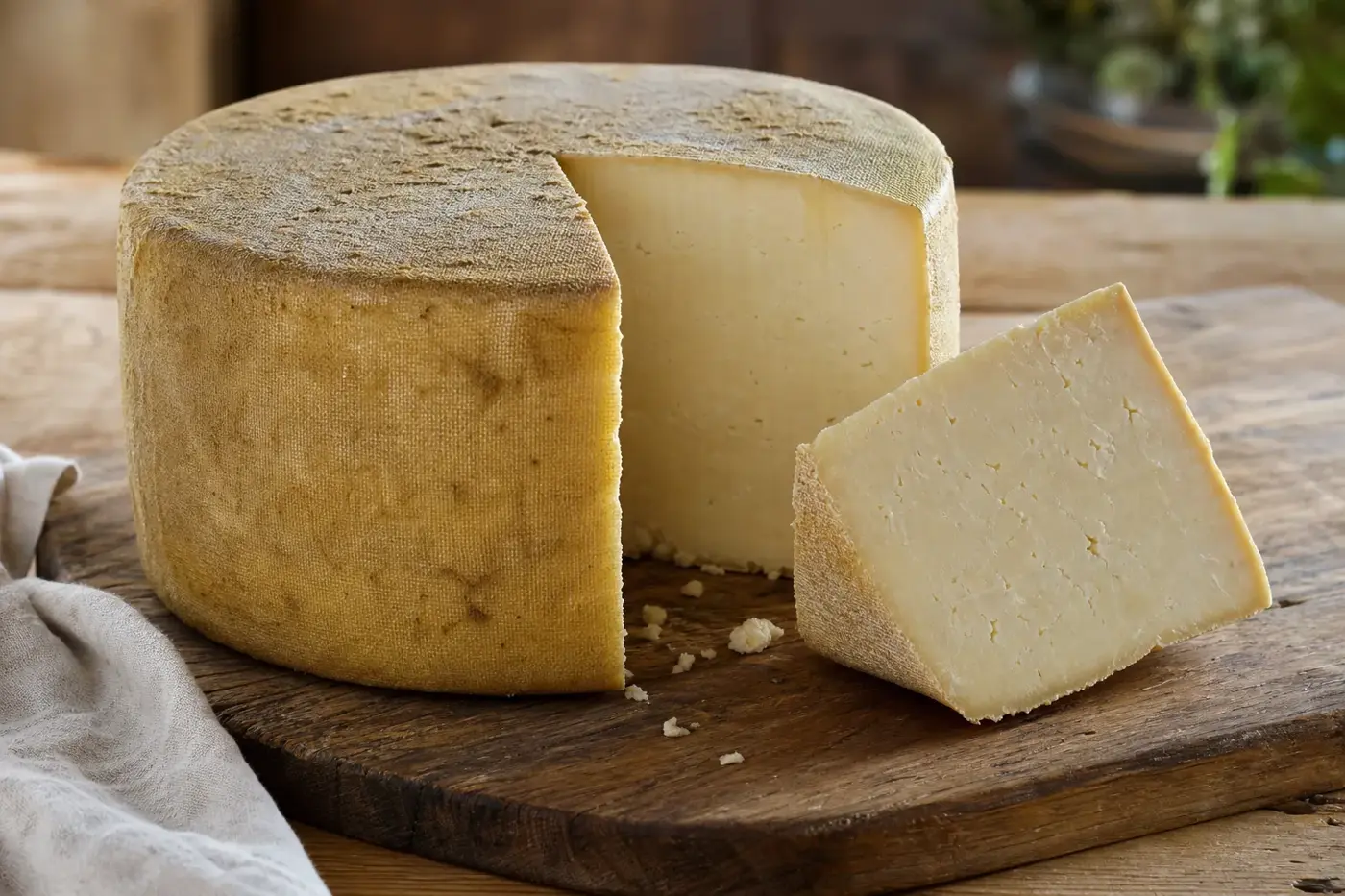
A warm Staffordshire oatcake, folded around pale cream cheese, is a fine place to begin. The county’s savoury oatmeal pancake makes a natural home for cloth-bound, slightly crumbly Staffordshire Cheese. Its official specification promises a fresh, lactic flavour, while its Great Britain PDO registration remains listed as registered in November 2026. [1][2][3]
| What to know | Your quick guide |
|---|---|
| Registered name | Staffordshire Cheese [1] |
| Milk | Cow’s milk [2] |
| GB protection | PDO, registered; November 2026 [1] |
| EU history | Registration regulation published 18 September 2007 [4] |
| Where it is made | County of Staffordshire, England [2] |
| Milk treatment | Milk and added cream pasteurised together [2] |
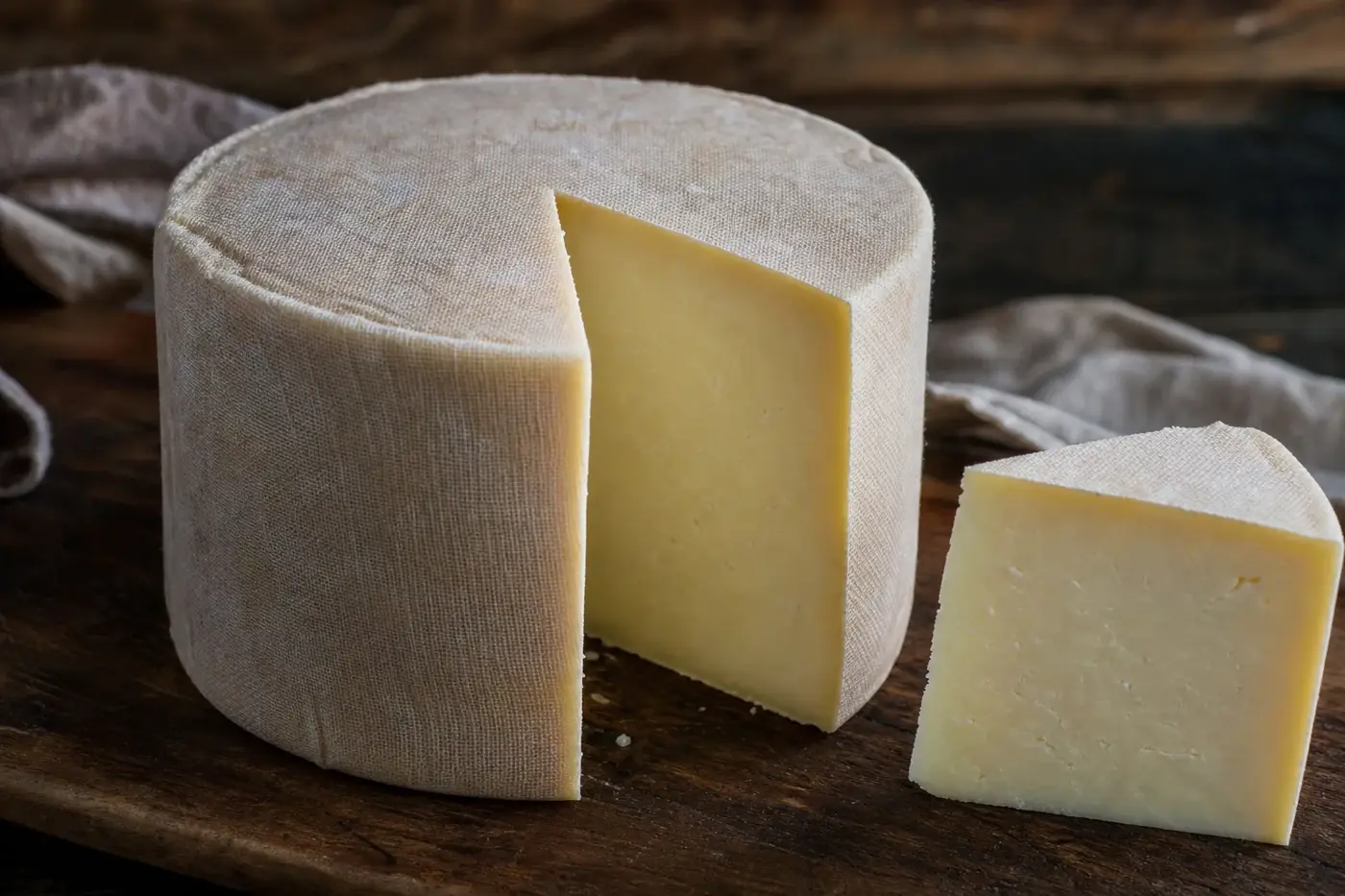
| Shape and size | Cloth-bound cylinders, 8 to 10 kg [2] |
| Time to mature | Mild at 2 to 4 weeks; up to 12 months [2] |
| Legal minimum ageing | Not specified separately [2] |
| What sets the milk | Rennet; origin not specified [2] |
Get to know that gentle crumble
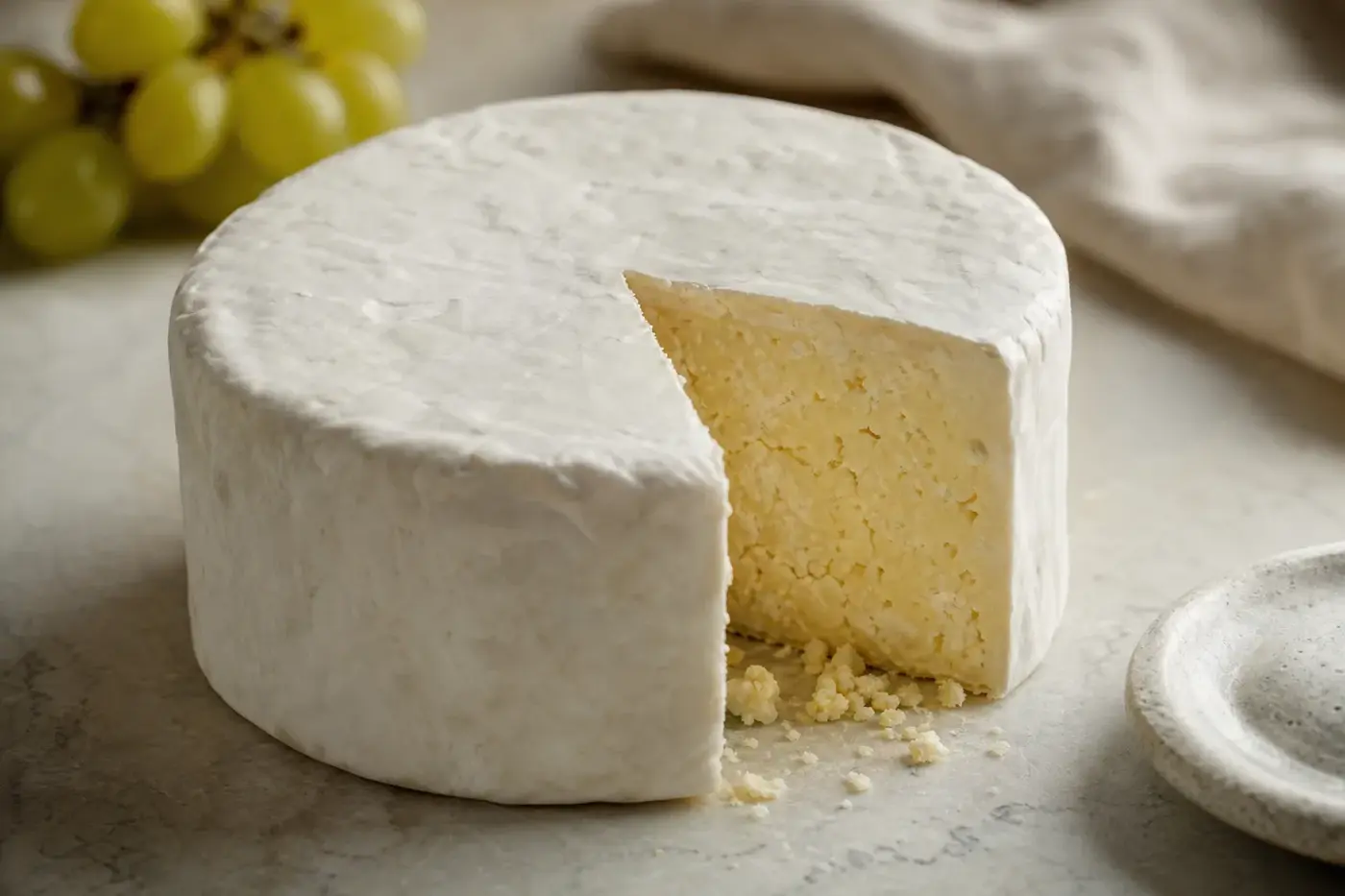
Cut yourself a piece and look for two things: a smooth body and a slight crumble. The specification describes Staffordshire Cheese as hard or semi-hard, depending on maturity, with a fresh, lactic flavour. Lactic means a milk-derived acidity. Ask your cheesemonger how that freshness comes through in this particular cut, at this age. [2]
Before you reach for chutney or mustard, give the cheese a moment on its own. Does it break into small pieces or hold together in a cohesive slice? Compare what you notice with the age the seller gives you. There is more to say here than “strong” or “mild”, those two overworked employees of the cheese counter.
Meet the monks behind the revival story
The PDO specification takes you back to Cistercian cheesemaking around Leek in the thirteenth century. It tells of a regional cheese lost during wartime milk centralisation, then revived. This is the applicant’s account, recorded in the protection dossier. It roots the cheese’s story firmly in its Staffordshire home. [2]
The modern revival has a clear milestone: 24 June 2006, when the European Union published the application summary. Before registration, that document set out the cheese’s character and manufacturing method, explicitly calling the undertaking a revival. You are tasting a modern cheese whose makers looked to a local tradition for their starting point. [5]
Follow the milk into the making room
Staffordshire cow’s milk and cream begin the process. Makers pasteurise them together, then add starter cultures, the bacteria that develop acidity and flavour, and rennet, the coagulant that sets the milk. They cut and stir the curd, or set milk solids. Then they drain away the whey, the liquid portion. [5]
Next, the makers break, mill and salt the curd. They fill cloth-lined moulds by hand, press the cheeses overnight, then mature them on shelves with regular turning. You can have a mild cheese at 2 to 4 weeks. Given longer, maturation can continue for up to 12 months. [5]
For the wider journey from milk to finished cheese, follow how cheese is made. If you want to separate the milk arriving at the dairy from the treatment it receives there, turn to milk treatments.
Four turns make a telling detail
Four turns. That is all the production instructions specify for mixing the salted curds, because further turning would dry them. It is a small instruction with a big part to play: the finished texture depends on a practical decision at the vat, not simply on time spent maturing. [5]
When you taste, ask two separate questions about texture. How readily does the cheese crumble under your knife? How does it feel as you chew? A piece can break neatly without feeling dry in your mouth. [2]
Bring both questions to the counter, especially if you are choosing between a younger cut for a sandwich and an older piece for a tasting plate. How a cheese cuts and how it eats are different pleasures. Give yourself time to notice both.
Unpick the dates behind the protected name
PDO stands for Protected Designation of Origin. In November 2026, Defra’s Great Britain record lists Staffordshire Cheese as registered, with UK scheme registration dated 31 December 2020 at 23:00. It gives 18 September 2007 as the original EU registration date. [1]
The underlying EU act sets out the legal sequence more precisely. Regulation (EC) No 1067/2007 was adopted on 17 September 2007 and published on 18 September. Under Article 2, it entered into force on the twentieth day after publication, 8 October 2007. The regulation also records an objection that was subsequently withdrawn. [4]
If you are buying in Great Britain, consult the official register entry and its linked specification. For the distinctions between PDO, PGI and TSG, turn to the guide to protected names.
Ask for the name, not just the postcode
A Staffordshire address tells you only part of the story. The full registered name identifies cheese made to a defined specification, including a county production area and local milk and cream. If a label or counter ticket leaves you guessing, compare its details with the specification’s requirements. [1][2]
Ask for Staffordshire Cheese by its full name, then ask who made that particular wheel. If your cheesemonger offers another local cheese, get to know its name, milk treatment and style on their own terms. You will leave knowing rather more than “the local one”. Better still, you will know what to ask for next time.
Invite Cheshire and Cheddar to the tasting
Put Staffordshire beside Cheshire and you have a good reason to pay attention to that smooth, slightly crumbly body. The Staffordshire dossier describes Cheshire as more markedly acidic and crumbly. Taste with those differences in mind. You are getting to know the cheeses, not refereeing a county dispute. [5]
For a comparison with Cheddar, choose a named example and note its age alongside the Staffordshire cut’s. Ask your cheesemonger where the clearest contrast lies: acidity, firmness or the way each cheese breaks. Named pieces of known age tell you more than treating either regional name as a fixed measure of strength.
Set equal-sized pieces on plain plates and taste without accompaniments first. Jot down the differences before deciding which you would choose for an oatcake, a sandwich or a cooked dish. The useful discovery is your own preference, and where you might put each cheese to work.
Take a few good questions to the counter
For current production and availability, start with the name, maker and age. Ask how your cheesemonger received and stored the wheel. If you are buying online, request a photograph of the actual label and written storage instructions. Settle delivery arrangements before ordering, especially if you have a particular meal and a fixed date in mind.
- Is this the PDO Staffordshire Cheese named in the GB register?
- Who made this batch, and when?
- How long has it matured, and what is this cut like?
- What storage and use instructions come with this portion?
If you need a vegetarian cheese, ask for the maker’s declaration for that particular product. The specification names rennet but does not identify its origin. [2] For help separating the product name from the other information on the pack, turn to reading cheese labels.
Keep your cheese chilled and its instructions handy
Keep dairy products refrigerated, with your fridge set between 0 and 5 °C, under Food Standards Agency guidance for England, Wales and Northern Ireland. Follow your portion’s packaging instructions, including its date marking and directions after opening. The agency recommends using a fridge thermometer to check the temperature. [6]
Leave any cheese you are not serving in the fridge. For advice on keeping food chilled during preparation and serving in England, Wales and Northern Ireland, consult the FSA guidance. [6]
Cut a few modest pieces at a time, with a plain accompaniment first so you can get to know the cheese itself. Keep the packaging until you finish the last piece, with its date and handling instructions close to hand. For help with wrapping and arranging your fridge, see storing cheese at home.
Let an oatcake lead you to lunch
Staffordshire oatcakes are griddled oatmeal pancakes, and the county’s visitor partnership describes fillings including cheese, tomatoes, bacon, beans and egg. Cheese-filled oatcakes belong firmly to that local custom. For your first taste of Staffordshire Cheese in one, keep the filling simple. Give the cheese room to make its impression. [3]
Think of these as serving ideas, rather than a tested recipe. Try one addition at a time: tomato for a fresher contrast, cooked mushrooms for something earthier, or mustard on the side so everyone can choose their balance. Taste an unfamiliar batch before deciding how much seasoning the finished dish needs. A simple first attempt gives you a useful starting point for the next.
Beyond oatcakes, try a cheese sandwich with sliced apple, a baked potato finished with small pieces of cheese, or a little cheese in a vegetable tart. Start with a single vegetable or fruit accompaniment, so you can tell what you enjoy about the pairing. Serve water or an alcohol-free drink of your choice alongside.
For cooked dishes in England, Wales and Northern Ireland, consult the FSA guidance on cooling and storing leftovers. Follow the cheese label and the instructions for your other ingredients too. [6]
Find your next reason to linger over cheese
- How to Tell Cheese Styles Apart: Milk, Rind, Texture and Method: give yourself a useful framework for comparing the pieces on your board.
- Rennet Explained: Animal, Microbial and Fermentation Produced: get to know the coagulant and the questions to ask about its origin.
General information only, not medical advice: follow the official guidance where you live.
Questions people ask
What does Staffordshire Cheese taste like?
The specification describes a fresh, lactic flavour, with a smooth body and a slight crumble. It is hard or semi hard according to maturity.
Is Staffordshire Cheese made with pasteurised milk?
Yes. Staffordshire cow’s milk and added cream are pasteurised together before starter cultures and rennet are added.
Is Staffordshire Cheese suitable for vegetarians?
The specification names rennet but does not identify its origin. Ask for the maker’s declaration for the particular product.
How long is Staffordshire Cheese matured?
Mild cheese is ready at 2 to 4 weeks. Maturation can continue for up to 12 months.
Is Staffordshire Cheese protected by a PDO?
Yes, the Great Britain register lists Staffordshire Cheese as registered with a Protected Designation of Origin. The specification defines the production area as the county of Staffordshire in England.
Sources
[1] Department for Environment, Food & Rural Affairs. Staffordshire Cheese, official GB protected food name register entry. Published 4 January 2021; live record checked November 2026. Register entry.
[2] Department for Environment, Food and Rural Affairs. Staffordshire Cheese: Product specification. Document dated September 2007, as currently linked from the GB register. Sections 4.2 to 4.6. Product specification.
[3] Visit Staffordshire, administered by the Staffordshire and Stoke-on-Trent Local Visitor Economy Partnership. Taste of Staffordshire, undated live page, checked November 2026. Section “Staffordshire Oatcake Shops”. Local food culture account.
[4] European Commission. Commission Regulation (EC) No 1067/2007 of 17 September 2007 entering a designation in the register of protected designations of origin and protected geographical indications (Staffordshire Cheese (PDO)). Official Journal L 243, 18 September 2007, page 21. Articles 1 and 2 and Annex. Registration regulation.
[5] European Commission. Staffordshire Cheese PDO application summary. Official Journal C 148, 24 June 2006, pages 12 to 14. Sections 4.2, 4.5 and 4.6. Published application.
[6] Food Standards Agency. How to chill, freeze and defrost food safely. Published 18 December 2017; live guidance checked November 2026. Applies to England, Northern Ireland and Wales. Official storage guidance.
[7] Food Standards Agency. Alerts, live official food and allergy alert index, accessed November 2026 for the editorial recall check. Official alerts index.
This piece was researched from the official GB register, its specification, the original EU application and registration act, local food culture material and published FSA guidance.
Last checked: November 2026
Last checked November 2026.
The editors suggest you read next
West Country Farmhouse Cheddar Cheese
Large pieces of curd turn and stack under the cheesemaker’s hands.