Tartiflette
Break through tartiflette’s golden Reblochon crust with a spoon.
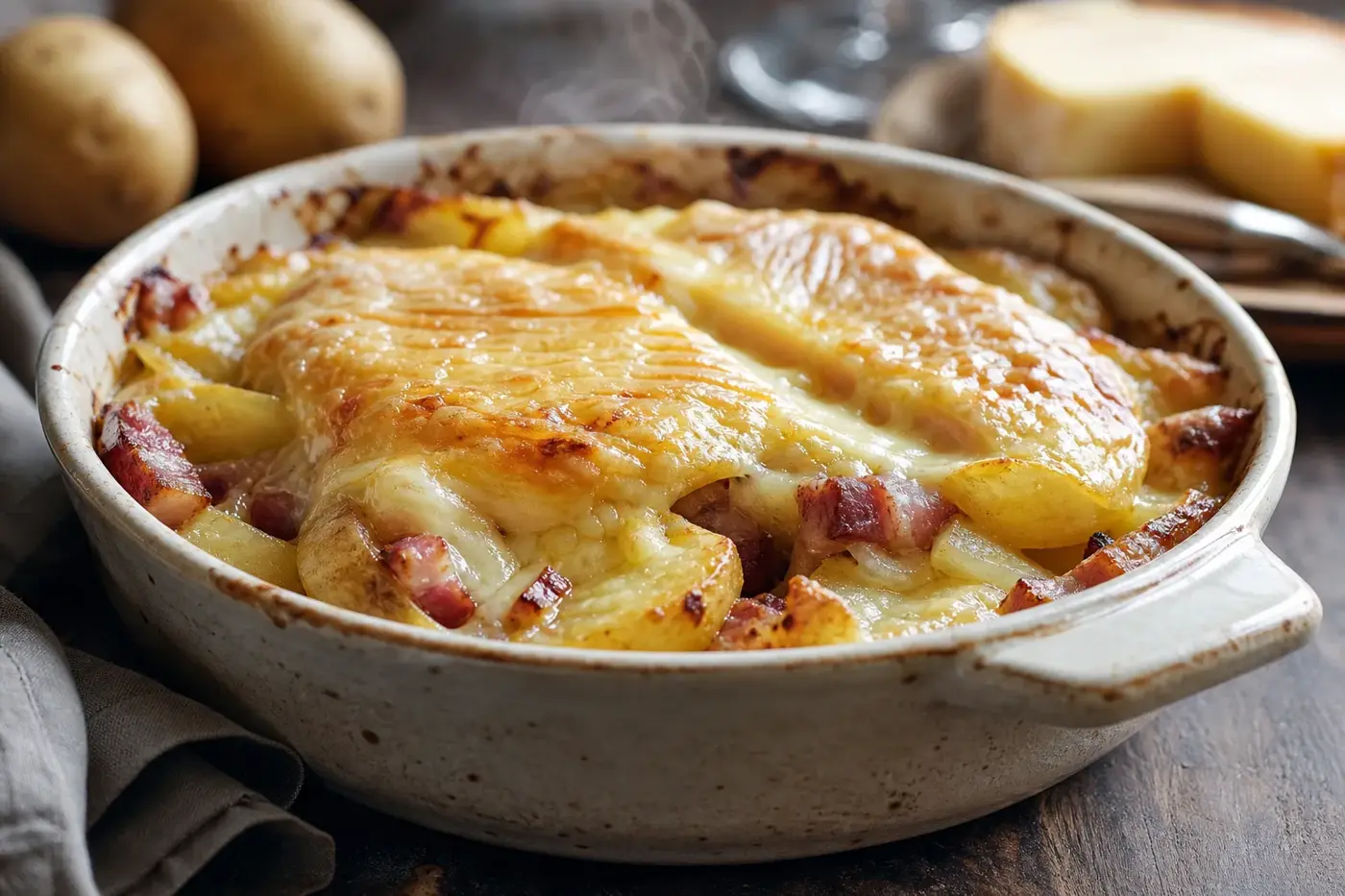
Break through tartiflette’s golden Reblochon crust with a spoon. Underneath are soft potatoes, onions and smoked pork, with melted cheese working its way into every gap. It looks like an Alpine supper handed down through centuries. Yet the Reblochon industry dates its modern emergence to the 1980s.[1]
You need one simple sequence to get this Savoyard bake right. Cook the potatoes until tender first, then bake until the cheese is golden and the centre steaming hot.[5,6]
Follow the trail from hearth to ski resort
Before tartiflette, there was péla. According to the Reblochon industry, it cooked in a long-handled pan over a hearth or in a communal bread oven. Regional scholarship describes a variable potato fricassée, sometimes using leftover Reblochon, rather than a fixed recipe for an oven bake.[1,2]
The modern story takes you to Alpine ski resorts in the 1980s, where tartiflette spread and helped promote Reblochon. Restaurateurs, a cheese maturer and the Reblochon producers’ organisation all appear in accounts of its invention. Regional scholarship records competing claims, with nobody holding an undisputed claim to inventing it.[2]
Think of today’s oven recipe as a modern expression of older mountain cooking. It belongs to that story, but it is not an ancient tradition preserved unchanged.
Let Reblochon take the lead
Look for Reblochon made from raw, whole cows’ milk in its defined area, covering parts of Haute-Savoie and Savoie in France. Its registered name, “Reblochon” or “Reblochon de Savoie”, is an EU protected designation of origin, or PDO.[3,4] To untangle origin protection from branding, turn to protected names explained.
The specification describes a thin, washed rind with a fine white surface bloom.[3] That rind is edible, so leave it on. The industry’s tartiflette recipe puts some cheese among the potatoes and the rest on top: melted cheese below, a browned crust above.[5]
Shop by the cheese’s name on the label. A pack marked “tartiflette cheese” does not necessarily contain Reblochon.[1,5] The dish’s name on the packet is not quite the introduction you need.
Give your potatoes a tender landing
Choose firm-fleshed potatoes sold for boiling or salads. The Reblochon industry suggests Roseval or Belle de Fontenay, but what matters is that your cooked slices stay intact as you lift them into the dish.[1] For this version, peel them and cut rounds about 8 mm thick, keeping them reasonably even so they cook together.
Simmer gently until a knife slips through without resistance, then drain thoroughly. The oven’s job is to melt and brown the cheese. Hard potatoes underneath give it a second job, and make the cooking time much less dependable.[1,5]
Bring a golden tartiflette to the table for four
Recipe status: an independently untested adaptation of the Syndicat Interprofessionnel du Reblochon’s published recipe, keeping its quantities but boiling the potatoes first.[1,5]
Serves: 4. Preparation: about 25 minutes. Hob cooking: allow about 25 minutes, partly overlapping preparation. Baking: 20 minutes, then longer if needed to meet the doneness checks below. Rest: 5 minutes. Oven: 200 °C conventional, 180 °C fan (392 °F conventional, 356 °F fan).[1,5]
Set out your kitchen kit
You need a large saucepan, colander, wide frying pan, chopping board, knife and scales. Set out a shallow ovenproof dish holding roughly 2 litres too. A clean food thermometer is useful for checking the centre against the FSA’s cooking guidance.[6]
Gather the good things
- 1 kg firm-fleshed potatoes, peeled
- 1 whole Reblochon, 450 to 550 g, rind retained
- 200 g smoked pork lardons
- 200 g onions, thinly sliced
- Black pepper
- Optional: 100 ml dry white wine
- Optional: 50 ml pasteurised double cream
- Optional: a little grated nutmeg
Build your bake, layer by layer
-
Get the oven hot. Preheat to the temperature above. Keep the cheese and lardons refrigerated until you need them. The handling advice here follows the FSA for England, Wales and Northern Ireland.[6,7]
-
Start with tender potatoes. Slice as described above, cover with water in the saucepan and bring to a gentle simmer. Test for tenderness before the slices begin to break up. Drain carefully and let the steam escape, so excess water does not follow them into your baking dish.[1]
-
Soften the onions, brown the pork. Put the lardons and onions in the frying pan over medium heat. Stir until the onions are soft and the pork is cooked through, with some browned edges. Lower the heat if the onions catch before softening. Add the optional wine and simmer for 5 minutes, as the industry recipe directs.[5,6]
-
Bring the filling together. Gently fold the potatoes through the onions and lardons. Add pepper and optional nutmeg, then taste the cooked mixture before deciding whether it needs salt. Stir in the cream, if using. Cut the Reblochon horizontally into two thin discs, cut one disc into pieces and distribute those through the potato mixture in the baking dish.[5]
-
Lay the cheese across the top. Divide the remaining disc into sections that fit across the surface, cut sides down and rind sides up. Spread them over the potatoes rather than piling them in the middle. Keep the filling fairly shallow and even so the centre can heat through.[5,6]
-
Bake, then check the centre. Start checking after 20 minutes: look for golden cheese, bubbling edges and completely tender potatoes. Check the centre too: FSA guidance specifies 70 °C (158 °F) for 2 minutes, or an equivalent combination. Cover loosely if the top colours before the centre is ready. Rest for 5 minutes, then serve.[1,6]
Wine and cream: choose your own richness
White wine appears in the industry recipe, while its wider guidance leaves cream to personal preference.[1,5] For your first batch, try leaving the cream out and letting the cheese supply the sauce. Reblochon is unlikely to need encouragement in that department.
If you prefer a softer filling, use the small optional quantity of cream above. You want to soften the mixture, not submerge the potatoes.
Leave out the wine if you need an alcohol-free dish. Cooking reduces alcohol but does not reliably remove it. USDA retention data establish that point, although they cannot predict how much remains in this particular bake.[10]
Try another cheese, or make room for mushrooms
If you need a Reblochon substitute, try a soft, surface-ripened cheese sold for baking, such as a generic Brie or Camembert. Follow its rind instructions and use the same weighed quantity, expecting a different flavour. The guides to brie and camembert explain those styles in more detail.
Check the label for added salt and ingredients before seasoning. Keep the cream optional until you can judge how much moisture the mixture has.
Diced smoked bacon is the simplest swap for pork lardons. For a vegetarian potato bake, replace them with 250 g sliced mushrooms. Brown the mushrooms separately in 15 ml oil until their released moisture has evaporated, then combine with the onions.
Choose cheese explicitly labelled suitable for vegetarians; do not assume Reblochon qualifies. Check the wine too, if you use it. These are independently untested suggested adaptations, so apply the same doneness checks to the full bake.[6]
Put something crisp beside all that cheese
Give your tartiflette some contrast with a crisp green salad and a sharp vinaigrette. Try lettuce or chicory, a little mustard and wine vinegar, dressed just before serving. Keep it in a separate bowl so the leaves stay crisp.
Cornichons make another sharp accompaniment. Along with the salad, they bring something fresh and brisk to a plate of soft potatoes and melted cheese.
The Reblochon industry recommends Savoyard whites including Apremont and Roussette de Savoie with its cheese.[9] They make useful starting points for tartiflette too. For an alcohol-free option, try sparkling water with lemon, or an unsweetened apple drink diluted with sparkling water.
Offer either alongside the wine, with the same care rather than as an afterthought. Wine pairings are for adults of legal drinking age, in small servings. See cheese and wine pairing for the broader approach.
This page summarises published guidance from the official sources it cites. It is not medical advice. Guidance differs between countries and changes over time, so check the current source for where you live, and ask your doctor, midwife, pharmacist or dietitian about your own circumstances.
Give leftovers a safe route to another meal
Divide leftovers into smaller portions so they cool quickly, then refrigerate within 1 to 2 hours. Keep your fridge between 0 and 5 °C (32 and 41 °F). Eat refrigerated leftovers within 48 hours, or freeze them if that will not be possible. This is FSA home food safety advice for England, Wales and Northern Ireland, as of November 2026.[7]
Reheat only the portion you need, and only once. The FSA says leftovers must be steaming hot throughout.[6] In the oven, cover your portion initially to protect the top, then uncover towards the end if you want it browned.
Check the centre rather than relying on a fixed reheating time. For wider handling advice, see cheese food safety.
Cooking for pregnancy or an allergy? Start here
UK NHS guidance, as of November 2026, says any cheese cooked until steaming hot can be eaten during pregnancy, including soft cheese. It also advises avoiding alcohol during pregnancy.[8] Follow its current pregnancy guidance, and ask your midwife or doctor about your own circumstances.
The cheese and optional cream contain milk. If you are cooking for someone with an allergy, check every ingredient’s label, including substitutions and accompaniments.[3]
Find your next stop on the cheese shelf
- How to Store Cheese at Home: give any remaining cheese the care it needs.
- Rennet Explained: Animal, Microbial and Fermentation Produced: get help choosing a cheese for the vegetarian variation.
Questions people ask
Do you leave the rind on Reblochon for tartiflette?
Yes, the rind is edible and is kept on. Place some cheese among the potatoes and the rest on top, with the rind facing upwards.
Should you cook the potatoes before baking tartiflette?
For this recipe, gently simmer the potato slices until a knife passes through without resistance, then drain them thoroughly. The oven melts and browns the cheese.
Can you make tartiflette vegetarian?
The page suggests replacing the lardons with 250 g of sliced mushrooms, browned separately in 15 ml oil until their released moisture has evaporated. Choose cheese explicitly labelled suitable for vegetarians and check the wine too, if using it.
Can you eat tartiflette during pregnancy?
UK NHS guidance says any cheese cooked until steaming hot can be eaten during pregnancy, including soft cheese. It also advises avoiding alcohol during pregnancy. Check the current NHS pregnancy guidance and ask your midwife or doctor about your own circumstances.
How long can you keep and reheat leftover tartiflette?
The FSA advises refrigerating leftovers within 1 to 2 hours and eating them within 48 hours, or freezing them if that is not possible. It says to reheat leftovers only once and make sure they are steaming hot throughout.
Sources
[1] Syndicat Interprofessionnel du Reblochon, La Tartiflette, undated online edition. Industry account of the dish’s history, potato choices, optional cream and oven cooking. The organisation represents Reblochon producers and has a commercial interest in its use.
[2] Géoconfluences, École normale supérieure de Lyon, Géographie de la tartiflette, online PDF edition, publication date not verified. Historical synthesis, particularly the box on tartiflette’s emergence in the 1980s and its relationship with péla.
[3] Institut national de l’origine et de la qualité and French Ministry of Agriculture, Cahier des charges de l’appellation d’origine protégée “Reblochon” ou “Reblochon de Savoie”, specification homologated by the order of 31 July 2020, published 8 August 2020; accompanying INAO product record consulted for subsequent notices.
[4] Syndicat Interprofessionnel du Reblochon, Le secret du Reblochon, undated online edition. Producer organisation’s account of raw, whole milk production and geographical context.
[5] Syndicat Interprofessionnel du Reblochon, Recette de la Tartiflette au Reblochon, undated online edition. Published recipe for four, including quantities, wine reduction, cheese division and retained rind. Commercial interest as noted in source [1].
[6] Food Standards Agency, Cooking your food, published 18 December 2017, current online edition retrieved from GOV.UK. Applies to England, Northern Ireland and Wales. Cooking temperatures, pork, doneness checks and reheating.
[7] Food Standards Agency, How to chill, freeze and defrost food safely, published 18 December 2017, current online edition retrieved from GOV.UK. Applies to England, Northern Ireland and Wales. Refrigeration, cooling and leftover storage.
[8] NHS, Foods to avoid in pregnancy, current online edition, checked November 2026. UK advice on thoroughly cooked cheese and alcohol during pregnancy.
[9] Syndicat Interprofessionnel du Reblochon, Les accompagnements, undated online edition. Attributed wine recommendations, including Apremont and Roussette de Savoie.
[10] United States Department of Agriculture, Agricultural Research Service, USDA Table of Nutrient Retention Factors, Release 6, December 2007. Alcohol retention research and preparation-method tables.
[11] Food Standards Agency, Alerts, live official recall and allergy-alert service, accessed November 2026.
[12] French government, Rappel Consommateur, live official recall service and Reblochon search results, accessed November 2026.
This piece was researched from the Reblochon industry’s published recipes, official cheese documentation, regional scholarship and national food safety guidance.
Last checked: November 2026
Last checked November 2026.
The editors suggest you read next