The Revival of Farmhouse and Artisan Cheese
An old piggery is about to become a Lancashire cheese dairy.
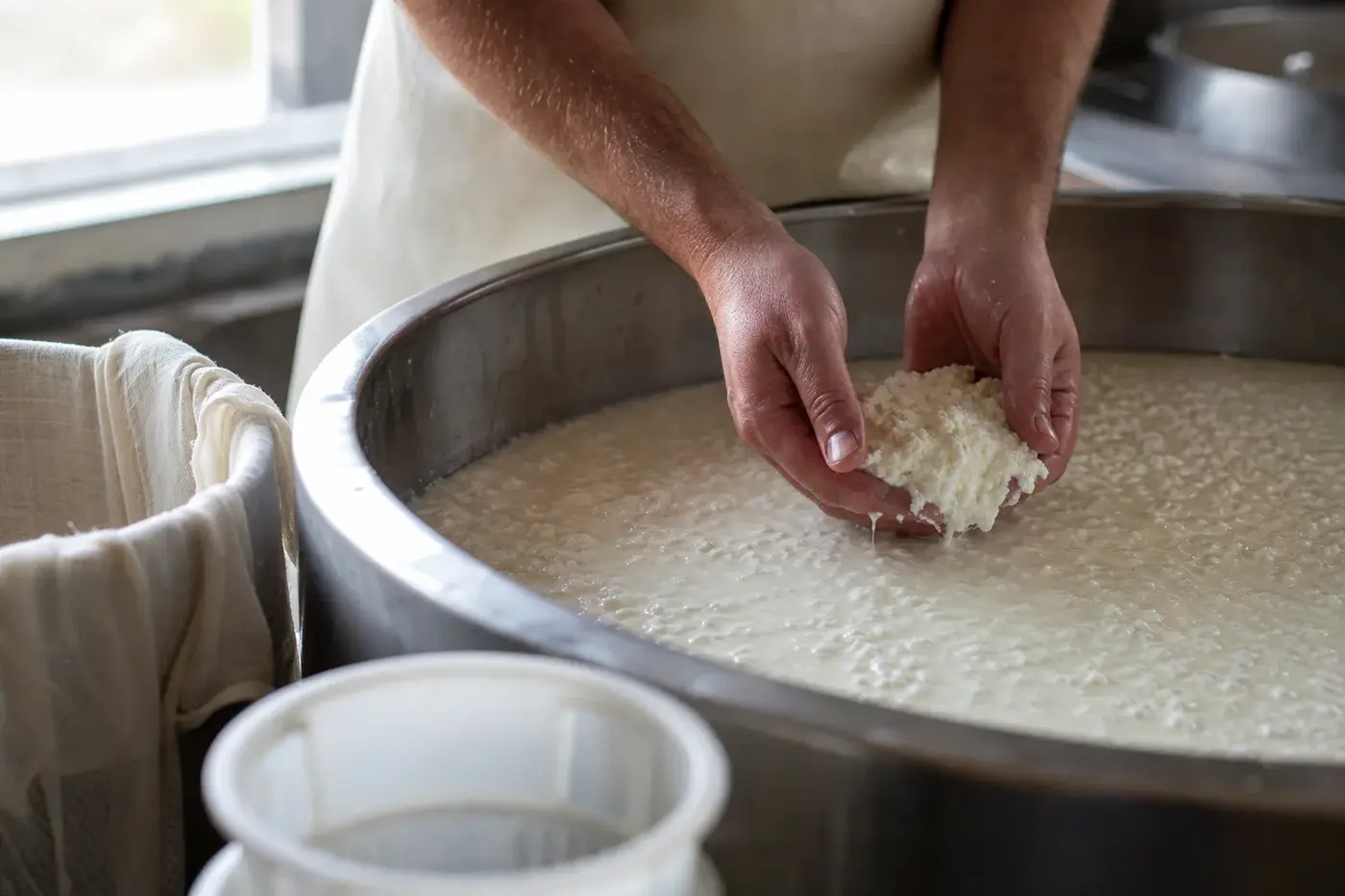
An old piggery is about to become a Lancashire cheese dairy. At Beesley Farm in 1978, the family behind Mrs Kirkham's arrived with inherited equipment, a recipe and the knowledge to put both to work. A year later, a dairy founded in London began building another vital connection: a route from cheesemaker to customer. The revival took shape through partnerships like these, joining preserved skills and new cheeses with specialist shops that could explain them and deliver them in good condition. [1][2]
Farmhouse and artisan: look behind the lovely label
You can learn more from a few good questions than from an appealing label. Farmhouse points towards the relationship between farm, milk and dairy; artisan draws attention to the maker's skill and involvement. Both descriptions need to be understood within the applicable rules. Whose animals supply the milk, which decisions does the cheesemaker make, and where does the cheese mature?
Two documented approaches show why it pays to ask. Keen's describes using its own herd's milk, with people deciding how each stage proceeds. The British specification for West Country Farmhouse Cheddar allows milk from other farms, pasteurised or unpasteurised milk, and both cylindrical cheeses and blocks. The farmhouse connection can take more than one form. [3][4]
Neither word tells you how a cheese will taste. Milk treatment, scale and appearance offer clues, but the particular cheese and its condition complete the picture. Ask your cheesemonger who made it and how it was matured: artisan starts the conversation, rather than finishing it. For the practical details, begin with reading a cheese label.
First, find the milk
English cheese factories opened in Derbyshire in 1869, but farm production remained substantial well into the twentieth century. There was no neat handover from farmhouse to factory. The Society of Dairy Technology's historical synthesis describes factories struggling to secure milk and compete with imports, while farm dairies worked alongside industrial businesses. [5]
Behind both stood a deceptively simple choice: make cheese or send the milk to the drinking milk market? Changes in collection, distribution and national policy altered that calculation for farmers. The same history traces how these competing demands shaped farmhouse and factory cheesemaking alike. Knowing your way around a cheese vat counted for little if you could not get the milk. [5]
Wartime records bring that dependence into sharp focus. On 18 February 1942, the Minister of Food told Parliament that the government had redirected milk between regions, overriding existing contracts to supply those considered most in need. Summer production of cheese, condensed milk and milk powder would help provision the following winter. Cheese had its place in a national allocation system. [6]
For a regional cheesemaker, this changed the working conditions fundamentally. You might have a familiar recipe and customers ready to buy, but neither could replace the milk itself.
Wartime cheese was not quite so simple
The scarcity of speciality cheeses reached the Commons on 25 February 1947. A debate recorded controls on cheese manufacture and imports, which the government defended as necessary to national food priorities. Members questioned what those controls meant for choice and for the survival of regional skills. [7]
The minister's reply complicates the familiar claim that wartime Britain made only Cheddar. The official account grouped Cheshire, Lancashire, Leicestershire, Derby, Wensleydale and Dunlop within the administrative category of Cheddar-type cheese. It also stated specifically that Dunlop had been supplied throughout the war. That administrative label contained rather more variety than you might imagine. [7]
Some producers' histories show a thread of continuity through these changes. Keen's dates its family's cheesemaking at Moorhayes Farm in Somerset to 1899, linking the later business with that earlier farm tradition. This was a practice carried forward, not a recipe rediscovered after a complete disappearance. [8]
Revival, then, did not mean just one thing. It made surviving practices more visible, helped pass them on and found customers beyond their home districts. Elsewhere, it meant reconstruction or invention. Keep those differences in mind and you get a richer story than a straightforward tale of loss and rescue.
Lancashire cheese finds a home in an old piggery
At Beesley Farm in 1978, the equipment, recipe and practical knowledge arrived together. Mrs Kirkham's producer history records the move after the previous generation retired from another farm. The old piggery became a dairy, giving an inherited Lancashire cheesemaking practice somewhere new to work. [1]
The machinery was only part of the inheritance. Someone still had to know how to work with the milk and curd, carrying familiar methods into a different production setting. You could move the objects, but they needed the knowledge to come with them. [1]
During the mid-1980s, the business began supplying customers directly, including Neal's Yard Dairy. Farmers' markets, speciality food events and television appearances later brought the cheese to more people. A regional cheese was finding its way to a wider audience, by several different routes. [1]
Another milestone arrived in May 2008, with the completion of a replacement dairy. Keeping the tradition alive did not mean keeping every building or piece of equipment unchanged. The inherited knowledge continued in a workplace rebuilt to accommodate the work. [1]
Old knowledge, new cheeses
Neal's Yard Dairy began in London's Covent Garden in 1979. Its retrospective describes travelling to find cheesemakers and building relationships around their cheeses. Through the shop, production outside London reached customers who might otherwise never encounter it. The cheeses gained an audience and a place where someone could explain their stories. [2]
The same account dates the beginning of Beenleigh Blue to 1979 and Lincolnshire Poacher to 1992. Alongside inherited regional cheeses came new ones, developed through experimentation, teaching and exchanges between makers. You did not need an unbroken family cheesemaking lineage to join in. A working farm could draw on knowledge beyond its boundaries and make something distinctive. [2]
Stonebeck Wensleydale offers a later example. Neal's Yard Dairy records receiving its first wheel in 2020 and describes the makers studying older cheesemaking texts and seeking specialist advice. Historical research became a practical tool for developing a new farm enterprise. [2]
Follow these accounts and three strands emerge. Makers continued established practices, adapted knowledge to create new cheeses, or recovered older approaches through research. The revival drew strength from making room for all three. Tradition, it turns out, did not require everyone to stand perfectly still.
Meet the people between the maturing room and your counter
A specialist shop could offer much more than a spot on a shelf. The Kirkham account credits Neal's Yard Dairy with introducing its Lancashire to southern customers and explaining it to them. Distribution brought the cheese within reach; interpretation helped people understand what they had found. [1]
Before a cheese reached that counter, maturation called for its own expertise. Keen's describes turning cheeses by hand and grading them at successive ages. The maturing room was an active part of production, with cheeses watched and assessed as they developed. Judgement mattered long after the work in the vat was done. [3]
Different records give you different views of this work. Producer histories preserve family practices, specialist retailer accounts trace relationships and audiences, and technical histories explain changes in milk supply and distribution. Read together, they show how these contributions connected to support the revival. [1][2][5]
Customers had a practical role, too. Direct sales, markets and specialist counters gave you chances to ask questions and return to a particular maker's cheese. The Kirkham history explicitly links these encounters with developing sales. Coming back for more was not merely a cheese lover's habit; it helped give production an ongoing outlet. [1]
Follow your cheese back to the milk
Keen's identifies its own cows and land as the source of its milk, then describes the short journey from milking to dairy. That gives you a farm connection you can actually follow. Farmhouse becomes more than an appealing general description: it reveals a particular production relationship and the choices behind it. [3]
The story starts well before the vat. Food Standards Scotland's commissioned literature review identifies animal breed, feeding, milking cycles and transport among the factors affecting raw milk's quality and safety. Husbandry and milk handling belong alongside the recipe in any account of a cheese. [9]
Inside the dairy, starter cultures are microorganisms used to develop acidity. Curd is the coagulated milk material separated from whey, the liquid portion. The West Country Farmhouse Cheddar specification describes balancing time, temperature and acidity, then turning and stacking curd by hand during cheddaring. Here, skill means particular decisions and actions, not just an attractive word on a label. [4]
Those decisions carry on through maturation. Keen's describes regular turning and grading, while the protected Cheddar specification distinguishes the handling of rind-forming cylinders from wrapped blocks. A cheese's distinctiveness grows from connected choices, from milk to finished cheese, rather than any single ingredient. You can follow the broader sequence in how cheese is made. [3][4]
Raw or pasteurised? Consider the whole process
Raw milk carries diverse microbial communities and has been important to several traditions described here. Food Standards Scotland's 2018 review also documents how harmful organisms can enter through milk or through contamination during production and maturation. Understanding raw milk means considering both that microbial diversity and the controls needed throughout cheesemaking. [9]
The review emphasises milk hygiene, acidification, process control and monitoring of the production environment. It also records outbreaks associated with cheeses made from pasteurised milk. Pasteurisation and careful handling address different parts of the safety problem. The whole process needs attention. [9]
When you explore flavour and craft, ask how milk treatment fits the particular cheese. West Country Farmhouse Cheddar's specification explicitly accommodates both pasteurised and unpasteurised milk. Treatment alone neither describes the maker's skill nor tells you the condition of the finished cheese. [4]
For the distinctions between treatments, see raw, thermised and pasteurised cheese. You can find current consumer advice through the official sources linked from cheese food safety.
A protected name gives you something specific
West Country Farmhouse Cheddar Cheese has a documented geographical identity. In November 2026, the Great Britain register lists it as registered with Protected Designation of Origin status, or PDO. That geographical protection gives the regional name a defined set of requirements. [10]
The specification requires production on farms within the defined four-county area, hand cheddaring and maturation for at least nine months. Within those boundaries, it permits different formats and milk treatments. You get specific requirements, without a demand that every cheese be made in exactly the same way. [4]
That is the value of a protected name: it describes a particular product and its geographical relationship. It is not a general grading system for every cheese called artisan. Instead, it helps you understand what this named cheese must be.
For makers, a specification can put regional knowledge into a shared, inspectable form. For you, it turns questions about origin and production into questions with documented answers. Explore the wider distinctions in PDO, PGI and TSG explained.
Good questions help keep the story going
Suitable milk, skilled labour, equipment, maturation space, regulatory compliance and reliable outlets all have to work together. The histories here show how much rests on relationships: a recipe passed between generations, a retailer introducing a regional cheese to new customers, a farm seeking advice before developing its own cheese. Each brings substantial practical demands. None stands alone. [1][2][3]
Succession means passing on judgement as well as premises. Resources remain tied up while cheese matures, and replacement facilities must support production and its controls. The documented rebuilding of the Kirkham dairy shows why continuity can require physical change. Sometimes the workplace needs to change so the practice can carry on. [1]
Technical support helps makers sustain that work. The Specialist Cheesemakers Association, an industry association, lists an assured code of practice, technical training, cheesemaking courses, supplier information and technical assistance among its resources. These give makers routes towards the knowledge and support they need. [11]
For new makers, the opportunity lies in joining such networks while developing a clear production identity. For you as a customer, curiosity becomes most useful when it gets specific. Ask whose milk is used, what the maker controls and who matured the cheese. The answers bring you closer to the working relationships that keep farmhouse and artisan cheesemaking alive.
General information only, not medical advice: follow the official guidance where you live.
Questions people ask
What is the difference between farmhouse and artisan cheese?
Farmhouse points towards the relationship between the farm, milk and dairy. Artisan draws attention to the cheesemaker's skill and involvement, but neither word tells you how a cheese will taste.
Does farmhouse cheese have to be made with milk from the farm's own animals?
Not always. Keen's describes using milk from its own herd, while the specification for West Country Farmhouse Cheddar permits milk from other farms.
What makes West Country Farmhouse Cheddar a protected cheese?
Its specification requires production on farms within a defined four county area, hand cheddaring and maturation for at least nine months. It permits both pasteurised and unpasteurised milk, as well as cylindrical cheeses and blocks.
How did Neal's Yard Dairy help the cheese revival?
Neal's Yard Dairy began in London's Covent Garden in 1979 and travelled to find cheesemakers. It introduced cheeses to customers beyond their home districts, including Mrs Kirkham's Lancashire to southern customers.
Did the cheese revival also produce new cheeses?
Yes. Neal's Yard Dairy dates the beginnings of Beenleigh Blue to 1979 and Lincolnshire Poacher to 1992. It also received its first wheel of Stonebeck Wensleydale in 2020, after the makers studied older cheesemaking texts and sought specialist advice.
Sources
[1] Mrs Kirkham's Cheese, Our story, undated producer account, retrieved November 2026. Producer history.
[2] Neal's Yard Dairy, 45 Years of Neal's Yard Dairy, 3 July 2024. Retailer's retrospective, including accounts of relationships with cheesemakers. Published retrospective.
[3] Keen's Cheddar, About us, undated producer account, retrieved November 2026. Production account.
[4] Department for Environment, Food & Rural Affairs, Product specification: West Country Farmhouse Cheddar, version linked from the Great Britain register in November 2026, document undated. Sections 4.2, 4.3, 4.5 and 4.6. Official specification.
[5] Society of Dairy Technology, The Evolution of the British Cheese Industry, first edition, November 2018, ISBN 978-0-900681-12-7. Historical synthesis, particularly chapters 6, 10, 11 and 12. Published monograph.
[6] UK Parliament, Hansard, Milk distribution, House of Lords, 18 February 1942, volume 121, columns 889 to 922. Ministerial account of milk allocation and seasonal manufacture. Parliamentary record.
[7] UK Parliament, Hansard, Cheese (Control and Prices), House of Commons, 25 February 1947. Contemporary debate and ministerial explanation of production policy. Parliamentary record.
[8] Keen's Cheddar, Home, undated producer statement recording the family's cheesemaking from 1899, retrieved November 2026. Producer statement.
[9] Food Standards Scotland, Improved Food Safety Guidance for Scottish Artisan Cheesemakers: A Literature Review, final report, version 4.7, 20 November 2018. Introduction and sections on milk hygiene and process control. Commissioned review.
[10] Department for Environment, Food & Rural Affairs, West Country Farmhouse Cheddar Cheese, Great Britain protected food names register, published 4 January 2021, retrieved November 2026. Official register entry.
[11] Specialist Cheesemakers Association, website resource directory, undated, retrieved November 2026. Association resources.
This desk-researched history brings together contemporary parliamentary records, producer and retailer accounts, an official product specification, and published technical literature.
Last checked: November 2026
Last checked November 2026.
The editors suggest you read next
A History of Cheese: From the First Curds to Global Food
Picture cheese lying beside Bronze Age burials in China's Tarim Basin, surviving for approximately 3,500 years.