Cheeses of the Southwest and the Causses
Cool, moist air slips through fleurines, the fissures beneath the limestone plateaux of the Causses.
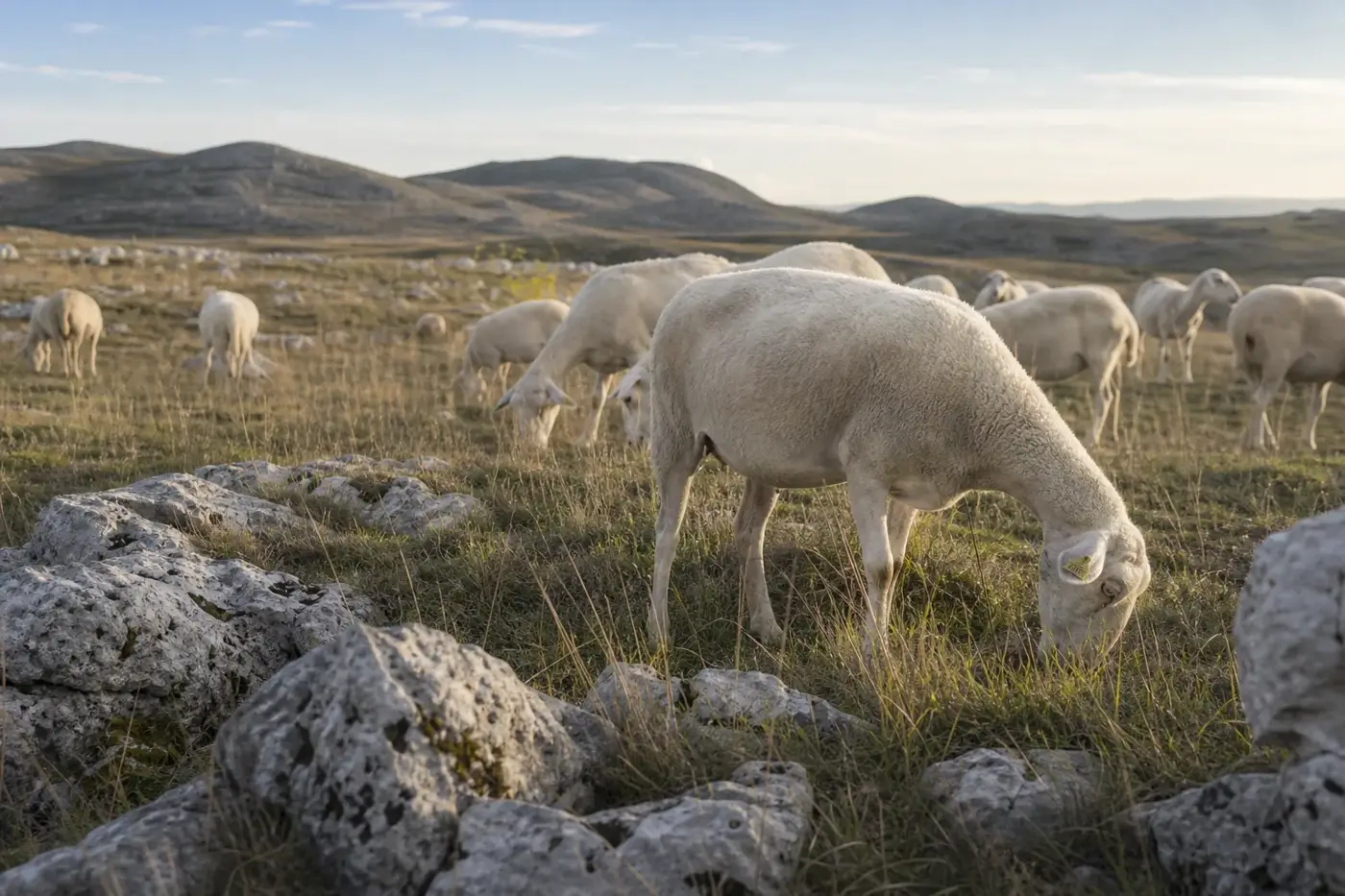
Cool, moist air slips through fleurines, the fissures beneath the limestone plateaux of the Causses. In Roquefort’s caves, affineurs adjust doors and hatches, coaxing that air through the cheeses as they ripen. Follow its path and you meet four characters from this corner of France: Roquefort, Bleu des Causses, Rocamadour and Laguiole. The landscape has excellent taste. [1, 2, 3, 6, 9]
Find your bearings at the cheese counter
Begin in the Quercy limestone country around the Lot, then take in the southern Massif Central and adjoining Aubrac uplands. These places make a rewarding cheese region to explore together. Each cheese, though, has its own production area, farming habits and cheesemaking traditions. At the counter, those boundaries tell you more than a single administrative outline. [1, 5, 7, 8]
France’s INAO records all four names as appellations d’origine protégées, or AOPs, the French term for the EU’s protected designation of origin. Each specification binds its cheese to a defined place and method, as protected names explained sets out. Geography draws these cheeses together; their production rules give each its own identity. [1, 5, 7, 8]
Step below the limestone, then into the pasture
Those cool caves are only part of the story. Around the Causses’ limestone plateaux, farming country spreads through valleys, hills and different soils. Roquefort’s producer confederation describes dry grasslands, cultivated ground and varied uplands shaped by sheep husbandry. Pastoral tracks, watering places and sheepfolds belong in the picture just as much as the caves. [4]
At Roquefort-sur-Soulzon, the limestone takes a direct hand in cheesemaking. The caves lie in rockfall beneath the Combalou, where natural fissures admit cool, humid air. The producer confederation describes affineurs, the people who mature the cheese, controlling that circulation with doors and hatches. What reaches your plate owes as much to their judgement as to the rock around them. [1, 3]
Above ground, the scenery changes markedly. INAO connects Rocamadour’s territory with dry summers and vegetation suited to goat farming. Aubrac brings basaltic and granitic soils and a demanding upland climate. Laguiole’s specification links its production to those pastures and the need to preserve milk as a substantial ageing cheese. [7, 8]
Roquefort: follow those blue veins underground
Roquefort begins with raw, whole sheep’s milk from Lacaune sheep. Milk production and cheesemaking take place across a wider defined area of southern France, but cave ripening belongs to the delimited rockfall zone at Roquefort-sur-Soulzon. When you see that village name, think of where the cheese must undergo cave maturation, not where every supplying farm stands. [1]
Ripening and maturation must last at least 90 days from manufacture. During that time, the cheeses spend a minimum of two weeks exposed in the designated caves, then carry on maturing under wrapping. Three months of overall maturation, in other words, does not mean three months sitting unwrapped in cave air. [1]
The blue-green veins come from Penicillium roqueforti, the mould added during manufacture. Piercing creates ventilation channels inside blue cheese, a purpose expressly described in the Bleu des Causses specification. Air can then reach the internal spaces where the mould develops. Humidity and the maturation that follows also help shape the finished texture. [1, 3, 5]
INAO describes Roquefort’s paste, the body beneath any surface covering, as unctuous, with a pronounced flavour. Try small pieces on bread or alongside pear to enjoy that richness and intensity. For your first purchase, ask the cheesemonger how that particular cheese tastes. Visible blue alone makes a poor shopping compass. [2]
Bleu des Causses: the caves tell a different story
Whole cow’s milk gives Bleu des Causses a different starting point from Roquefort, despite their shared limestone cave traditions. Its specification allows either raw or heat-treated milk. If that matters to your choice, check the individual cheese. The rules tell you what producers may use, not what every producer actually uses. [5]
Ripening starts in naturally ventilated limestone caves with fleurines, where the cheese stays for at least 12 days. It can bear the appellation only from the seventieth day after renneting, when the milk is coagulated. Its cave area has boundaries of its own, extending beyond Roquefort’s particular cave zone. [5, 6]
Expect, in INAO’s description, an ivory paste threaded with blue, a yielding texture and a distinct blue-cheese flavour. INAO suggests gratins and sauces, but leave a place for Bleu des Causses on your regional board, too. Taste it beside Roquefort rather than assuming the two are straightforward substitutes. You will get a much more interesting comparison. [6]
Rocamadour: a small round worth lingering over
Now change the scale of your board. Rocamadour is a small round rather than a wheel, identified by INAO as a raw, whole goat’s milk cheese from the Causses du Quercy. Its production area centres on the Lot and reaches into neighbouring departments, including Aveyron, Corrèze, Dordogne and Tarn-et-Garonne. Alpine or Saanen goats provide the milk. [7]
Under that lightly velvety surface sits a soft paste. INAO describes aromas of cream and butter with a delicate goaty smell; as maturation progresses, a thin flowing layer develops between skin and centre. Ask about that layer when you buy. It is a useful way to explain exactly the texture you fancy. [7]
Cabécou: ask what is behind the name
Spotted “Cabécou” on a counter card? It is a wider name for small goat’s cheeses, not a synonym for every Rocamadour. Ask which cheese you are looking at, where it was made and who made it. [7]
For the Lot appellation cheese described here, request Rocamadour by name. Its specified milk, production area and method establish its identity. Being small and round is not enough to get the job. [7]
Laguiole: bring the Aubrac to your board
Laguiole brings the Aubrac plateau to your board in a very different shape. Made from raw, whole cow’s milk, it belongs to the pressed, uncooked family. The curd, or coagulated milk, is pressed without the high-temperature curd cooking used for some other firm cheeses. Its production area stretches across Aveyron, Cantal and Lozère. [8, 9]
Maturation lasts at least four months from renneting. INAO describes a supple but firm paste, with flavour notes ranging from fresh hay to dried hazelnut. The specification connects that character to raw milk, local fodder and prolonged cool maturation, with repeated turning and rubbing. Those patient attentions matter as much to the mature cheese as its birthplace. [8, 9]
For aligot, start fresh
Aligot does not begin with an aged wedge melted into mash. The Laguiole producer organisation identifies tome fraîche, an early stage in cheesemaking, as the fresh curd combined with potatoes for this regional dish. Fresh curd and mature cheese have different work to do here. [10]
When you shop, ask specifically for tome fraîche suitable for aligot, rather than mature Laguiole. Different fresh curds can be used, so ask what the cook actually uses instead of assuming every version contains the same cheese. Aligot’s connection with Laguiole does not make every ingredient sold for the dish a matured Laguiole. [8, 10]
Good questions make a better cheese board
Start with the exact name, then ask who made the cheese and how mature it is. For Rocamadour, say whether you want a softer centre or a more flowing layer beneath the skin. Ask Laguiole’s age rather than treating every wedge alike. Check Bleu des Causses’ declared milk treatment, too. [5, 7, 8]
For a first selection, try Rocamadour, Laguiole and one of the blues. Choose Roquefort and you have three milks represented, alongside contrasting approaches to ripening; choose both blues if comparison is your aim. A board you can explore closely offers more pleasure than the largest possible collection. Even a cheese lover need not turn every board into a census.
Keep each wrapper or counter label with its cheese, so its name, date and storage instructions stay attached. Buying a cut piece? Ask for those details. The guide to reading a cheese label helps you distinguish the food’s name from branding and the other information on the pack.
Keep your cheese cool and serve with care
For household storage in England, Wales and Northern Ireland, the Food Standards Agency’s published guidance recommends a refrigerator between 0 and 5 °C. It says to refrigerate dairy products and follow their packaging instructions. Start with your individual cheese’s directions, including its date and any instructions for after opening. [11]
Put out what you intend to eat and keep the rest refrigerated. The same FSA guidance says chilled food should spend the shortest possible time outside refrigeration during preparation, with a maximum of four hours. Follow any stricter product instructions, and see how to store cheese at home for more detail. [11]
Make room for bread and pear
Before reaching for anything else, taste each cheese on its own. INAO suggests bread and pear with Roquefort, and bread or cooked dishes with Bleu des Causses. On your board, walnut bread and sliced pear offer a useful contrast. Serve them separately so you can explore a pairing without coating every cheese. [2, 6]
For an alcohol-free accompaniment, try sparkling water across the selection, or an unsweetened apple drink beside the blues. These are serving suggestions, not fixed regional rules. Give yourself room to notice the differences: Rocamadour’s soft paste, Laguiole’s firmer body and the blue veining of Roquefort and Bleu des Causses. [2, 6, 7, 9]
If you would like to explore choosing by intensity and texture, turn to cheese and wine pairing.
Let the uplands guide your next tasting
Laguiole’s Aubrac territory crosses three departments, making it a natural bridge to the separate Auvergne page and its adjoining upland traditions. Fancy heading south instead? Turn to the separate Pyrenees page. Within the Southwest and the Causses, though, you already have a revealing comparison close at hand: a sheep’s milk blue, a cow’s milk blue, a small goat’s cheese and a substantial pressed cheese. [8, 9]
General information only, not medical advice: follow the official guidance where you live.
Questions people ask
What is the difference between Roquefort and Bleu des Causses?
Roquefort is made from raw, whole sheep’s milk, while Bleu des Causses is made from whole cow’s milk. Bleu des Causses can be made with raw or heat treated milk.
How long is Roquefort matured in a cave?
Roquefort spends at least two weeks exposed in designated caves at Roquefort-sur-Soulzon. Its total ripening and maturation must last at least 90 days from manufacture, with further maturation under wrapping.
Is cabécou the same as Rocamadour?
Cabécou is a wider name for small goat’s cheeses. Rocamadour has its own specified milk, production area and method.
What cheese is used to make aligot?
Aligot is made with fresh curd called tome fraîche, combined with potatoes. Different fresh curds can be used, so ask what the cook uses.
How should I store these cheeses at home?
For households in England, Wales and Northern Ireland, the Food Standards Agency recommends a refrigerator between 0 and 5 °C and advises following the cheese’s packaging instructions. It also says chilled food should spend as little time as possible outside refrigeration during preparation, with a maximum of four hours. See the Food Standards Agency’s published guidance for details.
Sources
- Ministère de l’Agriculture, Cahier des charges de l’appellation d’origine protégée « Roquefort », modification associated with the order of 6 February 2026, published in the agricultural official bulletin on 12 February 2026. Official specification.
- INAO, Roquefort, official product profile, undated current webpage, retrieved November 2026. Product profile.
- Confédération Générale de Roquefort, L’affinage naturel, undated current webpage, retrieved November 2026. Producer organisation’s account of its cave environment and maturation practices. Technical account.
- Confédération Générale de Roquefort, Le territoire d’origine, undated current webpage, retrieved November 2026. Producer organisation’s account of its agricultural territory. Territory account.
- Ministère de l’Agriculture, Cahier des charges de l’appellation d’origine protégée « Bleu des Causses », homologated by the order of 8 March 2017. Official specification.
- INAO, Bleu des Causses, official product profile, undated current edition, retrieved November 2026. Official profile PDF.
- INAO, Rocamadour, official product profile, undated current edition, retrieved November 2026. Official profile PDF.
- INAO, Cahier des charges de l’appellation d’origine « Laguiole », official hosted specification, retrieved November 2026; edition date not established from the retrieved document. Official specification.
- INAO, Laguiole, official product profile, undated current edition, retrieved November 2026. Official profile PDF.
- Syndicat de défense et de promotion du fromage de Laguiole, Un cahier de ressources, undated current webpage, retrieved November 2026. Producer organisation’s account, used specifically for its explanation of tome fraîche and aligot. Production account.
- Food Standards Agency, How to chill, freeze and defrost food safely, published 18 December 2017, current retrieved text, applicable to England, Northern Ireland and Wales. Official household guidance.
Researched through official specifications, INAO profiles, attributed producer organisation accounts and published household food-storage guidance; this is desk research.
Last checked: November 2026
Last checked November 2026.
The editors suggest you read next

French Cheese: The Complete Guide
Picture Normandy’s pastures, then follow the milk towards the Loire’s goat dairies, the Jura’s shared cheesemaking traditions and the sheep country of the Pyrenees.


