Pasta Filata: What Makes Stretched-Curd Cheese Different?
Crumbly curd meets hot water.
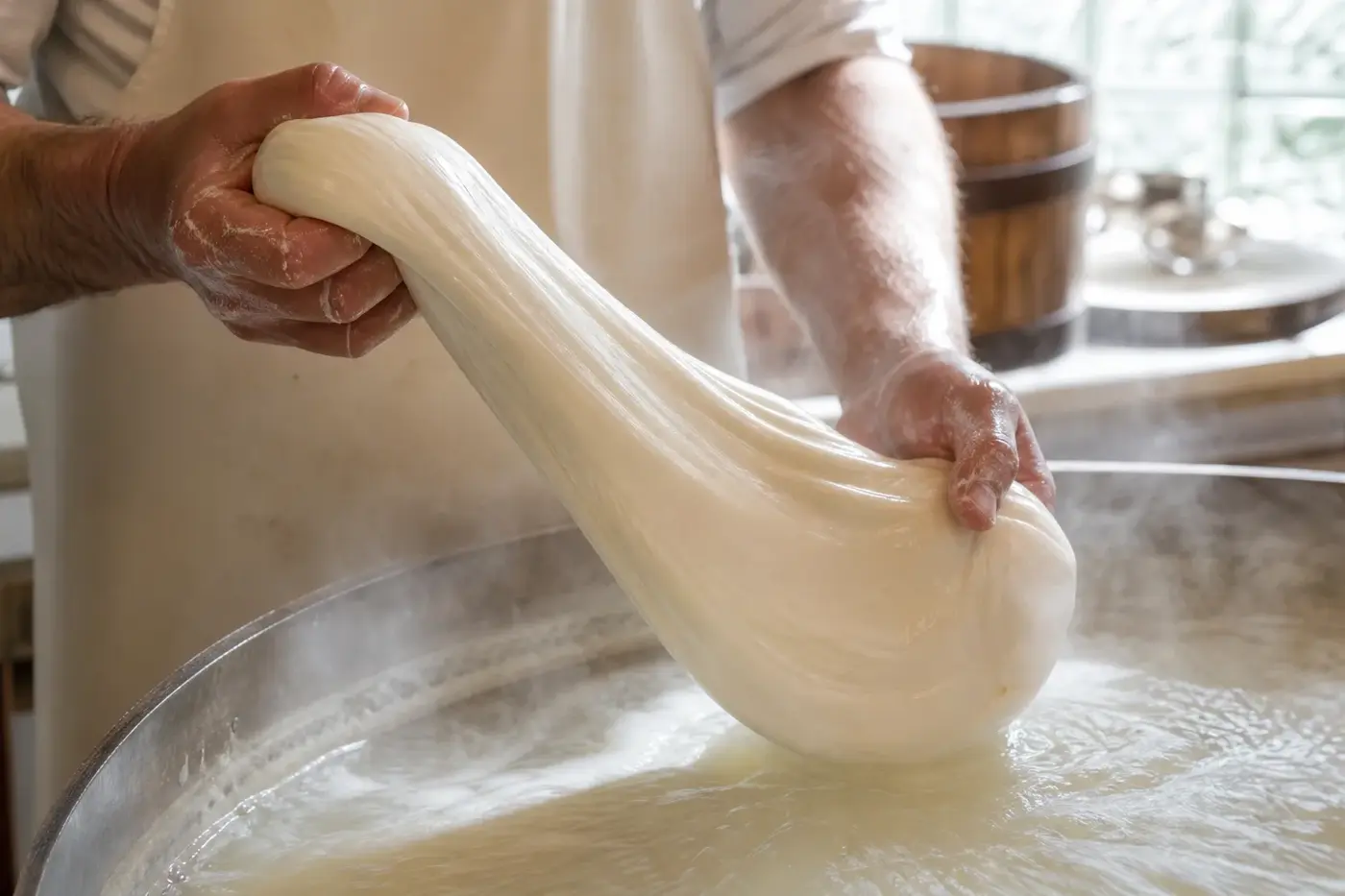
Crumbly curd meets hot water. Once acidified, it can turn into a smooth, elastic ribbon, ready for pulling, folding and shaping. Watch that transformation and you have the connection between moist fresh mozzarella and firm, matured provolone: very different cheeses with the same stretched-curd structure beneath the surface.[1,2]
Pasta filata is a method, not an age bracket
Pasta filata means “spun paste”. The cheesemaker acidifies, heats and works the curd until it becomes plastic, meaning it can be moulded. Stretching earns a cheese its place in this family, not softness, roundness or being eaten fresh.[1,2]
Ask “how was it made?”, rather than “how will it feel?”. One stretched-curd cheese holds abundant moisture; another is salted and matured into something compact, with a developed rind. That is why method belongs alongside milk, rind and texture when you identify a cheese. It starts the conversation rather than settling the matter.[1,5,7]
First, give the milk time to become curd
The stretching must wait until the curd has developed the acidity it needs. First come the familiar steps of ordinary cheesemaking. Rennet, a preparation of milk-clotting enzymes, helps milk set into a gel. Cutting that gel creates curd particles and releases whey, the liquid that separates from them.[2,5]
| Stage | What happens | What it gives the cheese |
|---|---|---|
| Setting the milk | Rennet coagulates the milk | A protein network holding fat and water |
| Cutting and draining | The gel is cut and whey separates | The beginnings of moisture control |
| Developing acidity | Starter bacteria produce acid, or acid is added directly | A change in the calcium balance around the proteins |
| Heating and stretching | Prepared curd is heated, kneaded and drawn out | A workable mass with a reorganised structure |
| Shaping and finishing | Cheese is formed, cooled and salted, then packed or matured | Its shape and the starting point for later development |
These stages draw on dairy teaching material and mozzarella research. Individual cheeses have their own production specifications. Think of this as the shared outline, not one recipe expected to do every job.[2,3,4,5,7]
The hot working stage has a name: filatura. Hands or mechanical cooker-stretchers bring about the same broad transformation, although equipment and working conditions differ. While warm, the mass can become balls, braids, pears or blocks. Cooling makes those shapes hold.[1,5,7]
Acidity, calcium and heat must get along
Behind that supple ribbon is a changing protein network. Casein, the principal cheese-forming milk protein, forms a network whose behaviour depends partly on calcium. As acidity develops, some calcium moves from the proteins into the watery phase. Heat can then make the network more mobile, allowing the curd to deform and stretch.[3,4]
How that acidity develops matters as much as the reading itself. Add acid to milk before coagulation and calcium retention changes differently from when a starter culture acidifies already formed curd. There is no single stretching pH that suits every pasta filata cheese. The maker must consider acidity and calcium together.[4]
Heat has to reach the curd, too. In a laboratory study with a controlled batch kneader, researchers varied temperature and working time across nine settings, with three independent runs per setting. Hotter processing increased losses into the stretching water and changed the finished cheese's composition. Water temperature alone could not tell you the curd's whole thermal story.[3]
For the maker, the task is to bring appropriately acidified curd to the right working condition without unnecessary heating or kneading. Timing affects moisture and fat retention, and whether the curd stretches cleanly. The aim is a workable mass, with as little avoidable loss as possible.[3,4]
Pull it apart and the structure reveals itself
Pull string cheese and you feel its directional structure. Tear some fresh mozzarella and you can see fine layers. Stretching aligns the protein network, leaving elongated spaces holding fat and liquid between protein-rich regions. Nobody adds fibres; the structure already there is rearranged.[4,5]
That gives the cheese its textural framework. Milk, cultures, coagulant and maturation help shape flavour. Provolone Valpadana's specification links a more pronounced, piquant flavour with longer maturation and kid or lamb rennet. As it matures, the paste can become more noticeably layered, rather than staying elastically stringy.[7]
Follow the stretch out of southern Italy
Mozzarella, provolone and caciocavallo belong to southern Italy's stretched-curd tradition. Follow the technique and you travel further: Tetra Pak's dairy-processing handbook also includes kashkaval, produced in several Eastern European countries. The shared method connects them without making them the same cheese.[1]
Even within Italy, this is not only a southern story. Emilia-Romagna's regional authority traces Provolone Valpadana to southern stretched-curd practice spreading into the Po Valley during the second half of the nineteenth century. Fresh southern cheeses and northern matured forms show you how one method can find a home in different dairy traditions.[8]
Meet mozzarella, burrata and their firmer relations
A continuous body, a filled shell, a compact matured paste: stretched curd can give you all three. The examples below show how construction and development change what you eat. These named Italian specifications describe particular products. Mozzarella, burrata, provolone and caciocavallo are broader names covering more than those specifications.[1,5,6,7]
| Style | Moisture and surface | What you find inside | Put it to work |
|---|---|---|---|
| Fresh mozzarella | High moisture; many formats sold in liquid | A continuous stretched-curd body | Drain when extra liquid would be unwelcome.[1,5] |
| Burrata di Andria | 50 to 70% moisture in the whole cheese | A stretched shell filled with cream-soaked shredded curd | Open over a finished dish to keep that contrast of shell and filling.[6] |
| Provolone Valpadana | Drier paste; usually a thin rind | Compact, becoming increasingly piquant with maturation | Slice for melting; choose matured pieces for stronger flavour.[7,8] |
Cut burrata and its difference spills into view. The EU single document for Burrata di Andria describes a cow's-milk stretched-curd casing enclosing stracciatella: hand-shredded pasta filata soaked in cream. Its specification records aromas of fresh or heated milk, butter and cream. Shell and filling give you quite a different bite from a uniform ball of mozzarella.[6]
Provolone Valpadana starts with whole cow's milk and allows salami, melon, truncated-cone and pear shapes. Its 2023 specification sets minimum maturation at ten days for cheeses up to 6 kg, thirty days above 6 kg, and ninety days for piccante cheeses above 15 kg. Those are minimum requirements. They do not tell you the actual age of the piece you are buying.[7]
Caciocavallo takes another matured path alongside provolone, rather than finishing as a fresh mozzarella-like cheese. For your board or dish, look at the particular cheese's age and the producer's description. Expecting every stretched-curd cheese to behave like fresh mozzarella is asking rather a lot of the family resemblance.[1,2]
Buffalo or fior di latte? Let the milk tell you
To distinguish buffalo mozzarella from cow's-milk mozzarella, often called fior di latte, read the milk declaration. Both belong to the mozzarella family. Colour, shape and an Italian-sounding name are less useful clues than that declaration. The fuller mozzarella guide takes you through the family.[1,4]
Mozzarella di Bufala Campana's Italian specification requires fresh whole buffalo milk from its defined production area, covering specified territory in Campania, Lazio, Puglia and Molise. It allows raw milk, thermisation or pasteurisation, and specifies natural whey starter and calf rennet. Look to its description for a porcelain-white exterior and thin internal layers.[5]
For these named examples, PDO means protected designation of origin, while PGI means protected geographical indication in the EU. These are geographical designations with different requirements. You can explore what separates them in the guide to protected names.[5,6,7]
Choose for the plate, not just the family name
Start with what you want to eat. Fresh mozzarella gives you a moist stretched-curd body; low-moisture mozzarella is made for uses such as pizza. Burrata offers that contrast of shell and filling, while matured provolone supplies the more assertive flavour described in its specification. Same family, different talents.[1,6,7]
Drain fresh mozzarella when a wet topping would be troublesome. Open burrata over vegetables or bread immediately before serving, so its filling becomes part of the dish. For a baked topping, low-moisture mozzarella is the more direct starting point. Let construction and moisture guide you, rather than asking dinner to accommodate a small puddle.[1,6]
Melting, though, is not the same as stretching. Cheese can soften and spread without giving you long threads. Mozzarella research shows that processing conditions, calcium balance and changes during refrigerated storage all influence performance. The family name tells you the method, but not exactly how a particular product will behave in the heat.[3,4]
Keep fresh cheese cold and follow the label
Refrigerate fresh mozzarella and burrata promptly. In its November 2026 guidance, the Food Standards Agency advises households in England, Wales and Northern Ireland to keep a fridge between 0 and 5 °C and follow the pack's storage instructions.[9] Follow the manufacturer's instructions after opening, too. Plan quantities around that guidance, rather than assigning every fresh cheese the same shelf life.[9]
A use-by date is a limit, not a suggestion. UK government guidance says not to eat food after it, even if it looks and smells fine. A best-before date concerns quality instead. Whether you are checking a fresh tub or a matured piece, remember that the labels do different jobs.[10]
When preparing and serving food in England, Wales and Northern Ireland, follow the Food Standards Agency's guidance on keeping chilled food out of the fridge.[9] For the wider household routine, turn to the guide to storing cheese at home.
For cooked dishes, the FSA's guidance for England, Wales and Northern Ireland is to cool the food and refrigerate it within one to two hours. Divide it into smaller portions to help it cool faster. Eat refrigerated leftovers within 48 hours, or freeze them if that will not be possible. For uncooked cheese, follow the pack's freezing instructions when deciding whether to freeze it.[9]
General information only, not medical advice: follow the official guidance where you live.
Questions people ask
What does pasta filata mean?
It means “spun paste” and describes cheese made from curd that is acidified, heated and stretched. The method includes both fresh mozzarella and matured provolone.
Why does pasta filata cheese stretch?
Acidification changes the calcium balance around the milk proteins. Heat makes the resulting protein network more mobile, allowing the curd to deform and stretch.
What is the difference between mozzarella and burrata?
Fresh mozzarella has a continuous stretched curd body. Burrata di Andria has a stretched curd shell enclosing shredded curd soaked in cream.
Is mozzarella always made from buffalo milk?
No. Cow's milk mozzarella is often called fior di latte. Check the milk declaration to distinguish it from buffalo mozzarella.
How should I store fresh mozzarella and burrata?
The Food Standards Agency advises households in England, Wales and Northern Ireland to keep their fridge between 0 and 5 °C and follow the pack's storage instructions. Consult the agency's guidance for storing and serving chilled food.
Sources
-
Tetra Pak. Dairy Processing Handbook, chapter 16, “Cheese”, current online edition, undated. Sections on cooking and stretching pasta filata, moulding and industrial pasta filata production. Read the handbook.
-
CAVA Erasmus+ project. Dairy Chain: Elaboration of Learning Kits, project 2014-1-IT01-KA202-002680, undated. Cheesemaking and stretched-curd teaching material. Read the learning kit.
-
University of Hohenheim research team. “Systematic approach to study temperature and time effects on yield of pasta filata cheese”. International Journal of Dairy Technology, volume 69, issue 2, 2016, pages 184 to 190. Original experimental research. Read the study.
-
Food Technology and Biotechnology. “Mozzarella Cheese Stretching: A Minireview”, 2021. Research synthesis covering acidification, calcium, stretching and functional properties. Read the paper.
-
Italian Ministry of Agricultural, Food and Forestry Policies. Disciplinare di produzione della DOP «Mozzarella di Bufala Campana», published by provision of 11 February 2008. Official specification reproduced by the protection consortium. Read the specification.
-
European Commission. Publication of an approved standard amendment to a product specification: “Burrata di Andria”, C/2024/1948, published 5 March 2024, including the single document. Read the official publication.
-
Italian Ministry of Agriculture, Food Sovereignty and Forestry. Modifiche ordinarie al disciplinare di produzione della denominazione di origine protetta «Provolone Valpadana», decree of 22 June 2023, published 30 June 2023. Official text reproduced by the protection consortium. Read the specification.
-
Regione Emilia-Romagna. Provolone Valpadana Dop, current online product account, undated. Regional authority account of the cheese's history, formats and culinary use. Read the regional account.
-
Food Standards Agency. How to chill, freeze and defrost food safely, published 18 December 2017, current online text. Applies to England, Northern Ireland and Wales. Read the official guidance.
-
UK government. Understanding food labelling: Best before and use-by dates, current online edition, undated. Read the official guidance.
This desk-researched explanation combines dairy-processing references, experimental research, published product specifications and official household food guidance.
Last checked: November 2026
Last checked November 2026.
The editors suggest you read next
How to Tell Cheese Styles Apart: Milk, Rind, Texture and Method
Watch mozzarella curd being worked and stretched in hot water.