Cheeses of Central Italy
A cheese disappears into a flask-shaped pit in Sogliano's sandstone.
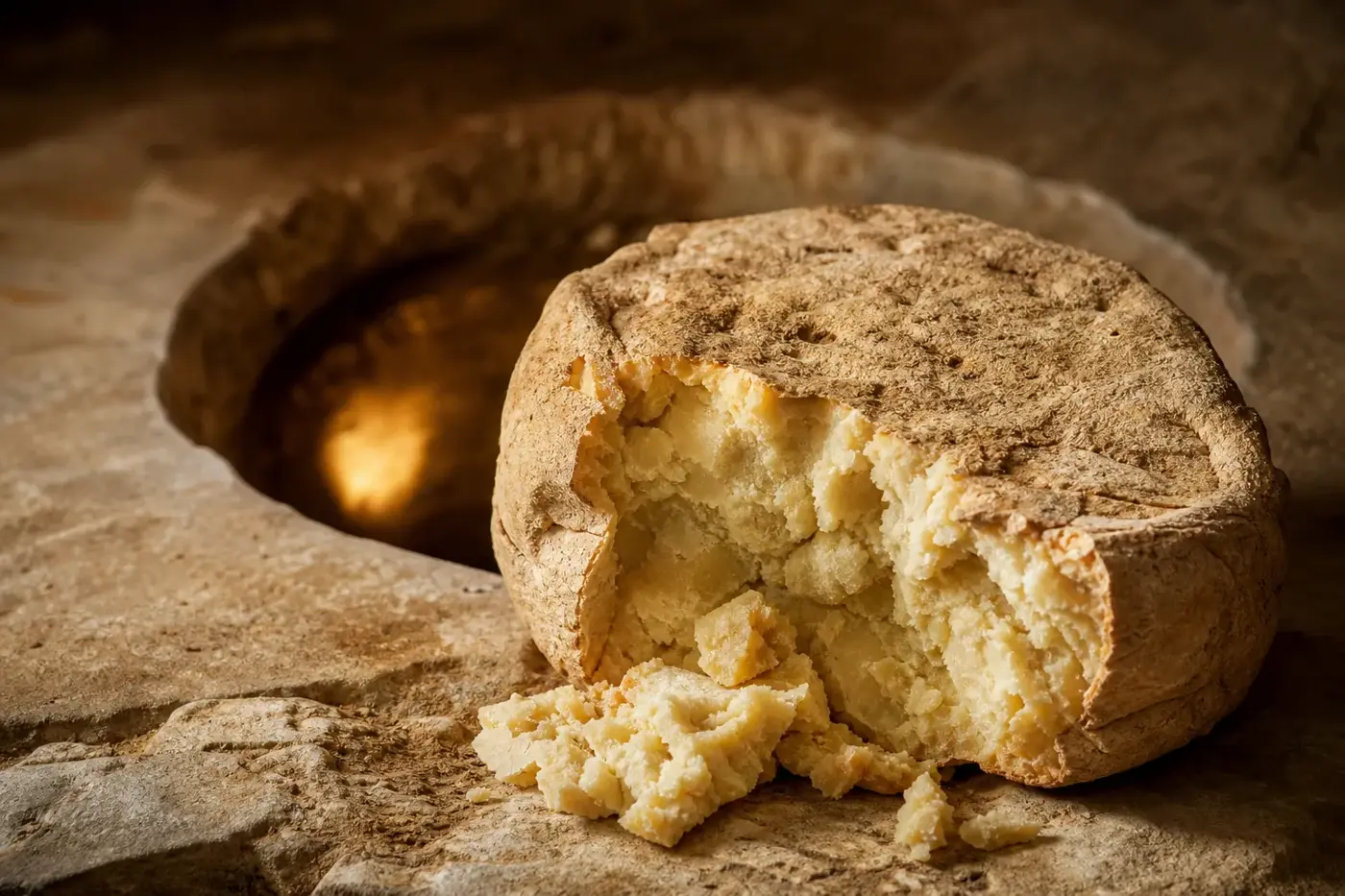
A cheese disappears into a flask-shaped pit in Sogliano's sandstone. It goes down partially matured and comes back an irregular wheel, its interior ready to crumble. Then come the lingering aromas of woodland undergrowth and truffle, recorded in the EU product description. Quite an entrance for something that has just been underground. [4,12]
That transformation is one chapter in Central Italy's pastoral story. Follow the sheep from Tuscan pastures through Umbria and Marche to the countryside around Rome, and pecorino becomes your connecting thread. You'll meet tender table cheeses, salty grating cheeses and mixed-milk rounds with characters all their own. [2,3,4,5,7]
Your starting map: Tuscany, Umbria, Marche and Lazio, following ISTAT's Central Italy grouping. [1]
Meet the milks: Sheep's milk, alongside cow's milk and mixtures of the two. [2,3,7,8]
Names worth looking for: DOP is the Italian abbreviation for the EU's protected designation of origin, or PDO. [2,3,4,5]
Follow the sheep beyond the borders
Tuscany, Umbria, Marche and Lazio form ISTAT's statistical Centre; Abruzzo belongs to its South. Cheese takes a less tidy route. Pecorino Toscano's authorised area reaches into Umbria and Lazio, while Casciotta d'Urbino connects Marche with municipalities now in Emilia-Romagna. [1,2,3]
The calendar shapes the story, too. Umbria's tourism authority singles out May and June milk from spring pastures for local pecorino; Pecorino Romano's documented production season runs from October to July. At the counter, ask when your cheese was made and how long it has matured. Each has its own rhythm. [6,7]
Pecorino Toscano DOP: let texture lead you
Give the grater a moment off. Pecorino Toscano DOP comes in soft-paste and semi-hard forms, distinguished in the consortium's specification. Both use whole sheep's milk from an authorised area covering all Tuscany, Allerona and Castiglione del Lago in Umbria, and eleven named municipalities in Lazio. [2]
For bread, salads or a simple lunch, start with the younger, softer form. Choose the firmer, more mature cheese for small pieces on a board or shavings over vegetables. Texture is your first clue, rather than the whole story. Ask the seller for the actual maturation period and the dairy's description of that particular wheel. [2]
Pienza and Volterra: get to know the name
Around Pienza, give the dairy and the individual wheel your attention. If the counter card says pecorino di Pienza, ask where the milk came from, where the cheese was made and whether its label carries a separate protected designation. A place-name and a complete registered name tell you different things.
Near Volterra, look for Pecorino delle Balze Volterrane DOP. Tuscany's regional description identifies raw whole sheep's milk and a plant coagulant made from cardoon or wild artichoke flowers. It records four maturation categories, from fresco at 7 to 44 days to da asserbo beyond twelve months. Floral and vegetal aromas intensify as the cheese ages. [9]
Those flowers connect this cheese with Caciofiore in Lazio. If you're curious about their part in turning milk into curd, follow rennet explained. [9,10]
Pecorino Romano DOP: make room for that salty bite
Pecorino Romano DOP joins this story through Lazio, although its authorised production area also covers all Sardinia and Tuscany's province of Grosseto. Its specification describes a hard, cooked-curd cheese made exclusively from whole sheep's milk. Minimum maturation is five months for table cheese and eight months for grating cheese. [5,6]
The table cheese is aromatic and slightly piquant, according to the specification; longer maturation brings greater intensity and piquancy. When you're cooking, grate a little, taste, then decide whether you need more cheese or added salt. At the table, try small shards with bread. There's more to Romano than its place over pasta. [5]
Lazio: discover flowers in the curd and sweetness on the spoon
In the Roman countryside, Caciofiore takes sheep's milk in another direction. ARSIAL, Lazio's agricultural development agency, describes raw milk set with artichoke or wild cardoon flower coagulant, then matured for 30 to 60 days. Picture a brick-like cheese with a wrinkled yellowish rind and a soft interior dotted with small openings. Its aromas recall artichoke and field vegetables, with a slightly bitter flavour. [10]
For something you can spoon, turn to Ricotta Romana DOP. It uses whey from whole sheep's milk produced in Lazio, where processing and conditioning also take place. The control body describes a white, grainy texture and a sweetish milk flavour. [11]
Ricotta makes something of the liquid left after cheesemaking, recovering material from it rather than forming a curd cheese. It belongs beside the region's cheeses, but deserves a different approach at the table. Try a spoonful on bread or alongside cooked greens. Let that milk flavour take the lead. [10,11]
Umbria: find out what makes your wheel
Umbrian pecorino is a family of local practices, not one uniform cheese. The regional tourism authority describes younger, sweeter examples eaten at about two months, alongside stronger cheeses matured for up to a year. It also records additions of cow's milk, herbs and Norcia black truffle. Pit, cave and ash maturation bring further variety. [7]
Cow's milk has its own story here. The same authority describes the caciotta or cacio fiore of the Valnerina as a fresh whole-milk cow's cheese, delicate and aromatic. It is associated particularly with Pian di Chiavano near Cascia. The suggested companion is torta al testo, the local flatbread, filled with wild greens. [8]
At the counter, ask which milk your caciotta uses and how old it is. Fresh cow's milk cheeses, mixed-milk examples and sheep's milk pecorini can look reassuringly similar while holding quite different contents. Ask about milk treatment separately, with raw milk, thermised and pasteurised cheese as your guide. [7,8]
Marche: slow down for tender Casciotta d'Urbino DOP
After Romano's months of maturation, Casciotta d'Urbino DOP offers a change of pace: just 15 to 30 days. Its blend is precise, with 70 to 80% whole sheep's milk and 20 to 30% whole cow's milk. The production area covers Pesaro and Urbino province and seven municipalities in Rimini province. [3]
You'll find a tender, crumbly interior with slight openings and a sweet flavour, as described in the specification. That document records the milk blend and short maturation alongside those qualities, rather than assigning flavour or texture separately to either. Bring this one to the table, but leave the rind: the specification says it is inedible. [3]
Formaggio di Fossa di Sogliano DOP: follow the cheese underground
Before the descent comes a substantial wait. The control body's account gives Formaggio di Fossa di Sogliano DOP an initial maturation of 60 to 240 days before it enters the pits. Connecting Marche with neighbouring Emilia-Romagna, it may use sheep's milk, cow's milk or a mixture. The mixed version requires at least 20% sheep's milk. [4,11]
Sogliano's municipality describes the flask-shaped sandstone pits that receive these partially matured cheeses. The EU product description records irregular wheels with a semi-hard interior that crumbles readily, and persistent woodland-undergrowth and truffle aromas. It also describes distinct flavour profiles for the cow's milk, sheep's milk and mixed versions. Your choice of milk matters here. [4,12]
Buy by the full designation and milk type, rather than the romance of the pit alone. An Umbrian cheese described as pit-aged may share the idea of underground maturation with this EU PDO, but it belongs to a different production tradition. Follow that distinction in protected names explained. [4,7]
Take three good questions to the cheese counter
Start with the complete name, the milk and the age. Latte ovino means sheep's milk, latte vaccino means cow's milk, and misto means a mixture. If the proportions aren't on the label, ask. Request the actual maturation period too; the rind isn't your calendar. [3,4]
DOP identifies the protected designation, while the named dairy identifies the particular product. For Formaggio di Fossa di Sogliano, the specification requires the milk category and, for raw milk cheese, the wording da latte crudo. Keep the label if you buy a cut portion. [4] For the rest of the pack information, turn to the cheese label guide.
Bring out a little and keep the rest chilled
Follow the pack's storage instructions and use-by date. The UK Food Standards Agency's guidance for England, Wales and Northern Ireland recommends a fridge between 0 and 5 °C. During preparation, keep chilled food out for the shortest possible time, with a maximum of four hours. [13]
Serve small portions and replenish from the fridge. To explore texture, begin with Casciotta d'Urbino or younger Toscano, move to firmer pecorino, then finish with Romano and pit-aged cheese. Keep plain bread and water alongside. Pear slices or cooked vegetables make simple, alcohol-free accompaniments. [2,3,4,5]
Give fresh ricotta its own container, and bring out only what you intend to serve. For the wider routine, turn to how to store cheese at home. [13]
This page summarises published guidance from the official sources it cites. It is not medical advice. Guidance differs between countries and changes over time, so check the current source for where you live, and ask your doctor, midwife, pharmacist or dietitian about your own circumstances.
Pregnancy and higher risk: find the guidance for you
If you're pregnant in the UK, the NHS lists hard cheeses, pasteurised semi-hard cheeses and pasteurised ricotta among foods that can be eaten. It distinguishes these from certain soft cheeses, including mould ripened and soft blue cheeses, which it says can be eaten if cooked until steaming hot. Check the current NHS advice for the exact cheese and its milk treatment. [14]
For other higher-risk circumstances, follow the official advice where you live and discuss individual questions with your clinician. The cheese food safety guide gives you the next reference point.
Let your curiosity travel beyond the Apennines
Continue with the Italian national guide for the wider picture, then explore the neighbouring regional guides, especially Abruzzo. After Marche's milk blends, Umbria's maturation traditions and Lazio's sheep's milk products, those neighbouring traditions help complete your picture. The administrative map and the cheesemaker's map overlap, but never quite match. [1,3,7,10]
Questions people ask
What is pecorino?
Sheep farming supplies the connecting thread of Central Italy's pecorino traditions. The region's pecorini range from tender table cheeses to salty grating cheeses.
Is Pecorino Romano made only around Rome?
No. Its authorised production area covers Lazio, all of Sardinia and Tuscany's province of Grosseto.
What is the difference between Ricotta Romana and cheese?
Ricotta is a whey product rather than a curd cheese. Ricotta Romana DOP uses whey from whole sheep's milk produced in Lazio and has a white, grainy texture and sweetish milk flavour.
How long does Formaggio di Fossa di Sogliano mature before entering the pits?
The control body describes an initial maturation of 60 to 240 days before the cheese enters the pits. It can be made from sheep's milk, cow's milk or a mixture.
Can I eat these cheeses during pregnancy?
For pregnancy in the UK, the NHS lists hard cheeses, pasteurised semi-hard cheeses and pasteurised ricotta among foods that can be eaten. It says certain soft cheeses, including mould ripened and soft blue cheeses, can be eaten if cooked until steaming hot. Check the current NHS advice for the exact cheese and its milk treatment.
Sources
-
ISTAT, Serie storiche: geographical divisions, glossary document, undated. The published classification lists Tuscany, Umbria, Marche and Lazio under Central Italy, and Abruzzo under Southern Italy. Source document.
-
Consorzio tutela Pecorino Toscano DOP, Il Disciplinare di produzione, undated webpage, and linked production specification hosted in December 2025. The webpage supplies the milk, geographical area and two texture classes used here. Specification page; linked specification.
-
Consorzio tutela Casciotta d'Urbino DOP, Disciplinare di produzione della denominazione di origine protetta “Casciotta d'Urbino”, specification hosted in October 2025, Articles 2, 3 and 5. Production specification.
-
European Commission, Publication of an approved standard amendment: Formaggio di Fossa di Sogliano, Official Journal C/2025/474, 22 January 2025, including the updated single document. Official publication.
-
European Commission, Commission Regulation (EC) No 1030/2009, 29 October 2009, Annex II, Pecorino Romano specification summary, sections 4.2 and 4.3. Official text.
-
IFCQ Certificazioni, Piano dei controlli Pecorino Romano DOP, revision 0, 5 December 2023, effective 1 January 2024, Table 1. Control plan.
-
Regione Umbria, Umbriatourism, Pecorino di Norcia del Pastore, undated. Regional account of season, maturation and local variations, rather than a binding specification. Regional account.
-
Regione Umbria, Umbriatourism, Caciotta: Il Cacio Fiore della Valnerina, undated. Regional account.
-
Regione Toscana, Pecorino delle Balze Volterrane DOP, regional product record, undated. Product record.
-
ARSIAL, Formaggi e prodotti lattiero caseari, edition date not stated, file hosted in March 2025. Italian-language entries for Cacio fiore and Ricotta romana. Institutional publication.
-
RINA, Prodotti tipici DOP, undated certification webpage, entries for Ricotta Romana and Formaggio di Fossa di Sogliano. Certification information.
-
Comune di Sogliano al Rubicone, Il Formaggio di Fossa di Sogliano DOP, undated municipal account. Municipal account.
-
Food Standards Agency, How to chill, freeze and defrost food safely, current online version, originating publication dated 18 December 2017, section 1. Applies to England, Northern Ireland and Wales. Official storage guidance.
-
NHS, Foods to avoid in pregnancy, current online version checked November 2026, “Cheese, milk and other dairy”. Official pregnancy guidance.
This desk-researched article compares production documents, institutional regional accounts and official UK consumer guidance; serving suggestions are editorial recommendations.
Last checked: November 2026
Last checked November 2026.
The editors suggest you read next

French Cheese: The Complete Guide
Picture Normandy’s pastures, then follow the milk towards the Loire’s goat dairies, the Jura’s shared cheesemaking traditions and the sheep country of the Pyrenees.


