Tome des Bauges
A mottled grey wheel rests on rough spruce boards in an Alpine cellar.
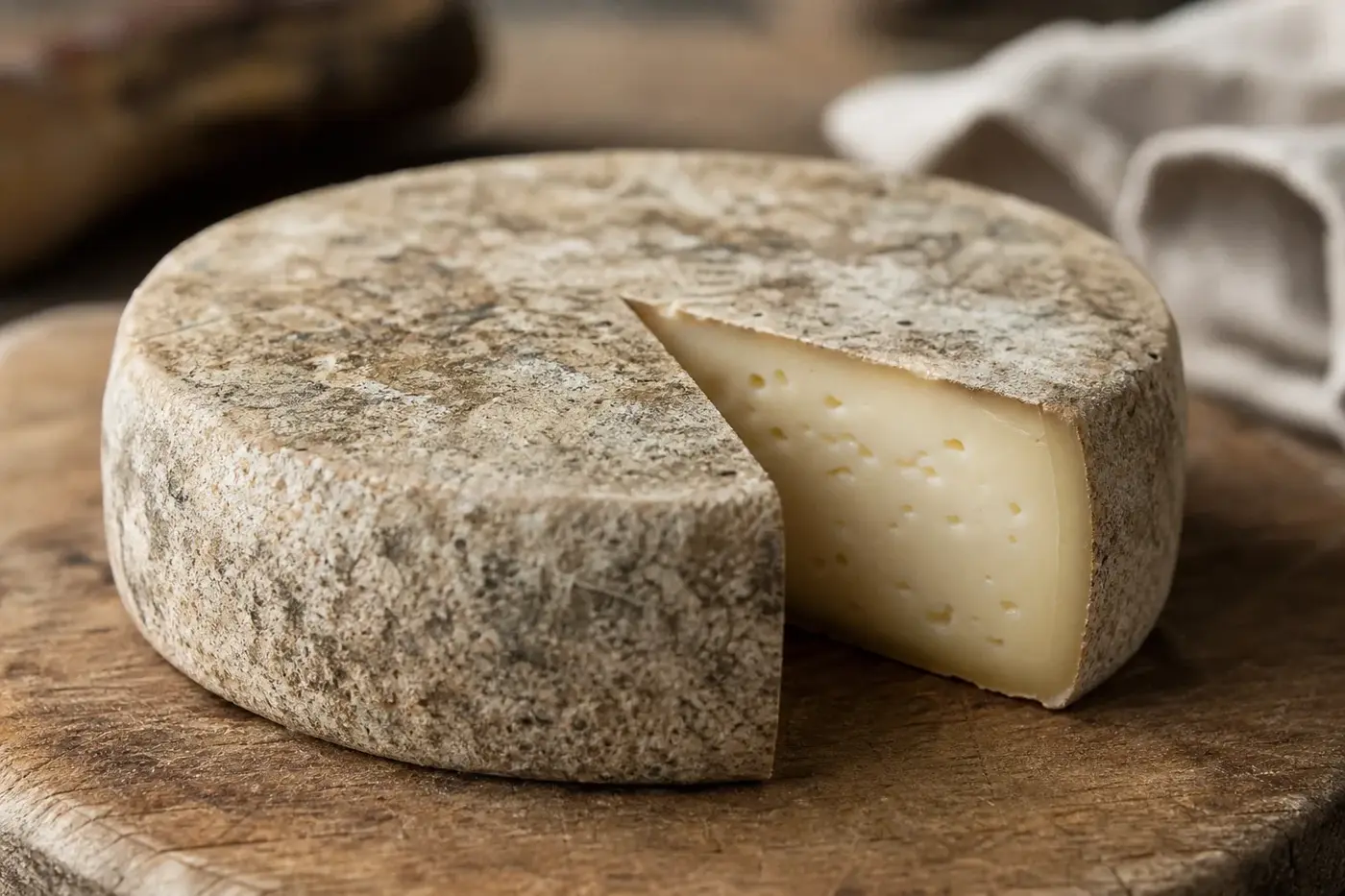
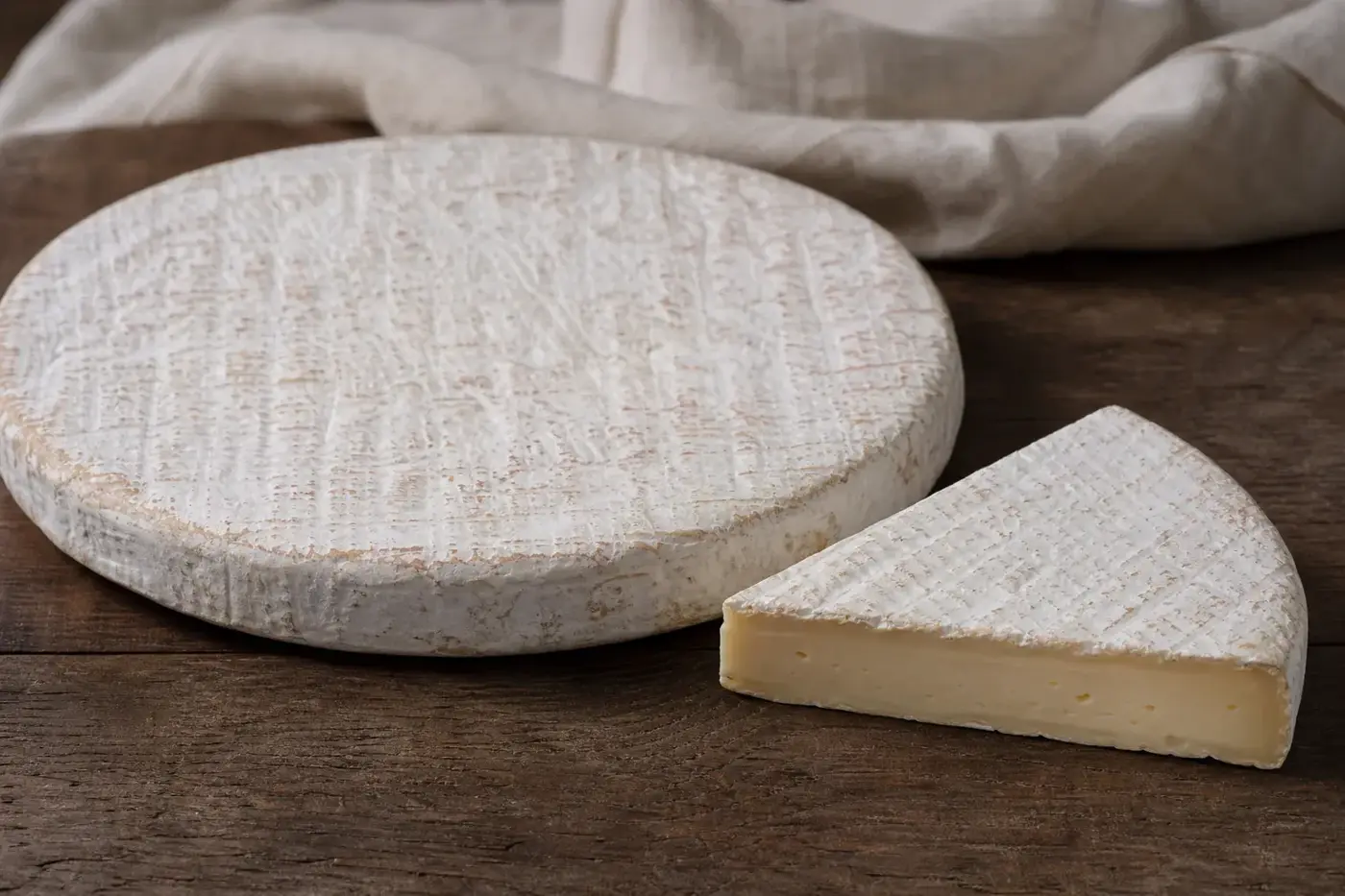
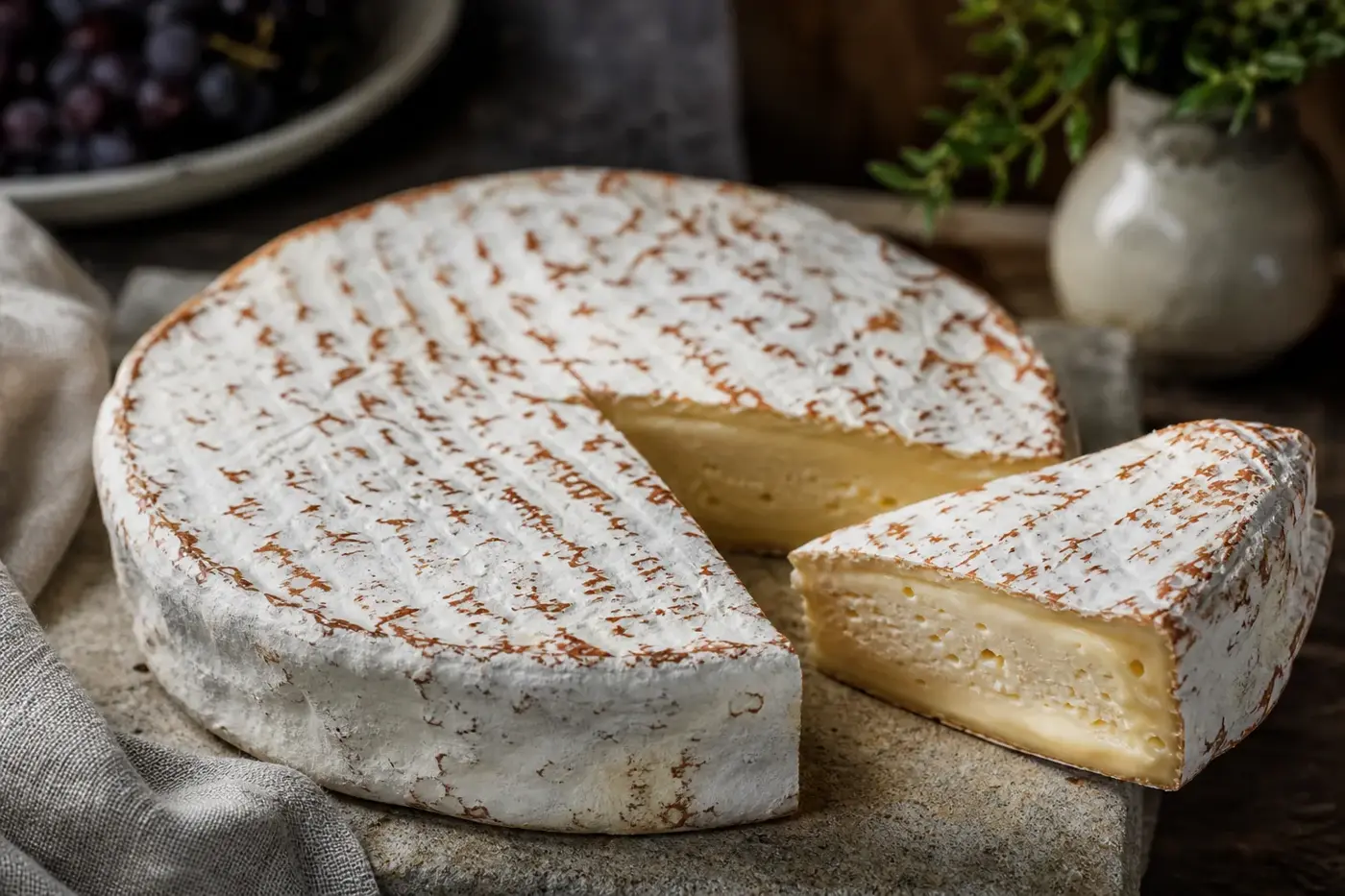
A mottled grey wheel rests on rough spruce boards in an Alpine cellar. After at least five weeks, there is pale, supple raw milk cheese beneath that rind. Taste Tome des Bauges and you meet the farming of the massif between Savoie and Haute-Savoie: grass, winter hay, optional hand skimming and a cellar method firmly at home in this corner of the French Alps.[1][2]
| What to know | The detail |
|---|---|
| Name to look for | Tome des Bauges, its familiar and registered name.[1][3] |
| Who registers it | EU: European Commission. Great Britain: Defra protected food names register.[3] |
| Protected status | EU: PDO, called AOP by INAO. Great Britain: registered PDO, registration dated 31 December 2020. Register information dated November 2026.[1][3] |
| Where it belongs | Defined territory in the Bauges massif, across Savoie and Haute-Savoie, France. Milk production, cheesemaking and maturation all happen there.[2] |
| Milk in the vat | Raw cow’s milk, whole or partially skimmed.[2] |
| What sets the milk | Rennet prepared from calf stomach.[2] |
| Time in the cellar | At least five weeks.[2] |
| Shape and size | Cylinder, 18 to 20 cm across, 3 to 5 cm high; 1.1 to 1.4 kg after maturation.[2] |
| Rind and centre | Irregular grey natural rind; ivory to yellow paste, slightly firm to supple, sometimes with small openings.[1][2] |
Follow the grass into the Bauges
Between Annecy and Chambéry, the Bauges rise within a ring of towns that includes Aix-les-Bains and Albertville. Natural meadows, summer grazing and haymaking shape this mountain farming country. The place you find on the label has a working life behind it.[1][4]
Long winters set the pace. Grass grows successively at different elevations, so lower meadows provide grazing and hay while some herds head higher for summer. Surplus grass is cut and stored for the months when fresh grazing is unavailable.[2]
You taste the results of that seasonal work in Tome des Bauges. Its protected production system ties the milk to the massif’s grassland resources, allowing both farm and dairy production. Different farmers and makers follow shared rules, rather than one producer speaking for the whole mountain.[2][4]
Mind the single m at the cheese counter
That single m belongs to the registered name. INAO suggests that tome comes from the local word toma, meaning cheese made on mountain pasture. It is the designation authority’s proposed derivation, rather than a precisely established linguistic origin.[1]
Tomme de Savoie is a different named cheese, not Tome des Bauges with a spare letter. The Savoie department’s regional guide lists them separately, under different designations. Read the whole name at the counter: tome or tomme alone cannot tell you which cheese you are choosing.[5]
A familiar name and a legal designation do different jobs. If you want to untangle the distinction, turn to protected names explained.
What the protected name brings to your plate
Milk production, cheesemaking and maturation must all stay within the specified area. Its boundary includes whole communes and defined parts of others in Savoie and Haute-Savoie. You will find the full territory in the production specification.[2]
AOP, appellation d’origine protégée, is the French expression for PDO, protected designation of origin. INAO identifies Tome des Bauges as an AOP. The Great Britain register separately lists it as a registered PDO, with 9 May 2007 as its original EU registration date.[1][3]
The protection covers more than geography. It reaches into the herd, its feed and the cheesemaking room, so origin depends on how the milk was produced and handled, not simply where the cheese was made. Start with the full registered name; reading a cheese label guides you through the other useful details.
Meet the herd, then follow its feed
Abondance, Tarentaise, also called Tarine, and Montbéliarde are the three permitted pure cattle breeds. Tarentaise and Abondance together must account for at least 55% of each dairy herd. Before you reach the vat, the herd has already helped shape the cheese.[2][4]
Grass and hay do the foundational work. Under the published standard feeding rules, grazed grass supplies the basic summer ration for at least 120 days, with hay taking over in winter. Fermented forage, including silage and wrapped fermented bales, is prohibited throughout the year on participating farms; supplementary feeds are allowed, but restricted.[2][4]
These rules keep the massif’s grassland at the heart of the milk supply. The specification links diverse mountain vegetation, the milk’s native microflora and the cheesemaking method to the finished cheese’s aromatic character.[2]
Ask when your wheel was made, not just when it arrived at the counter. Summer and winter production draw on different feeding periods. Time in the cellar then adds its own influence to the cheese you take home.[2][4]
A cream scoop, a copper vat and no rushing
A traditional scoop called a pôche may lift cream from the surface of the matured raw milk. Partial skimming is optional, so you may also find Tome des Bauges made with whole milk. The scoop has a place in the method, but not in every wheel’s story.[2]
Calf rennet, an enzyme preparation from a calf’s stomach, separates milk into curd, the soft solid portion, and whey, the liquid. You can explore that step in rennet. In open copper vats, the curd is cut into grains about the size of maize kernels; any heating of the curd and whey mixture must stay at or below 40 °C.[2]
Tome des Bauges is an uncooked pressed cheese. Here, “uncooked” describes the curd-making method, while the milk itself is raw. For the wider distinctions, turn to raw, thermised and pasteurised milk.
The curd enters moulds manually or by gravity. Stacked three or four high in their moulds, the cheeses press under their own weight for at least seven hours, with repeated turning. Then comes salt, followed by the cellar.[2]
Step into the cellar, where the rind takes shape
The cellar gives Tome des Bauges its distinctive surface. Affinage, the controlled maturation of cheese, lasts at least five weeks on unplaned spruce boards from trees grown within the production area. The specification calls for 10 to 15 °C, at least 95% relative humidity and regular turning.[2]
Look closely at the rind and the word tourmentée begins to make sense: uneven, ridged and irregular. Natural yellow to brown patches may interrupt the grey. That mottling and the small, low cylindrical shape are both part of the cheese’s specified appearance.[2]
Inside, INAO describes an ivory to yellow paste, sometimes dotted with small openings. It can be slightly firm or supple, softening readily in your mouth while keeping its structure. This is a cheese that can hold a slice, not one planning an escape across your plate.[1]
Let the wheel in front of you lead the tasting
INAO describes a definite aroma, balanced flavours and a developed, persistent aromatic character. Those are the designation authority’s tasting terms, rather than a fromage.co.uk tasting note. Treat them as an introduction, not a substitute for tasting the wheel yourself.[1]
The production specification traces that character to native milk microflora, diverse grassland, retained moisture and cellar conditions. Maturation changes both rind and paste. Age and handling matter alongside the season in which the cheese was made.[2]
Ask your cheesemonger about the piece in front of you. Is the paste firm or yielding, the aroma restrained or pronounced? The answers help you choose something to your taste, while leaving room for differences between wheels with the same designation.
For a French cheese comparison, explore Comté. You can use the two pages to compare documented production methods and maturation requirements.
Tell the cheesemonger your plans
Start with the complete name, then ask who made the cheese, when it was produced and how mature it is. Say whether you want cheeseboard slices or cheese for a cooked dish, and when you plan to use it. If you are buying a cut portion, ask for storage instructions too.
French recall notices, November 2026: RappelConso published batch-specific Tome des Bauges recalls on 14 and 15 October 2026 involving Nos Régions ont du Talent and Fruitière du Massif de Semnoz products. The notices identify affected lots and instruct consumers not to consume them. Compare those notices with any packaging or purchase information you have kept.[8][9]
Keep your cheese in its original paper, inside a food container in the refrigerator. This is the interprofessional syndicate’s advice, intended to protect the cut surface from drying.[6] Follow the supplied storage temperature and date instructions, in line with French government consumer guidance.[7]
Choose a portion that fits your plans, rather than giving every cut piece the same keeping time. For help with wrapping and finding its place in the refrigerator, see storing cheese at home.
Start with the centre, then ask about the rind
Bring out only the portion you intend to serve. For advice on taking chilled food out of refrigeration, consult current French government guidance and follow the product’s instructions.[7]
Cut manageable wedges or slices. If you want to taste the paste first, trim away the rind. If you would like to include it, ask the supplier about the rind on that particular cheese.
Natural mottling on the rind is different from an unexpected change on a stored cut surface. If a change worries you, consult mould on cheese: when to cut and when to bin. The usual grey exterior alone will not help you judge a new change.
Bring bread, potatoes and an Alpine appetite
Start with plain bread, then taste a little cheese on its own, adding accompaniments separately. Try apple or pear for a fresh contrast, or boiled potatoes for a more substantial plate. Water or an unsweetened alcohol-free drink keeps the cheese at the centre.
For cooking inspiration, the syndicate’s recipe collection offers potato waffles, polenta dishes, cheese tart, fondue and tartines with smoked diots, the regional sausages. These ideas come from the producing organisation. They also reflect its role in promoting the cheese.[10]
Choose a direction rather than crowding your plate. Potatoes or polenta give you a straightforward base; a tart or toast makes the cheese part of a complete dish. If your plans stretch to a broader French cheeseboard, continue with Brie and Camembert.
General information only, not medical advice: follow the official guidance where you live.
Questions people ask
Where is Tome des Bauges made?
It comes from a defined area in the Bauges massif, spanning Savoie and Haute Savoie in France. Milk production, cheesemaking and maturation must all take place within that area.
Is Tome des Bauges made with raw milk?
Yes, it is made with raw cow’s milk, either whole or partially skimmed. It is classed as an uncooked pressed cheese, which describes the curd making method.
What rennet is used in Tome des Bauges?
It uses calf rennet, an enzyme preparation from a calf’s stomach. The rennet coagulates the milk into curd and whey.
What does Tome des Bauges taste like?
INAO describes a definite aroma, balanced flavours and a developed, persistent aromatic character. The paste ranges from slightly firm to supple and softens readily in the mouth.
How should I store Tome des Bauges?
The interprofessional syndicate advises keeping it in its original paper, inside a food container in the refrigerator. Follow the supplied storage temperature and date instructions, in line with French government consumer guidance.
Sources
- Institut national de l’origine et de la qualité, Tome des Bauges, product and technical record, undated, accessed November 2026. INAO record.
- French Ministry of Agriculture, Cahier des charges de l’appellation d’origine « Tome des Bauges », approved by Décret n°2015-347 of 26 March 2015, Bulletin officiel n°14, 2015. Published specification.
- Department for Environment, Food & Rural Affairs, Tome des Bauges, protected food names register, published 4 January 2021, accessed November 2026. Great Britain register entry.
- Syndicat Interprofessionnel de la Tome des Bauges, L’AOP Tome des Bauges, undated, accessed November 2026. Production and feeding summary.
- Département de la Savoie, De quoi en faire tout un fromage !, 20 June 2022. Regional account.
- Syndicat Interprofessionnel de la Tome des Bauges, Conseils de conservation, undated, accessed November 2026. Storage and serving advice.
- French Government, Adoptez les bonnes habitudes alimentaires pour l’été, 9 August 2023, accessed November 2026. Consumer handling guidance.
- RappelConso, Tome des Bauges AOP (vendu au rayon coupe), Nos Régions ont du Talent, reference 2026-10-0117, version 1, 14 October 2026. Recall notice.
- RappelConso, Tomes des Bauges, Fruitière du Massif de Semnoz, reference 2026-10-0122, version 1, 15 October 2026. Recall notice.
- Syndicat Interprofessionnel de la Tome des Bauges, Nos recettes, undated, accessed November 2026. Recipe collection.
Researched through official designation records, the published specification, French government guidance, recall notices and the interprofessional syndicate’s published material.
Last checked: November 2026
Last checked November 2026.
The editors suggest you read next